Downtown Austin keeps turning workspaces into gathering spaces. That matters for smart vending Austin buyers because the food question changes when a building is not just desks and elevators anymore.
A recent local example makes the point. Google announced the opening of Sail Tower, its newest Austin office, and described a Google.org nonprofit venue inside the building for local community use. KVUE also reported that the downtown space is built for nonprofit programs and community use. Revvolto has no affiliation with any named company, source, or venue connected to the space. The local hook is simpler than that: more Austin buildings are being asked to support flexible, people-moving uses.
That is where smart vending, smart fridges, and compact micro market planning belong in the conversation. Not as decoration. Not as a lobby afterthought. As part of the pause path.
A flexible workspace has a different food-access problem
A traditional office can usually plan around predictable traffic. People arrive, work near their team, and take breaks before leaving. A community workspace is messier in a useful way.
People may come in for a workshop. A nonprofit team may gather for planning. A small-business group may use a training room. The building might have staff, visitors, and partner groups moving through the same floor at different times.
That kind of space does not always justify a full cafe. It also cannot assume everyone has time to leave the building between sessions. If the only food option is somewhere outside the pause path, the amenity misses the moment.
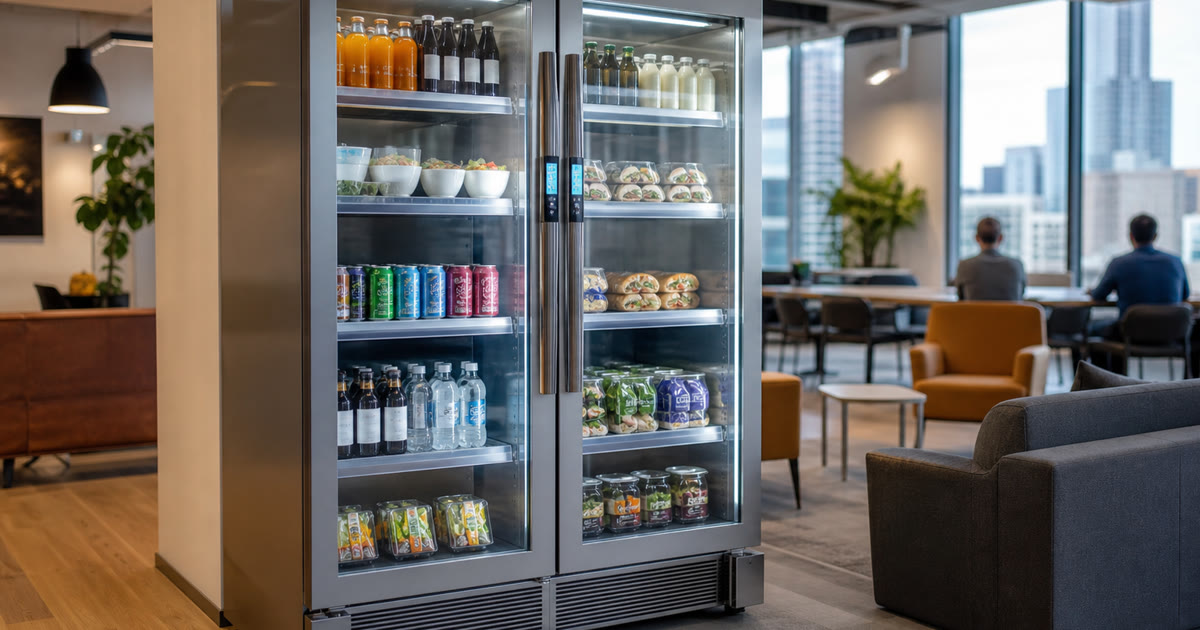
A smart vending cooler or smart fridge gives the property team a smaller, cleaner option. It can sit near the route people already use. It can support drinks and grab-and-go food without turning a meeting room into snack storage.
The key is not just having a machine. The key is placing it where the building already pauses.
Smart vending works better when the route is obvious
The best smart vending placement usually answers one question first: where do people naturally stop?
In a downtown workspace, that may be near the training room exit. It may be beside a shared kitchen. It may be along the path between elevators and flexible seating. The right answer depends on the room, but the principle is consistent. Put food access where the day already creates a break.
That matters because a smart cooler in the wrong corner becomes invisible. A unit near a bottleneck can become annoying. A machine next to a quiet work zone can feel out of place.
A better placement supports movement instead of fighting it. People can grab something without hunting for it. Service teams can reach the unit without crossing the main room at the worst time. Property staff do not have to babysit an amenity that should be simple.
Revvolto looks at this as an operations question, not just a product question. The machine should fit the room, the traffic, and the service path.
Downtown buildings should plan for service ownership
Food access is not finished when the equipment arrives.
Someone has to stock it. Someone has to handle restocking rhythm. Someone has to support payment technology. Someone has to notice when the product mix stops matching the room.
That is where many building amenities get heavier than expected. A property team starts with a good idea, then slowly inherits the work. The snack drawer becomes a job. The community fridge becomes a chore. The shared counter becomes a mess.
A managed smart vending program is different when the operator owns the ongoing work. Revvolto handles the ongoing stocking, payment support, and service work for qualified locations. The building gets a modern food-access amenity without asking internal staff to become part-time vending managers.
That point matters even more in flexible spaces. A room used for workshops one day and nonprofit planning the next can have uneven traffic. The product mix should be able to respond over time. The service plan should account for how the space is actually used.
A pretty machine is not enough. The operating model has to be sane.
The local lesson is bigger than one building
Sail Tower is only the news hook. The larger Austin signal is that office space keeps changing shape.
Downtown buildings are being used for collaboration, training, and hybrid work with more community programming mixed in. Those uses create short breaks and uneven dwell time. They also create a practical question for owners and workplace teams: how do people get food and drinks without turning the space into a managed kitchen?
Smart vending is a strong fit when the answer needs to stay compact. Smart fridges can work when the room calls for refrigerated food and drinks. A small micro market setup can make sense when the space supports a wider grab-and-go moment.
The decision should start with layout. Where do people enter? Where do they wait? Where can service happen without getting in the way?
If those questions are answered early, food access feels like part of the building. If they are ignored, the amenity feels bolted on.
What Austin teams should check before adding vending
Before adding a smart vending machine or smart fridge to a flexible workspace, look at the room like an operator would.
Start with the main pause path. Then check whether the unit can be serviced without creating friction. Finally, match the equipment to the type of use the space gets most often.
A workshop-heavy floor may call for cold drinks and light meals. A shared office lounge may work better with a smart fridge near the coffee area. A community venue may need a compact setup that can handle event spikes without taking over the room.
None of this requires a giant buildout. It does require a clear owner for the work after installation.
That is the real buyer lesson from downtown Austin’s newest flexible workspace examples. The building use is changing. The food-access plan should catch up before people are already asking where to get something between sessions.
If you are planning food access for an Austin workspace, tell us about the location at revvolto.com/contact-us.