
Austin campus projects are not just construction stories. They are movement stories.
A recent Community Impact roundup highlighted several Austin area project filings, including a planned Austin Community College Hays Campus building. The official Texas Department of Licensing and Regulation project record describes a three-story health sciences instructional building with classrooms, laboratories, and testing space.
That does not mean Revvolto is connected to the project. It is simply a useful local reminder: when a campus building is being planned, food access should not wait until after opening week.
For education and staff-heavy buildings, smart vending Austin planning works best when it starts with the route people already take. People leave class, move between labs, and wait near testing rooms. Staff areas have their own rhythm. If food and drink access is added late, it often lands wherever a leftover corner exists. That is how a good amenity becomes awkward.
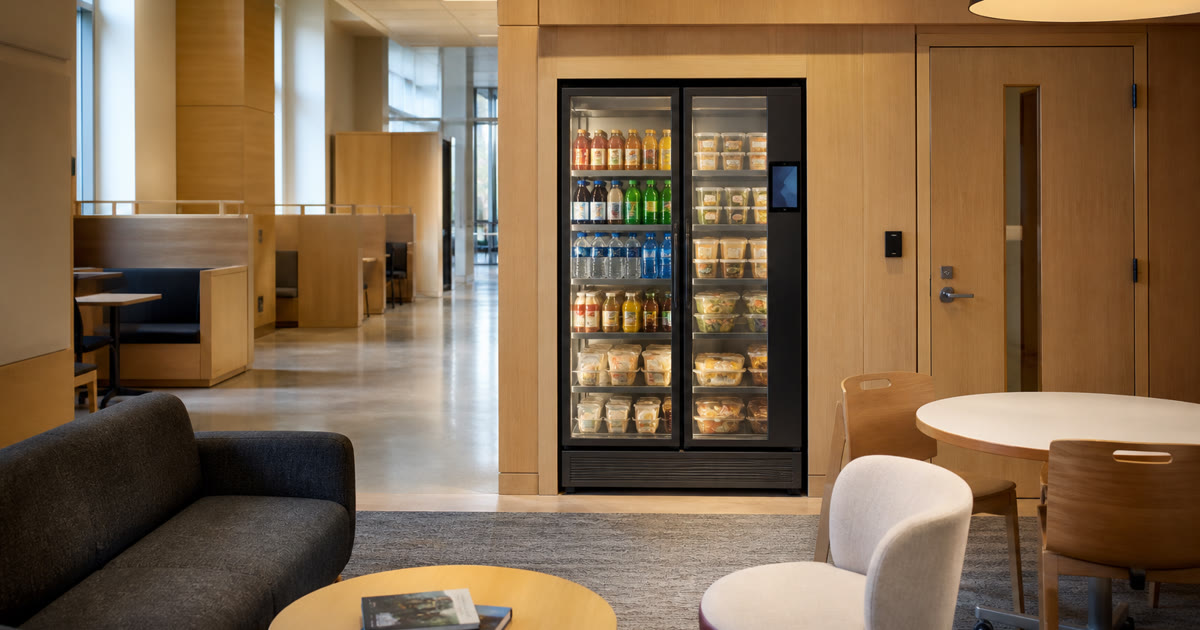
Campus food access is a layout decision
A campus building has obvious rooms on the drawings. The less obvious part is the daily pattern between those rooms.
People do not experience a building as a floor plan. They experience it as a string of short decisions. Where do I wait before the next session? Where can staff grab something without walking across the building? Where can a visitor pause without stepping into a restricted area?
Those questions matter before the furniture arrives. A smart fridge or smart vending cooler is not just an appliance dropped into a blank wall. It has to sit where people naturally pause, where service access is practical, and where the surrounding space does not create weird traffic.
That is especially true in campus environments. Training buildings, testing centers, and staff areas can have different rhythms across the same day. Morning class traffic feels different from afternoon lab traffic. Staff breaks do not always match student movement. Visitors may need simple wayfinding without wandering into back-of-house areas.
Planning early lets the food-access point support the building instead of interrupting it.
The best spot is rarely the loudest spot
The instinct is to place vending where the most people walk by. That can work, but it is not the whole test.
A smart vending location should match three things: visibility, pause behavior, and service access. If one of those is missing, the placement gets weaker fast.
A hallway with constant movement may be visible, but it may not give people a comfortable place to stop. A staff room may be convenient, but it may not support visitor use. A lounge may look perfect in a photo, but it still has to allow stocking and maintenance without turning the room into an obstacle course.
Campus projects are a good reminder because they combine planned movement with changing schedules. Classrooms, labs, and testing areas create demand at different times. A good food-access plan respects that instead of pretending the building has one single rush hour.
For Revvolto the better question is not, “Where can a machine fit?” The better question is, “Where would food access make the day easier without adding work for the site team?”
That shift changes the placement conversation.
Smart vending can remove the snack-work problem
The old version of campus food access often creates quiet labor for someone nearby.
A staff member becomes the person who answers snack questions. A front desk becomes the place people ask what is available. A break area becomes a mini supply closet that someone has to police. Nobody planned for that job, but the job appears anyway.
Smart vending and smart fridge service should reduce that burden, not relocate it.
Revvolto’s role is to provide modern cashless equipment and manage the stocked product side. Revvolto also handles maintenance. For qualified locations, that is typically at no cost to the site. The important word is typically. Placement still depends on fit and traffic.
In a campus setting, that managed-service model matters. A facility team should not have to become a snack operator. A department manager should not be chasing inventory. A front desk should not become a payment-help counter.
The better model is simple: put the right cooler or smart vending unit near the right pause point, then make the operation somebody else’s job. That is the useful part. Not gadget theater. Not a shiny box for the sake of it. A stocked food-access point that works without becoming another internal chore.
Construction timelines are a chance to get it right
The TDLR record for the Hays Campus project lists a future construction timeline. That is exactly why the hook is useful.
Food access is easier to plan before a building opens than to patch in later. Electrical access and service routes become cleaner when they are considered early. So do wall clearance, nearby seating, and sightlines.
Waiting until a building is full can lead to compromises. The machine ends up too far from where people actually pause. The service route annoys people. The unit sits in a place that looks available but feels inconvenient. Then everyone wonders why the amenity underperforms.
That is avoidable.
For campus and education-adjacent spaces, the smarter move is to audit the pause paths before opening. Training spaces deserve the same review. Look at where people wait. Look at where staff actually break. Look at where a stocked cooler can be visible without crowding the room.
That is where smart vending earns its keep.
What Austin site teams should ask before opening day
A good pre-opening food-access review does not have to be complicated.
Start with the daily route. Where do people naturally slow down? Then check the service side. Can stocking happen without disturbing the main flow? Finally, check the audience. Is the location mainly staff, students, or mixed use?
Those questions keep the conversation practical. They also prevent the common mistake of treating food access like a decoration.
Revvolto is built for this kind of planning. The equipment is modern and cashless. The stocked products can be matched to the audience over time. The service model keeps the operational work with Revvolto instead of pushing it onto the building team.
That matters for campus buildings because the first month sets habits. If food access is easy to find and easy to use, people notice. If it is hidden or awkward to service, the building quietly teaches people to ignore it.
Austin keeps adding spaces where people learn and work. The smartest time to plan food access is before the building has already trained everyone to walk past the wrong spot.
If your Austin area facility is planning a new space or amenity update, tell us about the location at revvolto.com/contact-us.



