
Smart vending machine planning in an office gets a lot easier when you stop treating the machine like furniture. The question is not where it looks nicest on a floor plan. The question is where people already pause, pass, and make quick decisions.
That is the difference between an amenity people notice and a stocked box everyone walks past.
Office teams already juggle badge access, visitor flow, and hybrid schedules. Food and drink access should support that flow, not become another pantry project. A smart vending setup works best when it fits the building’s daily movement and gives the workplace team fewer loose ends to manage.
Here is the practical office test.
Start with the route people already use
The best placement usually sits near an existing habit. Think shared kitchen, elevator corridor, or tenant lounge. People are more likely to use a smart vending machine when it sits inside a normal pause point instead of a forgotten corner.
That sounds obvious until a floor plan gets involved. A beautiful empty niche can be a terrible vending spot if nobody passes it with enough time to stop. A slightly less glamorous wall near the coffee bar can work better because people already slow down there.
This is also where accessibility and building flow matter. The U.S. Access Board explains that accessible routes are meant to connect accessible spaces and generally align with circulation paths. That does not make a vending location automatically compliant, and it is not a substitute for a site review. It is a useful reminder that placement is partly about routes, not just open wall space.
For an office, that means the vending plan should respect the same movement people already use to reach kitchen and lounge areas. If the machine interrupts that path, it creates friction. If it supports the path, it feels natural.
A good rule: place the unit where someone can stop for a drink without blocking everyone else’s morning coffee run.
Match the format to the room, not the brochure
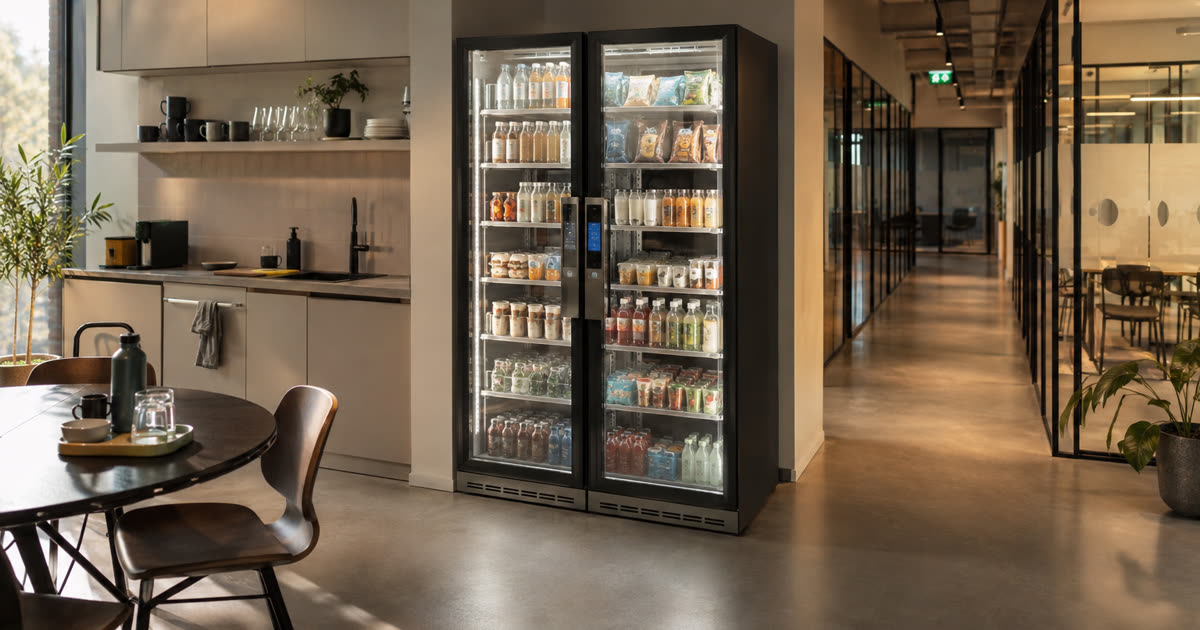
Office vending is not one format. A compact smart fridge may fit a small tenant lounge. A full-glass smart vending cooler may work better in a larger breakroom. A small micro market can make sense when the room has the right traffic and enough space for browsing.
The mistake is starting with the equipment before the room earns it.
Look at three things first: available footprint, expected traffic, and service access. If the room is tight, a bigger setup can make the space feel awkward. If the room gets heavy use, a single small cooler may feel underpowered. If restocking access is bad, the amenity becomes harder to maintain than it should be.
We help sort that out before a placement becomes public furniture. The right answer can be modest. That is not a weakness. A well-placed smart fridge that gets used every day beats an oversized market that looks impressive for one week and then becomes a hallway obstacle.
For office and tech workplaces, the format should make the room easier to use. Not louder. Not more complicated. Easier.
Keep payment support out of the office team’s lap
Cashless vending is convenient only if the support model is clear. Someone will have a card tap question. Someone will pick the wrong item. Someone will ask how refunds work. If every small question lands on the office manager, the amenity starts to feel like unpaid counter duty.
Payment security is its own serious discipline. The PCI Security Standards Council describes PCI DSS as a baseline of technical and operational requirements for environments where payment account data is stored, processed, or transmitted. An office buyer does not need to become a payments expert to add vending, but the buyer should know who owns the payment tech and support path.
That is where service model matters. The machine is only part of the decision. Ask who handles payment issues, stock questions, and routine maintenance. Ask what the office team is expected to do when something goes wrong.
The clean version is simple: your team should not become the help desk for snacks and drinks.
We handle stocking and payment tech, plus service for qualified locations, so the amenity stays useful without turning workplace teams into operators.
Plan product mix around office timing
Office food access changes throughout the day. Morning traffic may lean toward cold coffee, water, and quick breakfast items. Midday is more about drinks, snacks, and something substantial enough to save a trip outside. Late meetings and after-hours work create a different pattern again.
That does not mean the first product mix has to be perfect. It means the starting mix should be thoughtful, then adjusted from real usage.
Smart vending helps because purchase data can guide assortment changes over time. That is practical, not magical. It does not know what every employee wants. It shows what people actually buy, which is much more useful than guessing from a spreadsheet.
The office team should also think about audience. A headquarters floor, a tenant lounge, and a shared coworking-style amenity area can all behave differently. The best stocked setup pays attention to the people using the room and the times they are most likely to stop.
A vending plan that ignores timing usually turns into either empty rows or dusty products. Neither helps the building feel cared for.
Make the service route part of the decision
A smart vending machine has to be used by employees, but it also has to be serviced. That second part gets forgotten because it is less glamorous. Too bad. It matters.
If the restock path is awkward, the installation may still work, but it will be harder than it should be. Service teams need practical access. Building teams need the machine to stay out of the way. Employees need the area to feel clean and easy, not like a delivery route crashed into the breakroom.
The best office placements balance all three.
That is why site fit is more than headcount. A qualified office location needs the right traffic, the right room, and a service path that can keep the amenity maintained. When those pieces line up, smart vending feels like part of the workplace instead of a vending experiment parked against a wall.
If you are looking at food and drink access for an office or tech workplace, start with the path. Then the room. Then the service model. The equipment decision gets much easier after that.
Tell us about the location at revvolto.com/contact-us.



