
Austin clinic growth is usually covered as a patient-access story. That makes sense. But facility teams should also notice the quieter operations question behind the news: when a healthcare space expands, where do staff actually pause?
Community Impact reported that People’s Community Clinic opened an expanded Center for Women’s Health in Central Austin in September. The report describes added exam rooms and dedicated space for group care. People’s Community Clinic’s own update also describes the women’s health move to a larger space at the St. David’s pavilion.
Revvolto has no affiliation with People’s Community Clinic, St. David’s, Community Impact, or the project. The point is broader. Clinic expansion is a useful reminder that food access is not only a lobby question. In healthcare buildings, the better vending plan often belongs behind the public-facing flow. Staff should be able to use it without turning the front desk into snack support.
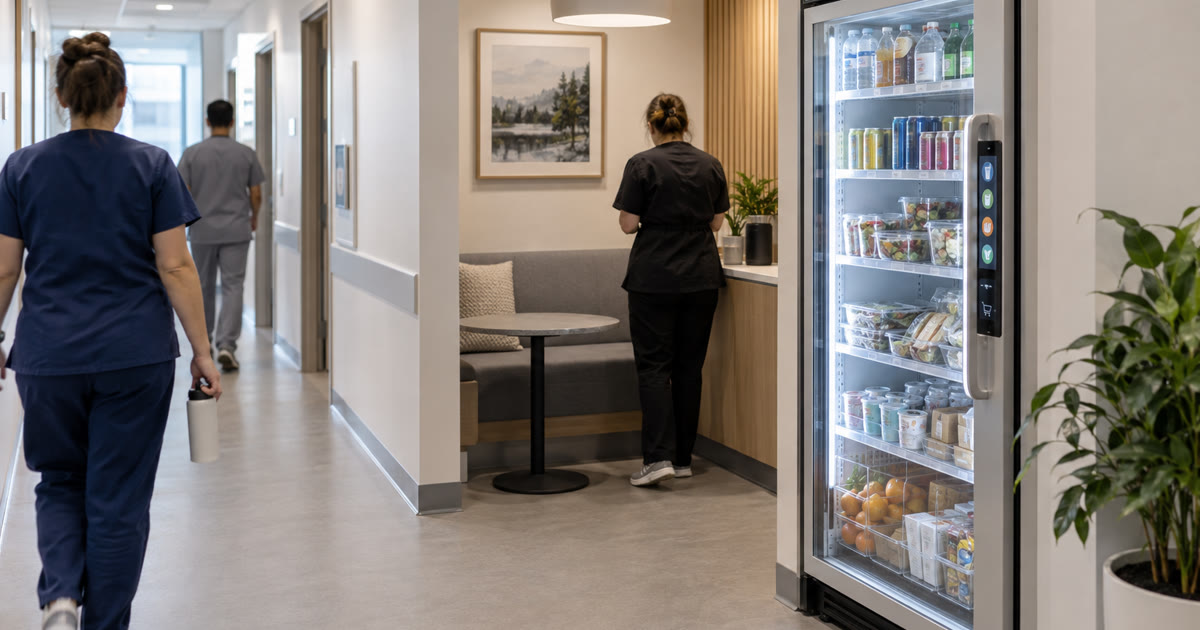
Clinic growth changes the break path
When a clinic adds space, the public story usually focuses on access. That is the right headline. The building still has to function hour by hour for the people working inside it.
Staff breaks in medical offices are rarely neat. A team member may have ten minutes between rooms. That is not the same thing as a clean lunch block. If food means leaving the building, the break becomes fragile before it starts.
That is where smart vending earns a serious look. Not as a flashy amenity. As a practical back-of-house tool.
The useful question is simple. Where do employees already pass during the workday? A smart cooler near that route can support short breaks without pulling someone through the public waiting area. A small smart fridge near a team room can handle drinks and quick meals without creating another task for clinic staff.
Good placement starts with movement. Watch where staff enter. Watch where they stash bags. Watch which hallway becomes the natural handoff point. The vending plan should meet that path instead of asking the staff to detour around it.
Staff-only placement matters in healthcare settings
Healthcare buildings carry a different standard than a normal office. A vending machine near the wrong area can feel awkward fast. Patient-facing space is not the place to improvise food access.
The safer clinic vending plan usually starts in staff-only space. Breakrooms work. Employee lounges work. Back-of-house corridors can work when the route is clean. The goal is to support employees without confusing the patient experience.
That separation does a lot of work. It avoids the visual weirdness of selling snacks beside care conversations. It keeps service visits away from sensitive areas. It also makes the amenity feel like a staff support tool rather than a public retail fixture dropped into a healthcare setting.
The details matter. A clinic team should ask whether the door swing blocks a hallway. They should check whether a restock visit can happen without interrupting work. They should know whether the unit is visible enough to be used.
Those are boring questions. Boring questions save the install.
Smart vending also helps because payment is cashless. Inventory can be managed without a breakroom committee. That matters in a clinic. The best amenity is the one staff can use without creating another clipboard or another person who somehow became in charge of sandwiches.
The vending plan should reduce staff workload
A stocked food option only helps if someone owns the work behind it. Otherwise, the clinic gets the worst version of convenience. The shelf starts strong. It slowly empties. Then it becomes one more thing people complain about.
That is why service ownership belongs in the planning conversation early. Who keeps products stocked? Who handles payment support? Who deals with maintenance? Who notices if the product mix is wrong for the actual staff schedule?
For Revvolto, the answer is straightforward. We handle stocking and service for qualified locations. We also support the payment technology. The clinic team should not have to manage inventory or chase repairs.
Product mix should follow the staff day. Early starts may call for cold coffee and breakfast items. Afternoon gaps may call for quick meals. Evening clinic hours may require options that still make sense after nearby food spots slow down.
The exact mix depends on the site. The planning principle does not. Food access should fit the workday as it exists, not the workday someone drew on a brochure.
Service access is part of the floor plan
Clinic teams do not need a giant market to solve a narrow staff-break problem. In many buildings, a compact smart vending unit or smart fridge is more realistic than a larger micro market. The right answer depends on the room, the staff schedule, and the service route.
A good site review should look at service access before anyone falls in love with a corner. Can a route driver reach the unit without passing through sensitive space? Is there room to open the door fully? Does the location keep the unit visible enough for staff but out of patient flow?
Those questions are not glamorous, which is exactly why they are useful. Clinic buildings already have enough operational friction. A vending plan should remove a little of it, not add a new source.
The local hook from Central Austin is not that every clinic needs the same setup. It is that expansion changes how buildings are used. When a clinic grows, staff movement grows with it. Break paths and service routes should be part of the conversation before the floor plan hardens.
If you are planning food access for a clinic staff area, Revvolto can help you pressure-test the space. Tell us about the location at revvolto.com/contact-us.



