
Austin keeps adding facilities where people cannot treat food access like an afterthought.
One current signal comes from the Austin Chamber member news page. Prudential Overall Supply announced a planned cleanroom and industrial laundry processing facility on West Howard Lane, with a groundbreaking and ribbon cutting scheduled for October 1, 2026. The company says the project represents a $40 million to $45 million investment and is expected to create more than 150 jobs once complete.
That is not a Revvolto relationship. It is a useful local planning cue.
Cleanroom support buildings, industrial processing sites, and advanced manufacturing facilities run differently from ordinary offices. People move through controlled paths. Breaks are timed around shifts. Some teams wear facility gear. The food-access plan has to respect the building, not fight it.
For Austin operators planning similar staff areas, smart vending belongs in that conversation early.
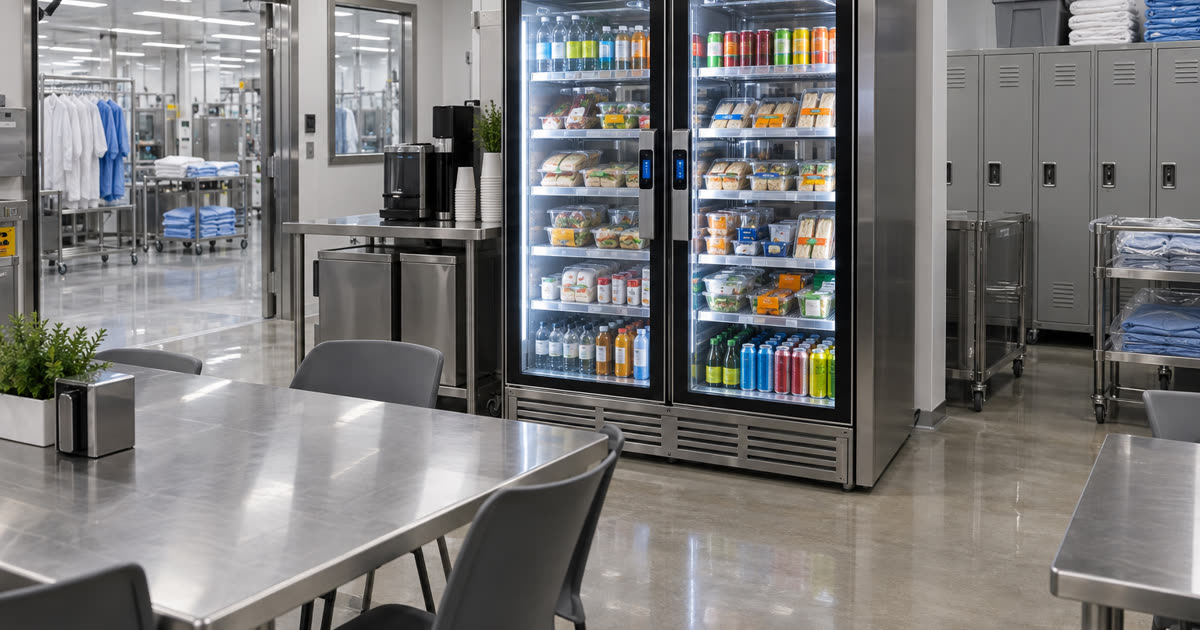
Clean facilities do not run on casual movement
In a normal office, someone can usually leave for coffee or walk to a nearby restaurant without breaking the day.
Cleanroom-adjacent buildings are less forgiving.
A staff member may be moving between production, gowning, and a locker area. A technician may have a short pause between tasks. A facilities lead may want fewer outside interruptions during the day. If food access sits too far from the natural path, people skip it or build their own workaround.
That is how breakrooms quietly become messy. Someone brings in a case of drinks. Someone else starts a snack drawer. The fridge fills with mystery containers. The front office gets pulled into questions it never wanted to own.
Smart vending is not magic. It is a controlled way to put food and drinks where people already pause.
For a cleanroom support facility, that might mean a glass-front smart cooler near the staff lounge instead of a public lobby. It might mean a compact unit near lockers, but outside any sensitive area. It might mean keeping the food amenity close enough for short breaks while still leaving space for carts, doors, and service access.
Good placement starts with movement.
The right question is where people already stop
The Austin Chamber announcement names a specific facility type: cleanroom and industrial laundry processing. That matters because the building is likely to include staff movement that is more structured than a standard office suite.
Before adding smart vending, the planning question is not “Where is there an empty wall?”
The better question is: where do people already stop with permission to pause?
In industrial and cleanroom support buildings, the answer is usually near staff-only break space or the route between parking and shift start. The unit should be visible enough to get used, but not placed where it clogs a controlled workflow.
A smart vending machine also needs room for service. If the unit sits in a tight corner, the installer may solve the first-day photo and create a long-term headache. The door has to open. The products have to be restocked. Payment support has to be reachable. Cleaning crews and facilities teams need the space to stay workable after the machine arrives.
That sounds basic because it is basic.
But basic is where many food amenities win or lose. The machine does not fail because the drinks are cold. It fails because nobody thought about the ten feet around it.
Product mix should match the shift, not the brochure
A clean industrial building is not a hotel pantry and it is not a student lounge.
The product mix should match the people using the space. For some teams, cold drinks and simple meals matter most. For others, smaller snacks and quick breakfast items carry the day. The mix can change after people start using the unit, but the first plan should be honest about the workday.
This is where modern smart vending helps.
Cashless payment keeps the interaction simple. Inventory visibility helps the operator see what is moving. A stocked smart fridge or cooler can support perishable grab-and-go items when the location and service plan fit. The point is not to overload the building with a giant market. The point is to give people a practical food option that matches the break path.
That matters in Austin because more local facilities are blending office, production, and technical functions inside one property. Food access cannot be planned as if everyone has the same schedule or the same ability to leave.
A production-adjacent team may need fast, close, and predictable. A front office team may want something clean and low touch. A facilities team may care most about who stocks it, who fixes it, and who answers when the card reader has an issue.
Those are not separate questions. They are the vending plan.
Service ownership is the difference between amenity and chore
A smart vending program should make life easier for the building team.
If the staff area gets a cooler but the team has to own the daily details, the amenity just became another job. That is the wrong trade.
The better setup gives people food access while keeping ownership clear. We handle stocking, payment tech, and service for qualified locations. The building team still helps with placement decisions and access, but it should not become the snack department.
For cleanroom-adjacent and industrial support facilities, that ownership line matters even more. The food area should stay separate from sensitive work. Service visits should be predictable. The unit should sit in a place that supports the day without creating friction for security, maintenance, or shift movement.
The Austin Chamber post is about one company expansion. The broader lesson is bigger: when Austin adds more technical and industrial staff facilities, food access has to be part of the floor-plan conversation earlier.
Not after the lockers go in.
Not after the breakroom fills up.
Not after someone realizes the closest food option is a car ride away.
Smart vending works best when it is planned around the route people already use.
A clean staff area deserves a clean food-access plan
The best smart vending placement in this kind of building is usually boring in the right ways.
It is easy to find. It does not block the work path. It gives people practical food and drink choices. It has room for service. It has cashless payment. It does not ask your staff to manage a mini store on top of their actual job.
That is the test.
Austin’s cleanroom, industrial, and advanced manufacturing support facilities are not all the same. Some will be too specialized for a standard placement. Some will have staff areas that are perfect for a smart cooler or compact vending setup. The deciding factor is not the headline on the building. It is how people move through the space every day.
If you are planning a staff area, do the break-path walk before the amenity decision.
Start at the door people use. Walk to the lockers. Walk to the break space. Watch where people naturally pause. Then ask whether smart vending can support that path without adding work for your team.
That is how a food amenity stays useful instead of turning into another thing to babysit.
For Austin-area buildings where a clean facility team needs a better grab-and-go option, tell us about the location.



