
Austin retail openings are easy to read as a sales floor story. New storefront. New shoppers. New weekend traffic. Fine.
The better operational question is what happens behind the sales floor once the doors open.
Community Impact reported that The Bins, a Houston-area thrift store, is opening its first Austin-area location on Guadalupe Street on September 25. The story is specific to one retail opening, but the planning lesson is bigger than one shop. Retail spaces with steady customer movement also have staff movement. Sorting, restocking, and checkout coverage all squeeze the break schedule.
That is where smart vending and smart fridges belong in the planning conversation. Not as decoration. As a practical food-access point that fits the path people already use.
Retail food access starts behind the counter
A busy resale shop has two different rhythms.
The front of the store is customer-facing. People browse, compare, and check out. The back of the store is where the real operational pressure lives. Staff sort inventory, handle carts, and move between storage areas when the rush hits.
If food access only works when someone can leave the building, it is not really supporting the workday. A ten-minute break disappears fast when the closest option means walking out, waiting in line, and coming back through a crowded sidewalk or parking area.
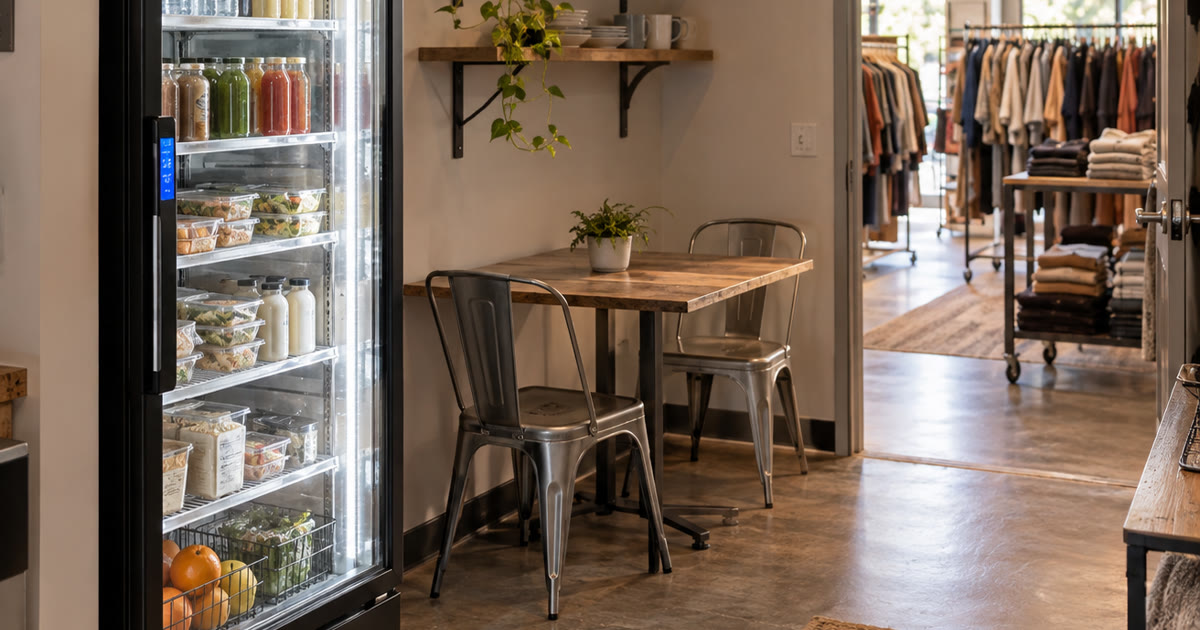
Smart vending gives the team a closer option without turning the front counter into snack duty. A clear-glass smart cooler can sit near a staff room, stock path, or shared back-area pause point. People can grab a drink or meal quickly, pay cashless, and get back to the floor.
That sounds simple because it should be. The mistake is waiting until after opening to notice that the staff break path is awkward.
The sales floor should not carry every job
Retail teams already have enough happening at the counter.
The counter is for shoppers, transactions, and service questions. It should not become the place where staff manage snacks, answer food questions, or keep track of a half-stocked mini fridge. That kind of work looks small until it lands on the same person trying to keep the line moving.
A smart vending setup separates food access from counter work. We handle stocking and service, including the payment tech. Your team does not have to assign someone to refill shelves or make another supply run because the drinks vanished during a rush.
For resale and thrift environments, the best location is usually not the prettiest empty wall. It is the spot that respects the work pattern. Near the staff break area. Close enough to the backroom route. Easy enough for service without dragging restocking through the busiest part of the store.
That is the retail version of good vending placement. The machine fits the workflow instead of asking the workflow to bend around the machine.
Opening week is the right time to map the pause points
The Bins story gives Austin a useful reminder: opening week creates attention, but it also tests the building.
People arrive in waves. Staff learn what slows them down. Backroom paths get used harder than the floor plan expected. A soft seating area, stock corridor, or staff room quickly reveals whether food access is helping or getting in the way.
This is why the placement conversation should happen before the routine settles in. Where do employees actually pause? Where can a service team reach the unit? Where can a cooler sit without blocking carts or customer paths?
Those are not glamorous questions. They are the questions that decide whether the amenity feels useful six weeks later.
For a retail location, smart vending works best when it supports the daily pattern. Short breaks matter. So do changing shifts and service access that does not fight the sales floor.
Smart vending can fit a small retail footprint
Retail teams often assume a food amenity requires a full breakroom or a large micro market. Sometimes it does. Often, it does not.
A smart fridge or compact smart cooler can work in a much smaller footprint when the location has the right traffic, service access, and product fit. The unit does not need to dominate the room. It needs to be visible enough, stocked well, and easy to maintain.
That matters for Austin retail because many stores are not sitting on spare square footage. Guadalupe Street storefronts, neighborhood retail strips, and mixed-use buildings usually make every foot earn its keep.
The planning test is practical. Can the machine be serviced without interrupting the store? Can employees reach it during a short break? Does the product mix fit the people using it?
If the answer is yes, a smaller smart vending setup can do more than a messy office fridge ever will.
The local hook is retail growth, but the lesson is operations
Revvolto has no affiliation with The Bins, Community Impact, or the Guadalupe Street location. The local story is useful because it points to a real Austin retail moment: a new storefront preparing for opening traffic.
For any retail operator or property team watching that kind of growth, the food-access question is worth asking early.
Where will your team pause when the store is busy? How will restocking work without creating another chore for staff? What happens when the rush hits and leaving the building is not realistic?
Smart vending will not solve every retail operations problem. It can solve one visible one: giving people a stocked, cashless, low-friction food option inside the building.
If you are planning a retail space or staff area in Austin, tell us about the location. We will help you decide whether smart vending or a smart fridge actually fits the way the space works.



