
Local growth is not just about big buildings. It is about the everyday friction inside those buildings once the doors open.
The latest signal comes from an Austin Chamber member-news item on Prudential Overall Supply’s planned cleanroom and industrial laundry processing facility in North Austin. The announcement says the project includes a $40 to $45 million investment. It also points to an October 1 groundbreaking and more than 150 expected jobs tied to regulated advanced industries.
That does not make Revvolto connected to the project. It does make the buyer question useful: when more industrial work comes to the area, where do staff get food without losing time to an off-site run?
For facilities like these, the food setup is not breakroom decoration. It is part of the operating plan.
The easy mistake is treating the machine as a late furniture choice. In a technical building, the better decision starts earlier. Food access should be considered beside room layout, staff movement, and restocking flow. That keeps the amenity useful without making the space feel crowded or improvised.
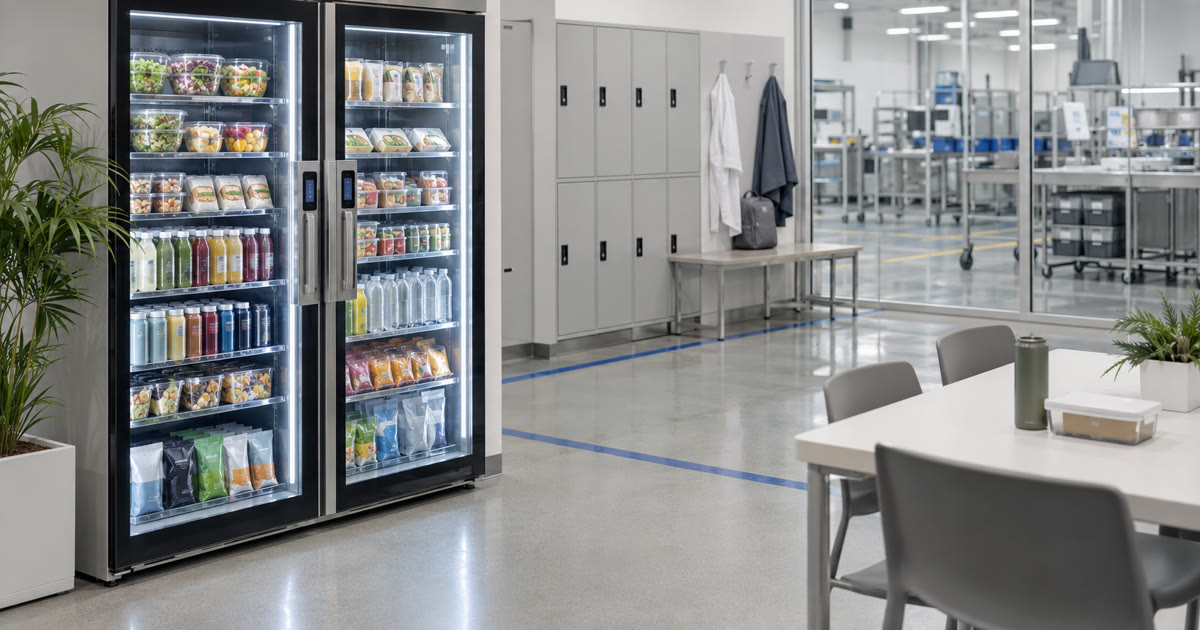
Industrial growth creates a food question
Cleanroom and manufacturing support buildings run differently from standard offices. People often move between controlled work areas and staff rooms on a schedule that does not care whether the nearest food option is open.
The Chamber announcement is a useful reminder because it names a facility type that depends on repeatable operations. Once a building like that is active, employee meal coverage has to fit the rhythm of the workplace. It cannot depend on someone leaving the site, crossing a parking lot, and hoping the timing works.
That is where a smart vending machine, smart fridge, or compact micro market can earn its place. The goal is not to turn an industrial building into a retail store. The goal is simpler: put stocked, cashless grab-and-go food close to the moments where staff already stop.
For property teams and operators, the planning question is not “Should we add snacks?” That is too small. The better question is: “Where will staff naturally stop without disrupting the work?”
Shift rooms need more than a coffee pot
Industrial staff areas carry more pressure than they look like they do. A small breakroom can become the only place where people can reset between production runs or training blocks. If that room has only a coffee maker and a tired vending box, the building is leaving convenience to chance.
A managed cooler or vending unit can make the setup more usable without adding another internal chore. Cashless checkout and stocked product variety reduce the little annoyances that pile up for facilities teams. The right setup can also fit smaller rooms better than a full cafeteria.
The strongest placements are usually close to existing behavior. In industrial buildings, that may mean a staff breakroom near lockers. It may mean a training-room corridor. It may mean a shared amenity point outside a controlled area. The unit should be visible enough to be used, but not parked where it blocks movement.
Revvolto’s role is straightforward: we help qualified locations add modern vending, smart fridges, or micro markets that are stocked and maintained by us. For the site team, that matters because the food amenity should not become another supply run.
Service ownership matters in controlled buildings
Industrial and cleanroom-adjacent facilities often care deeply about order. Even when the vending area is outside the controlled workspace, the building still benefits from a clear ownership model.
Who restocks the unit? Who handles payment issues? Who removes expired items? Who notices when product mix is wrong for the shift? If the answer is “whoever has time,” the amenity becomes a tiny operational tax.
A vending program should make those answers obvious before installation. That means restocking expectations are clear. Payment support has an owner. Product changes follow actual use instead of guesswork.
This is where newer equipment beats the old breakroom snack pile. It creates a cleaner handoff between the building and the operator. The property gets an amenity people can actually use. The facilities team gets a defined partner instead of loose snack decisions.
For technical buildings, that clarity is not fancy. It is the difference between a food option that quietly works and one more thing someone has to babysit.
Plan the location before the punch list is closed
The best time to think about vending is before the building is fully locked into furniture, traffic flow, and utility decisions. Waiting until after move-in can force the unit into whatever corner is left.
Industrial teams should look at three things early. First, where do people already stop? Second, where can restocking happen cleanly? Third, where can the machine be seen without crowding the workday? That is enough to avoid most bad placements.
The Austin Chamber announcement points to a larger pattern: the region keeps adding specialized workspaces. Those buildings need everyday support systems that match how the work actually happens.
A stocked grab-and-go program will not solve every facilities problem. Good. It is not supposed to. It solves a specific one: making food and drinks easier to reach, easier to manage, and easier to keep stocked in places where leaving the building is not always convenient.
If your Austin-area building is adding shifts or staff rooms, the grab-and-go plan belongs in the plan early. Tell us about the location at revvolto.com/contact-us.



