
Austin’s small business calendar is a reminder that food access is not only an office problem.
The City of Austin lists monthly Small Business Office Hours running from July 8 through October 21, 2026, at assorted Austin Public Library branches. The event page says sessions run from noon to 2 p.m., bring together several City departments, and require no appointment.
That is not a Revvolto event. We are not connected to the City, the library, or the program. It is just a useful local signal: community rooms and public-facing business events create real pause paths.
When people come to a resource session or business help day, the building has to do more than provide a room. People arrive early. They wait between conversations. Staff and partners stay through setup, the session itself, and cleanup. A smart vending plan can support that movement when it is placed where people already pause.
Business events create small food-access gaps
A two-hour public session sounds short on paper. In the building, it stretches.
Attendees may come from work. A staff member may arrive early to set up tables and materials. A department partner may stay after the session to answer one more question. That kind of day does not always justify a staffed cafe, but it does create demand for simple grab-and-go food and drinks.
The mistake is treating that demand as an afterthought. If the only option sits far from the meeting room, people either leave the building or skip it. Neither outcome helps the space feel easy to use.
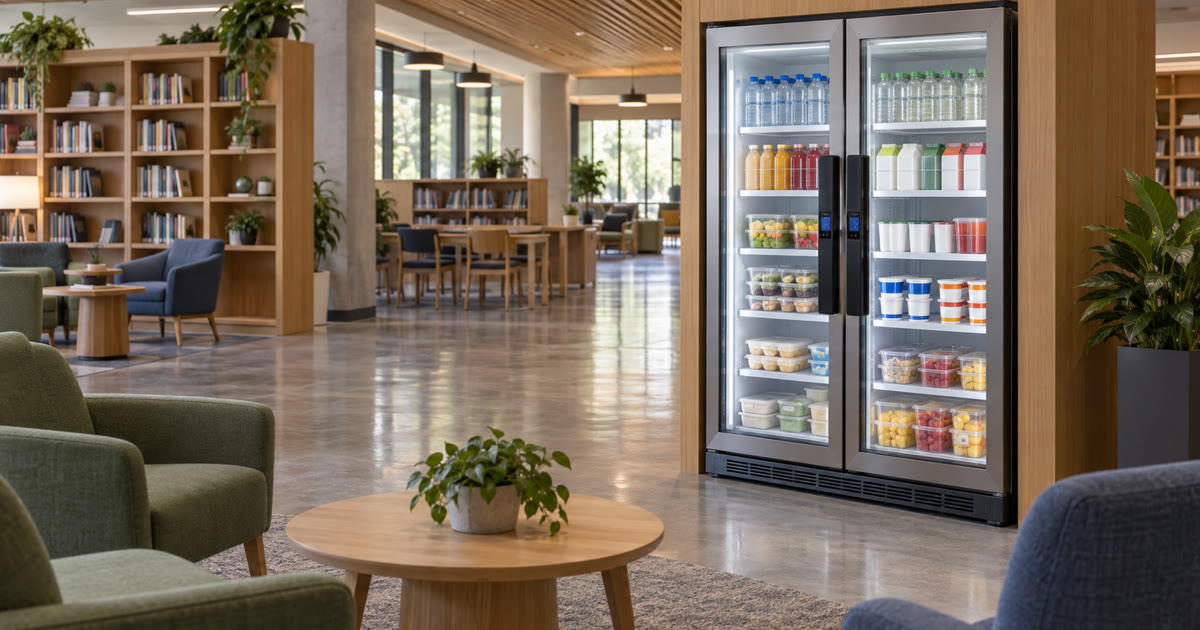
Smart vending works better when it is planned around the event path. That might mean a smart cooler near the meeting-room entrance, a compact market setup near a shared lobby, or a stocked unit close to the staff area that supports the room. The point is not to decorate the building with a machine. The point is to remove a small but real friction point.
Community rooms need service logic too
Public-facing rooms are busy in a different way from a normal breakroom.
They turn over. They welcome different groups. They may have visitors who do not know the building. They also have staff members who already carry the operational load for room access and setup.
That is why service ownership matters. A food-access amenity should not become another thing the front desk or facilities team has to babysit.
A modern vending machine or smart fridge has to fit three practical tests. Can people find it without wandering? Can it be restocked without interrupting the room? Can payment stay simple for visitors who are only there for one event?
Those questions are not glamorous. Good. Glamour is not what keeps a community room working. Layout does. Service access does. A clear plan for stocking and maintenance does.
The best placement is usually near the pause path
Community spaces have predictable pause points.
People stop near the entrance while they figure out where to go. They pause outside the meeting room before a session starts. They gather near shared seating after a conversation ends. Those spots are usually better than a random wall with an outlet.
A smart vending plan should start by watching that movement. If the machine sits too close to the room door, it can create a bottleneck. If it is hidden around a corner, people miss it. If restocking requires rolling through a packed event path, the building team inherits a problem.
There is also a visitor-confidence piece. A clear, cashless smart cooler tells people they can handle a quick drink on their own. They do not have to ask the desk or leave the building. That matters in spaces where people are already unsure where to go.
The same logic applies to staff. When food access is nearby and self-serve, the team can keep the room moving instead of solving every small refreshment problem one conversation at a time.
This is where Revvolto’s model fits qualified locations. We install modern cashless vending, smart fridges, or micro market setups. We stock the equipment, manage payment tech, and handle service. The building team gets a useful amenity without becoming the snack crew.
For community rooms, that operating model is the difference between “nice idea” and “actually useful.” A vending unit only helps if it still works on the tenth event day, not just the day it was installed.
Local business support needs practical amenities
The useful lesson from Austin’s Small Business Office Hours is not that every library branch needs the same setup. That would be lazy.
The better lesson is that local business support happens inside real rooms with real movement. People show up at noon. They ask questions. They wait. Staff members help them. The building has to support the whole path, not just the agenda.
For property teams and civic facilities, that means food access belongs in the planning conversation early. It should be close enough to use and modest enough to fit the room without taking it over.
Smart vending is not the whole answer to visitor experience. It should not pretend to be. But when people are already gathering for business help or community programming, a stocked smart cooler can make the space easier to use and easier to manage.
If you are planning food access for an Austin-area community room or business-resource space, tell us about the location at revvolto.com/contact-us.



