
Austin added 16,200 jobs over the year ending in August 2026. That number matters to more than economists. It is a practical signal for anyone responsible for a growing workplace, training site, or industrial facility.
The October economic indicators from Opportunity Austin show gains across professional services, construction, and manufacturing. More people at work means more break traffic, more demand on shared spaces, and more pressure on whatever food setup already exists.
A vending machine in Austin should be planned around that daily movement. The useful question is not whether a machine can fit against a wall. It is whether the location, product mix, and service plan fit the people who will use it.
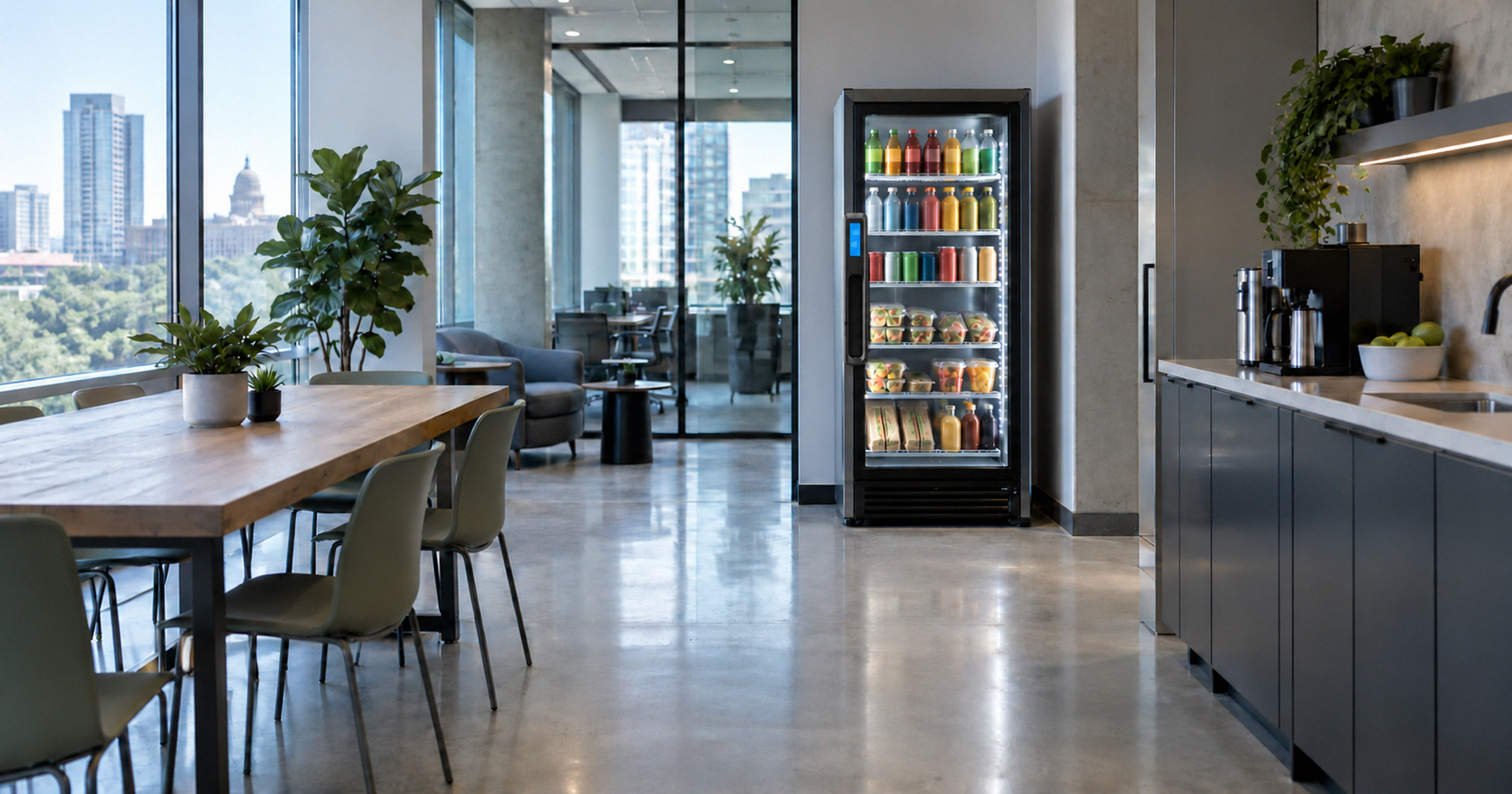
Job growth changes how shared spaces work
A workplace can add people faster than it updates the rooms those people rely on. The break area that felt adequate at one headcount can become crowded. A front desk can start fielding food questions. Employees on short breaks may skip an amenity that sits too far from their normal route.
Opportunity Austin reports that professional and business services grew by 5,600 positions during the period. Construction gained 4,000 positions. Manufacturing gained 2,500. Those work environments differ, but each creates the same facilities question: where can people get food or a cold drink without creating another staffed counter?
The answer depends on the building. An office may have concentrated midday traffic. An industrial site may have several break windows. A training facility may see groups move at the same time between labs and classrooms. A good plan starts with those patterns rather than a generic floor-plan guess.
This is why refreshment planning belongs in the occupancy conversation. Waiting until a room is already busy usually leaves fewer location choices and a messier restocking route.
Put refreshments where the workday already flows
The best location is rarely the most decorative corner. It is the place people naturally pass with enough room to browse and pay. Other employees still need room to move past it.
Watch how employees enter the building and move toward their work areas. Look at where breaks begin, not only where the official breakroom sign hangs. A smart fridge or cashless vending unit can work near a shared staff room, a training corridor, or another common route when it stays visible and does not pinch circulation.
Service access matters too. Stocking should not cut through a controlled work area or collide with the busiest employee movement. The unit also needs enough clearance for its glass door to open and for a person to make a selection comfortably.
That is the part glossy amenity photos skip. A machine can look good and still be badly placed. If employees have to hunt for it or squeeze around it, the location is doing the unit no favors. Crossing the building during a short break is another sign the setup is off.
Match the setup to the people and schedule
Headcount is one input. Schedule is another.
A workplace with a single midday peak behaves differently from a site with staggered shifts. Training days can create short, sharp rushes. Teams working later hours may value dependable access after nearby counters have closed.
Product decisions should follow the same logic. The mix in a professional office does not have to mirror the mix in an industrial staff room. Purchase data can refine the assortment after launch. The first plan should still reflect the setting and operating hours, then account for how breaks happen there.
Payment support also deserves a named owner. Cashless vending removes coin handling, but someone still has to respond when a transaction question comes up. A serious site plan identifies the owner of payment issues. It also settles maintenance and restocking before the equipment arrives.
We provide the equipment and payment technology for qualified locations. We also handle stocking and ongoing care. That keeps the amenity from quietly becoming another task for the reception or facilities team.
Treat growth as a prompt to review shared amenities
Austin’s latest job numbers do not prove that every growing workplace should add vending. Growth is not a reason to buy a machine. It is a reason to walk the building again and review on-site food options while space use changes.
Start with the building, not the machine. Count the people who share the space. Map the routes they already use. Check the hours when nearby food options are unavailable. Then decide whether a modern vending setup or compact micro market fits the location.
The wrong time to ask these questions is after the wall outlets and furniture are fixed. Once the circulation pattern is settled, moving the unit can mean reworking a room that already functions. The better time is while the workplace is still adjusting to growth.
Walk the building during a normal break before choosing a spot. Watch where people queue and where they stop to talk. Notice which doors stay busy and whether a delivery cart can reach the proposed location without cutting through the crowd. Ten minutes of observation can reveal more than a clean floor plan because the plan shows dimensions, not behavior.
For Austin-area businesses, that review can be simple. Is the amenity easy to find and maintain? Is it where people actually take a break? If the answer is no, the room is telling you what to fix.
Tell us about your location at revvolto.com/contact-us. We will help you assess whether a modern vending setup fits the space and the people using it.



