
Church buildings do not run like restaurants, and that is exactly why food access gets awkward.
A fellowship hall may be quiet on Tuesday morning, full after a service, then stretched during a youth event. The same space can serve staff, volunteers, and visitors in one week. If snacks and drinks depend on a closet or cash box, the food setup becomes another job for people who already have one.
AI vending gives church administrators and faith-based community center teams a more controlled way to support those daily routes. The goal is not to turn a community building into a convenience store. The goal is simpler: put modern grab-and-go food and drinks where people naturally pause, while Revvolto handles the operating work.
Revvolto’s role is practical. We place modern smart vending and smart fridge options in qualified locations, then keep the equipment stocked and supported. For church and community-center spaces, that means the conversation starts with fit: room flow and service access.
Why church facilities need a different vending test
A church or faith-based community center has a different operating rhythm than an office, gym, or hotel lobby. Traffic can arrive in waves. Volunteers may be responsible for setup and cleanup. Staff areas may be separate from public gathering rooms. Some events may be open to the community, while others are internal.
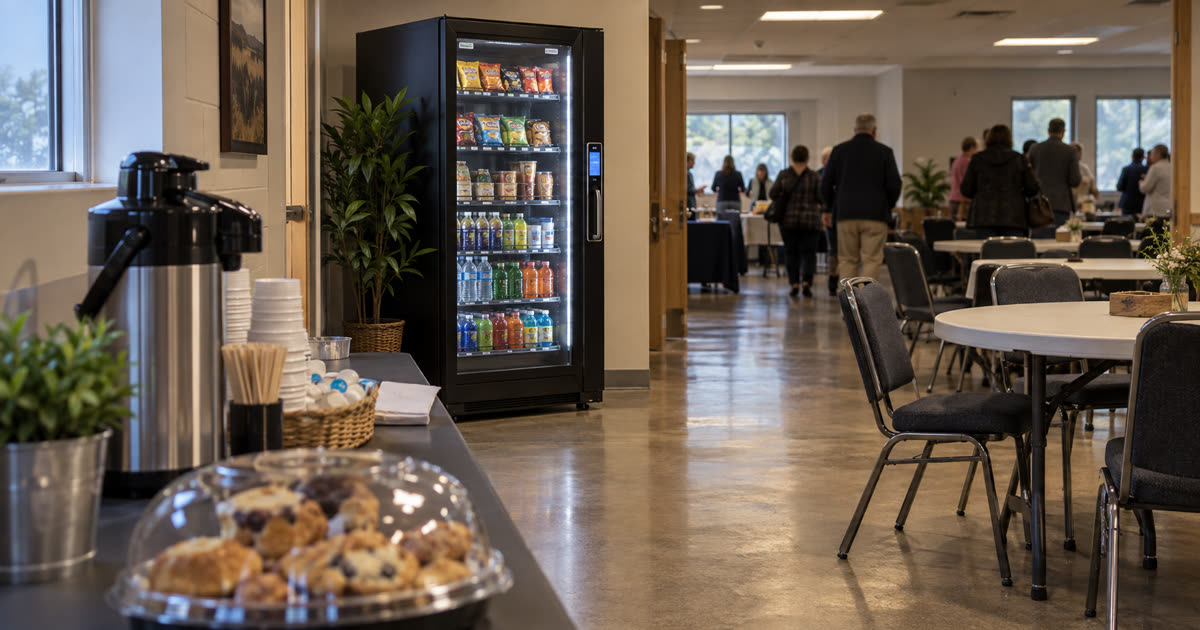
That makes placement more important than hype. A smart vending machine near a fellowship hall can work well when it sits close to natural daily routes and does not block the room. A smart fridge near a staff corridor may fit better when the goal is employee and volunteer access between meetings. A compact cooler near a community room can support longer gatherings without forcing the front office or event lead to manage snacks.
The wrong setup creates friction. If the machine is placed too far from the room people use, it becomes invisible. If it sits in a bottleneck, it gets in the way. If it requires internal staff to troubleshoot payments or restock products, the whole point is lost.
The better test is simple: where do people already stop, wait, or reset? That path matters more than the prettiest empty wall.
Accessibility also belongs in the early discussion. The U.S. Access Board’s ADA guidance on accessible routes is not a vending-machine placement manual, but it is a useful reminder that equipment should not be planned as an obstacle. Keep circulation and service access in the conversation before anyone falls in love with a corner.
What AI vending should actually do here
AI vending can sound bigger than it is. Strip away the buzzword and the useful part is straightforward: connected equipment and sales data can help the operator understand what moves, what sits, and what should be adjusted.
For a church community center, that matters because the audience is not one predictable office team. A weekday staff pattern may look different from Sunday traffic. A youth event may create different demand than a volunteer training session. A community meeting may need quick drinks and simple snacks more than a full food spread.
A smart vending setup should help the operator refine the product mix over time. It should support cashless payment. It should give the service team better visibility into stocking and maintenance. It should make the machine easier to manage without asking the church office to become the vending department.
That does not mean the machine “knows” the community. It does not guarantee the perfect assortment. It does not replace human judgment. A good operator still has to review the location, watch early usage, and adjust with common sense.
This is where Revvolto is useful. We are not dropping off a box and wishing everyone luck. We are looking for qualified placements where the unit can stay useful, stocked, and aligned with how the building actually runs.
Placement questions before anyone says yes
Before adding smart vending to a church or faith-based community center, ask a few unglamorous questions. They will save more trouble than a prettier machine photo ever will.
First, who is the primary user? Staff and volunteers may call for a back-of-house smart fridge. Visitors and event attendees may call for a fellowship-hall or lobby-adjacent vending unit. A mixed-use building may use a placement that serves both without confusing the flow.
Second, when does the building get busy? Weekly services, evening meetings, and volunteer days can create very different stopping points. The vending plan should support those rhythms instead of assuming every day looks the same.
Third, who handles the room today? If snacks are currently managed by the office or event staff, that is the operational burden to remove. A smart vending program should not create a new checklist for people who came to run the building, not a snack counter.
Fourth, where can service happen cleanly? The unit needs access for restocking and maintenance. If a machine can only be reached by interrupting an event or squeezing through a crowded room, the placement is wrong even if the foot traffic is right.
Fifth, how will payment support work? The PCI Security Standards Council’s merchant resources are a useful reminder that payment systems deserve serious handling. A site team does not need to become a payments expert, but it should know who supports the payment technology when a reader or transaction question comes up.
Product mix should match the room, not the fantasy
The product mix for a church community center should feel normal, useful, and easy to maintain. This is not the place for a fake luxury pantry story. It is also not the place for health claims, performance claims, or anything that sounds like the machine is making moral choices about snacks.
A practical mix might include cold drinks, simple snacks, and light grab-and-go items. The exact assortment should be adjusted after the operator sees what people actually buy. That is where smart vending data helps: not by replacing judgment, but by showing patterns clearly enough to make better restock decisions.
The building team should also think about what should not be handled by vending. Some events will still use catered food, donated refreshments, or planned hospitality tables. Smart vending is best for the in-between moments: the person who stayed late, the volunteer who missed lunch, or the parent waiting during a program.
That is the lane. Not everything. Just the useful gap.
The Revvolto fit
The right Revvolto setup should make the building easier to run. It should support people without turning staff or volunteers into product managers. It should feel modern without feeling pushy. It should be placed where the room naturally works.
For qualified Austin-area locations, Revvolto can provide modern cashless smart vending or smart fridge options, then handle stocking and service. The location still matters. Traffic, audience, and service access decide whether the program makes sense.
If your church or faith-based community center has recurring events or community-room traffic, the best first step is not picking a machine. It is walking the building and finding the daily routes.
Tell us about the location at revvolto.com/contact-us. We will help you figure out whether smart vending belongs there, where it should go, and what the internal team should not have to manage.



