Austin’s latest manufacturing news is not just a jobs story. It is also a reminder that modern facilities need to plan the ordinary parts of the workday before the building is full.
On August 19, the Texas Governor’s Office announced that Amazon selected Austin for a new robotics manufacturing facility expected to create 300 to 500 manufacturing and engineering jobs. The announcement points to the same thing many Austin-area facilities are wrestling with: more technical work, more specialized teams, and more buildings where people cannot always leave casually for food during the day.
Revvolto is not connected to Amazon, the Governor’s Office, or the project. The useful takeaway is broader. When Austin adds advanced manufacturing space, food and drink access should be planned around the real staff path. Waiting until after occupancy turns a simple amenity decision into a retrofit problem.
Advanced manufacturing runs on controlled movement
A robotics plant is not a casual office floor with a snack table in the corner.
Manufacturing and engineering teams move through controlled areas. People may pass between production areas, training rooms, and staff spaces. Some routes need to stay clean. Some doors need to stay uncluttered. Some breaks are short enough that leaving the site is not realistic.
That is why smart vending belongs in the facilities conversation early. The buyer question is not whether a building can squeeze in a machine. The better question is where food access fits without fighting the way the facility already moves.
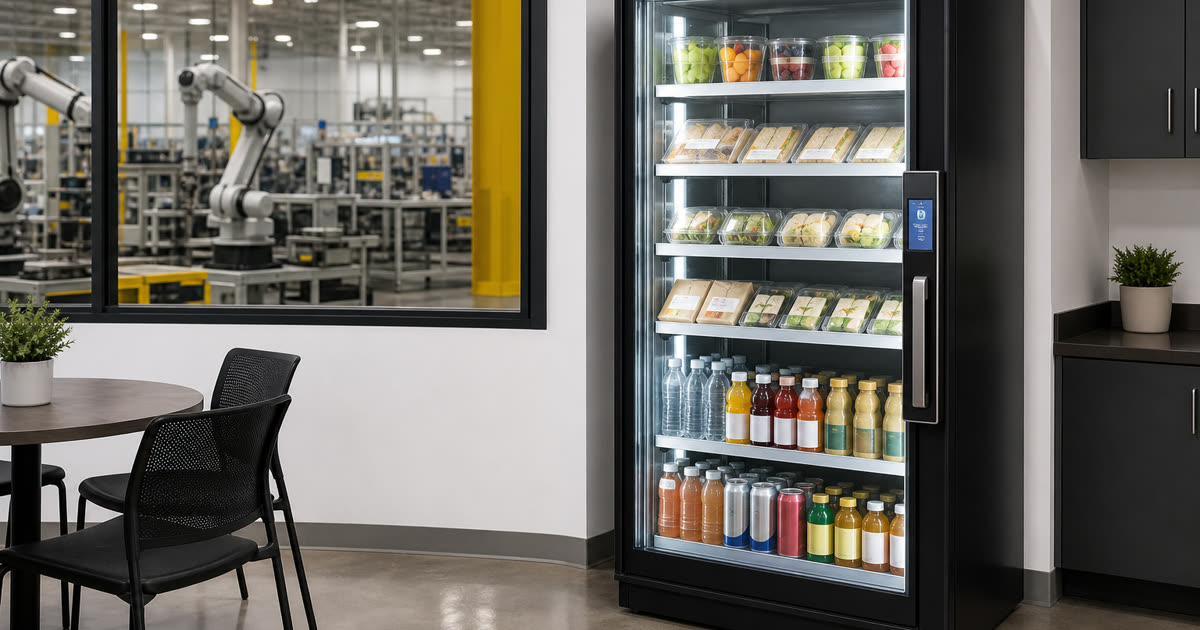
A smart vending cooler or smart fridge works best when it sits near the pause path. That might be a training-room corridor, a shift-change area, or a staff break space close enough to be useful without getting in the way. The location should be visible, easy to service, and far enough from sensitive work areas that restocking does not become a disruption.
This is where old vending thinking falls short. Dropping a machine wherever there is a spare outlet is not a plan. It is a guess with a plug.
For advanced manufacturing locations, the vending plan needs to respect the room. People need a fast grab-and-go option. The facilities team needs a service model that does not add inventory work. The provider needs a route that can be maintained cleanly and consistently.
Revvolto’s job is to handle the vending side: stocked products, cashless payment support, and service. The facility team should not have to become the snack department just because the building has long shifts and busy rooms.
Training rooms create a different food-access problem
The Amazon announcement also highlights workforce and education connections around robotics and STEM pathways. That detail matters for food access because training days create their own rhythm.
Training rooms are not the same as a permanent breakroom. People arrive at the same time, pause at the same time, and often have limited windows between sessions. If the only food option is somewhere across the site or outside the building, the break becomes longer than planned or less useful than it should be.
A smart cooler near a training room can support that moment without turning the table at the back of the room into a cluttered snack station. The machine creates one defined place for product, payment, and restocking. That matters in spaces where the room needs to reset cleanly after each group.
The point is not to overbuild the amenity. The point is to remove a small daily friction before it becomes normal.
In manufacturing and technical training environments, that friction is usually basic. Someone forgot lunch. A visitor needs a drink before the next session. A team member has ten minutes between tasks. The facility does not need a full cafe to answer every one of those moments. Sometimes it needs a serviced smart vending point placed where people already pause.
That is the difference between an amenity and a chore. If staff have to buy snacks and watch inventory, the system is not really solving the problem. It is moving the problem from one room to another.
Service access matters as much as visibility
A vending machine can be easy to see and still be hard to operate.
For manufacturing facilities, service access is not a minor detail. A unit may need restocking during active workdays. It may sit near doors, corridors, or shared staff spaces. If the service route cuts through awkward areas, the location will get annoying fast.
That is why the best vending locations balance three things: employee visibility, safe circulation, and realistic service access.
Visibility matters because people will not use what they do not notice. Circulation matters because a vending unit should not narrow a hallway or block a door. Service access matters because stocked vending only works when it can be maintained without becoming a production-day interruption.
Those are boring questions, which is exactly why they are worth asking before the room layout is already locked in.
For Austin facilities adding technical teams, the smarter move is to map food access alongside the daily movement plan. Where do people enter the staff area? Where do they wait before training? Where can a smart fridge sit without making the space feel crowded? Where can Revvolto service it without creating extra work for the facility team?
If those answers are clear, the vending decision gets easier. If they are ignored, the building may end up with a nice-looking machine in a bad spot.
The local lesson is simple
Austin’s robotics and advanced manufacturing growth is easy to talk about in big terms. Jobs. Investment. Innovation. Workforce development.
All of that matters. But inside the building, the daily experience is built from smaller decisions.
Can someone get a drink without leaving the site? Can a training group grab something quickly between sessions? Can the facilities team offer food access without taking on snack inventory? Can a service provider reach the unit without disrupting the workday?
Those are the questions smart vending can answer when it is planned early enough.
For qualified Austin-area manufacturing and technical facilities, Revvolto can help place modern vending machines and smart fridges around the actual break path. We stock and service the equipment, support cashless payment, and help keep the food-access plan from landing on the facility team’s desk.
If your Austin-area location is planning a new staff space or shift break area, tell us about the location at revvolto.com/contact-us.