
Austin’s workforce conversations are not only about training programs. They are also about the rooms, routes, and daily support systems people use while they learn and work. That is where smart vending Austin buyers should pay attention.
Workforce Solutions Capital Area published its Austin Infrastructure Academy Quarterly Impact Report on August 25, 2026. The report says the Academy brings workforce partners together around future skilled-trades work. It also raises a practical facilities question: when people move through training rooms and employer meetings, where can they get food without sending staff into errand mode?
This is not a claim that Revvolto is connected to the Academy or Workforce Solutions. It is a local planning cue. As Austin builds more workforce programs, more buildings will have training rooms and employer convening spaces that need simple food access.
Workforce campuses create real pause paths
A workforce campus is not always a classic office. It can include classrooms and career-service rooms beside labs or employer spaces. People may be moving between sessions instead of sitting at one desk all day.
That movement changes the food-access question. A staffed cafe may be too much for the space. A breakroom pantry may shift too much work to the property team. A basic refrigerator may create stocking, payment, and cleanup problems no one wanted to own.
The real test is whether the option works on a normal Tuesday. People should be able to grab something quickly, pay without friction, and get back to the next session. The building team should not have to chase inventory or answer payment questions all afternoon.
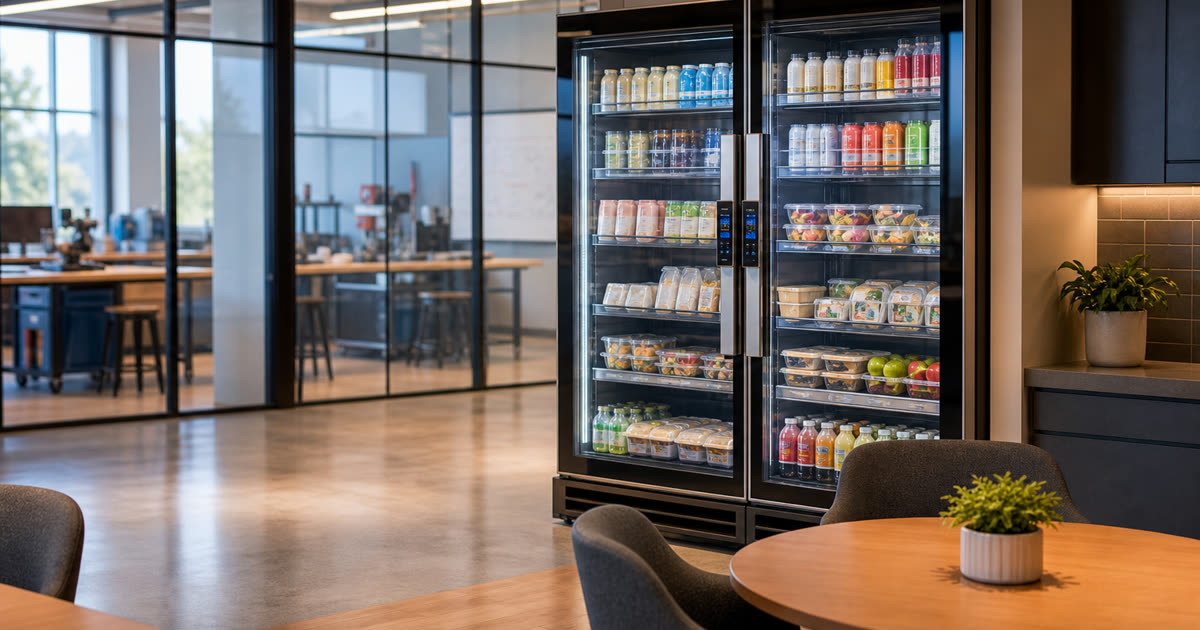
A modern smart fridge or smart vending setup gives the building a cleaner middle option. It can sit near the real pause path. It can support cashless grab-and-go access. It can be stocked and maintained by a dedicated operator instead of becoming one more task for the team running the building.
For workforce training settings, the best placement is usually not the prettiest corner. It is the point where people already stop: near the classroom exit, beside the staff break area, or along the route between training and employer meetings.
The local hook is workforce alignment, not event traffic
The August report says the Austin Infrastructure Academy works with partners across Austin’s workforce ecosystem. It also describes career pathways tied to major capital projects and workforce-demand planning.
That matters for building operators because workforce alignment creates recurring in-person use. Training sessions happen. Employer meetings happen. Career navigation happens. People arrive early, wait between appointments, and leave after long sessions.
Those are small moments, but they are exactly where food access either works or quietly fails. If the only option is leaving the building, the property loses the pause. If the only option is a staff-managed snack shelf, the work lands on the wrong people.
Smart vending is not a strategy document. It is a practical building decision. Put the food and drink access near the flow of the day, make payment simple, and make service ownership clear before opening day.
Service ownership matters as much as the machine
The Academy report highlights workforce systems and partner coordination. Building food access has a similar lesson: the device is only part of the answer.
A good smart vending or smart fridge program needs clear ownership. Who stocks it? Who handles maintenance? Who monitors product mix? Who deals with payment support? If those answers are fuzzy, the amenity becomes a chore wearing a touchscreen.
Revvolto’s role is built around removing that chore in qualified locations. We bring in modern cashless smart fridges and smart vending formats, then own the stocking and service work. For the site team, the better question is not whether a machine can fit. It is whether the full service model fits the building’s traffic and audience.
That distinction matters in workforce and training environments. A room can look ready on a floor plan and still miss the practical break path. A machine can look modern and still become a headache if service access is tight or the audience is wrong.
Plan food access before the building is busy
The easy mistake is treating food access as a finishing touch. That is backward. By the time the room is full, the best placement may already be blocked by furniture or security flow.
For Austin workforce training spaces, the smarter move is early planning. Walk the path people will actually take. Find the waiting points. Look at service access before the final layout locks. Decide whether a smart fridge or smart vending unit fits the room’s rhythm.
That early walk-through also surfaces boring but important details. Is there an outlet near the pause path? Can a restock visit reach the unit without crossing a training session? Will people see the cooler when they leave class, or only after they have already walked out? None of that is flashy. It is the stuff that keeps a smart vending program from becoming a pretty appliance in the wrong corner.
The result does not need to be complicated. It just needs to be owned.
If your Austin-area building is adding training rooms or shared staff spaces, Revvolto can help you think through the food-access plan before it becomes a hallway complaint. Tell us about the location at revvolto.com/contact-us.



