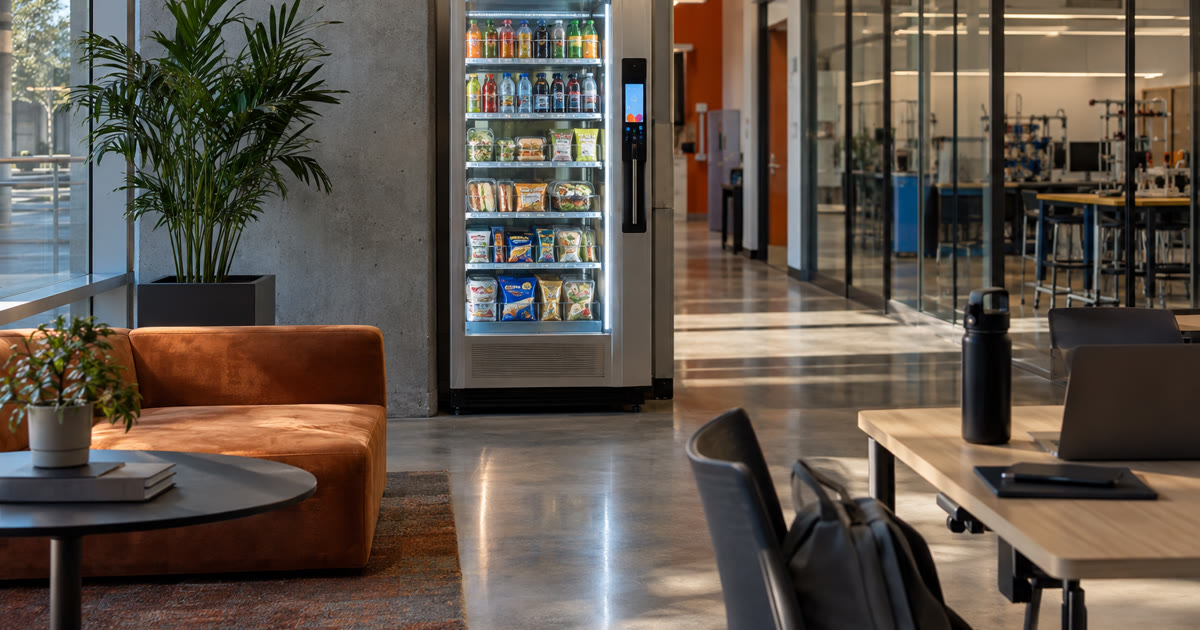
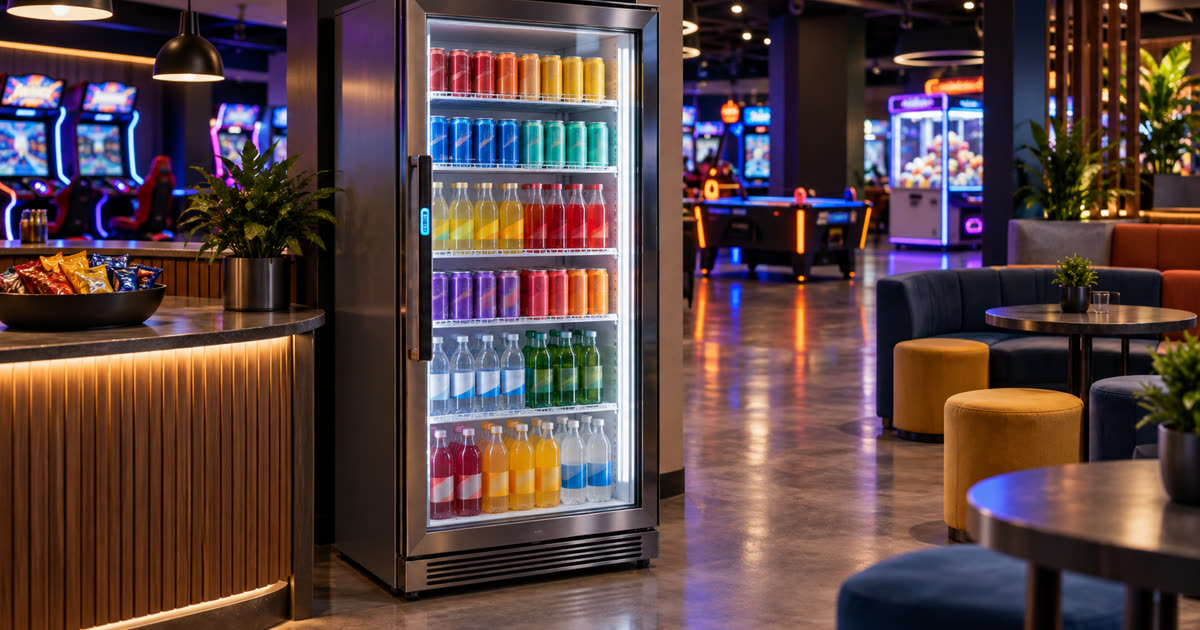
Coworking space vending in Austin has a different job than office vending. An office breakroom serves one company. A coworking space serves everyone from the person taking investor calls in a glass room to the designer who just realized lunch became a calendar casualty.
That mix changes the amenity math.
A vending machine, smart fridge, or compact coworking market setup in a coworking space should not feel like random snack furniture parked near the printer. It should support the way members actually move through the space: early arrivals, late workers, day-pass visitors, private-office teams, event guests, and the occasional laptop nomad whose entire food strategy is “surely there is something downstairs.”
That sentence is usually where bad amenity planning starts wearing a blazer.
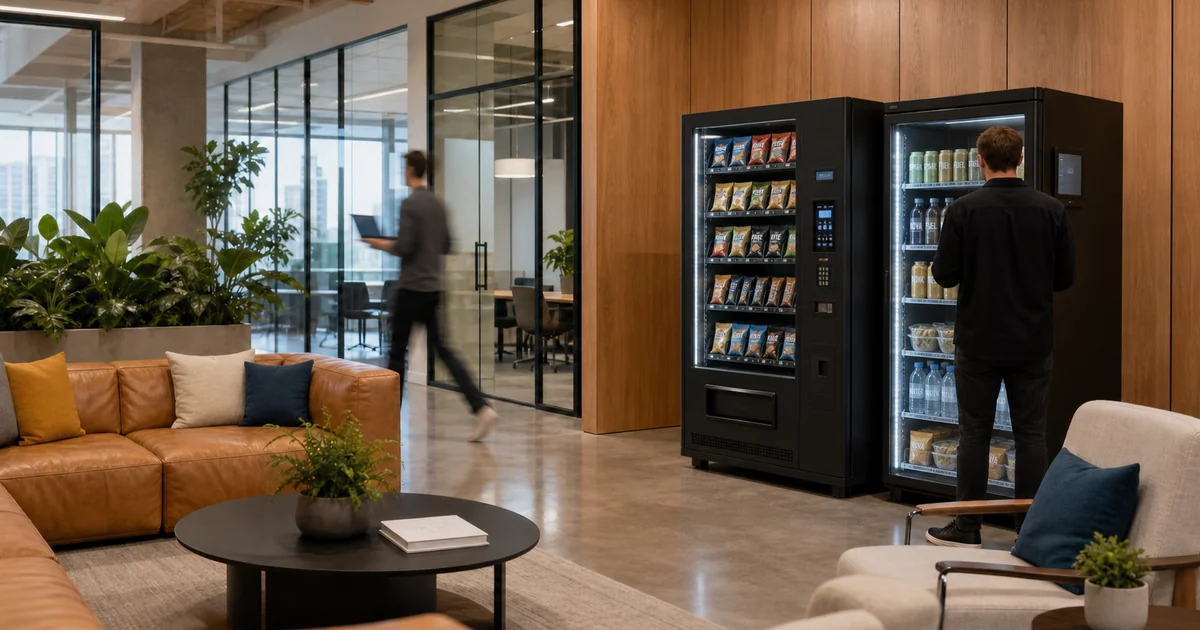
Coworking food demand does not keep office hours
Coworking spaces live in the awkward middle between workplace, hospitality space, and professional clubhouse. Members may not share one employer, one lunch rhythm, or one schedule. Some arrive before staffed hours. Some stay late. Some book rooms for half a day and forget that humans are supposed to eat.
That is where on-site food and drink access earns its keep.
The wrong setup treats coworking like a normal office with nicer chairs. The better setup respects the churn: drop-ins, teams, solo members, events, tours, and people bouncing between meetings with the grace of a browser tab that opened too many children.
For Austin coworking operators, the useful question is not “Should we add snacks?” Most spaces already know members like convenience. The useful question is: where does the snack decision happen, and who gets stuck managing it when the first plan runs out of Diet Coke and dignity?
A smart vending machine or smart fridge can help because it does not require the host team to run a mini convenience store. The operator should handle stocking, restocking, payment tech, and maintenance. The coworking team should not become the emergency mayor of trail mix.
Placement should follow member traffic, not leftover square footage
Coworking layouts tempt people into bad placement decisions. There is always a weird corner. There is always a hallway that feels underused. There is always a spot that looks open because no one wants to stand there.
That does not make it a vending location. That makes it a square footage alibi.
A better placement conversation starts with member behavior:
- Where do members already pass between calls?
- Where do event guests naturally pause?
- Where can people browse without blocking the front desk?
- Where can restocking happen without turning the lobby into a forklift ballet?
- Where does the unit feel useful without becoming the loudest object in the room?
Accessibility belongs in that discussion, but it has to stay narrow and honest. The U.S. Access Board’s ADA guide explains accessible-route concepts for connecting accessible elements and spaces; it does not prove that any coworking space, vending unit, smart fridge, route, door clearance, future installation, future site, or Revvolto recommendation is ADA compliant. Before that citation puts on a safety vest and starts giving legal advice, keep it in its lane: placement should leave room for people to move, reach, pass, and use the space comfortably. Final accessibility decisions need site-specific review. Source: U.S. Access Board
That is not glamorous. Good placement usually is not. Good placement is boring in the way a working outlet is boring. You only notice when someone made a mess of it.
Product mix should respect the coworking chaos calendar
Coworking spaces are not one audience. They are a rotating cast with Wi-Fi passwords.
A private-office team may want steady everyday drinks. A day-pass member may want something fast before a meeting. Event guests may want simple, recognizable options. Late workers may care less about artisanal anything and more about whether there is a cold drink that does not require leaving the building.
This is where old-school vending logic gets clumsy. Stock once, hope forever, and eventually the product mix becomes folklore with refrigeration.
A smarter setup should create room for adjustment. If certain drinks move quickly and certain snacks sit there developing a personality, the assortment should change. If event days shift demand, the operator should learn from that. If the space has more evening use than expected, the mix should not pretend everyone leaves at five because the spreadsheet enjoys fiction.
Keep the claim modest. A smart fridge or vending system does not “know” what members want. That language gets sloppy fast. Purchase data can help show what sells, what sits, and what needs to change. The operator still needs judgment. The machine is not a psychic with a compressor.
For Revvolto, the goal is practical: stock food, drinks, and snacks that make sense for the specific site, then adjust based on real use instead of guessing with the confidence of a confetti cannon.
Payment should be invisible until something breaks
Coworking members expect modern payment. Nobody wants a snack amenity that requires coins, a mystery app, or a front-desk rescue mission.
Cashless checkout matters because coworking spaces have mixed users. Members, guests, event attendees, and visiting teams may all use the same amenity. The cleaner the payment experience, the less the coworking team has to explain.
But payment language is another place where marketers can get drunk on certainty.
The PCI Security Standards Council publishes PCI DSS as a global standard for protecting payment account data. That supports a narrow operational point: payment security ownership and provider responsibilities should be clear before a coworking space adds cashless unattended retail. It does not prove PCI compliance for any vending machine, smart fridge, payment terminal, processor, provider, coworking installation, future installation, future site, Revvolto setup, or checkout flow. It also does not guarantee payment security, eliminate fraud risk, certify a payment experience, or make “we take cards” a complete answer. Source: PCI Security Standards Council
The practical buyer question is simple: if a member has a payment issue, who handles it?
If the answer is “the community manager, probably,” that is not a plan. That is a Slack message waiting to ruin someone’s afternoon.
Revvolto keeps snack ops off the community manager’s plate
Coworking teams already handle tours, room bookings, member questions, event logistics, Wi-Fi weirdness, printer drama, and the emotional fallout of people trying to find HDMI cables.
They do not need snack operations added to the pile.
Revvolto helps qualified Austin-area coworking spaces add smart vending or smart fridge options — and, where the site supports it, compact coworking market setups — without turning the host team into the operator.
For qualified placements, Revvolto typically installs and operates the setup at no cost to the host. Site fit still matters. Traffic, placement, member rhythm, restocking access, and equipment format decide whether the amenity has a real job or becomes furniture with snacks.
A good vending or smart fridge setup should make ownership obvious:
- Revvolto installs the right format for the space.
- Revvolto stocks and restocks the unit on a regular cadence.
- Revvolto manages the payment technology and equipment support.
- The coworking team gets a member amenity without becoming the snack department.
That last line matters most. A vending amenity that creates new daily chores is not an amenity. It is a side quest with refrigeration.
For Austin coworking spaces, the best fit usually comes down to traffic, placement, member rhythm, restocking access, and whether the space has enough repeat use to support the unit. Some sites may fit a smart fridge. Some may fit a vending machine. Some may need a compact coworking market setup. Some may not be ready yet, and pretending otherwise is how you end up with a very confident rectangle nobody uses.
Revvolto’s job is to help sort that out before equipment shows up.
Want to see whether smart vending, a smart fridge, or a compact coworking market setup fits your coworking space? Tell us about your space at https://revvolto.com/contact-us.
No-cost site assessment. No install pressure. No commitment.