
Smart vending belongs in the planning conversation for Austin creative studios because creative work rarely stops on a neat lunch schedule.
Community Impact reported that Studio Hill Austin, a rehearsal space and recording studio near Falconhead West, is opening Sept. 9.
The point is not that Revvolto has any relationship with that studio. We do not.
The useful lesson is broader.
When Austin adds specialized creative workspaces, food access becomes part of the room plan.
A studio day can stretch past the normal meal window.
A rehearsal can pause for five minutes and then restart because the room finally sounds right.
An edit session can run longer than expected because the last detail matters.
If the only food option is outside the building, the break becomes a bigger interruption than it should be.
That is where a smart vending machine or smart fridge can help.
The right unit gives people a quick option near the natural break route.
It also keeps the studio team from managing a snack shelf as a side job.
That last part matters, because creative teams already have enough moving pieces.
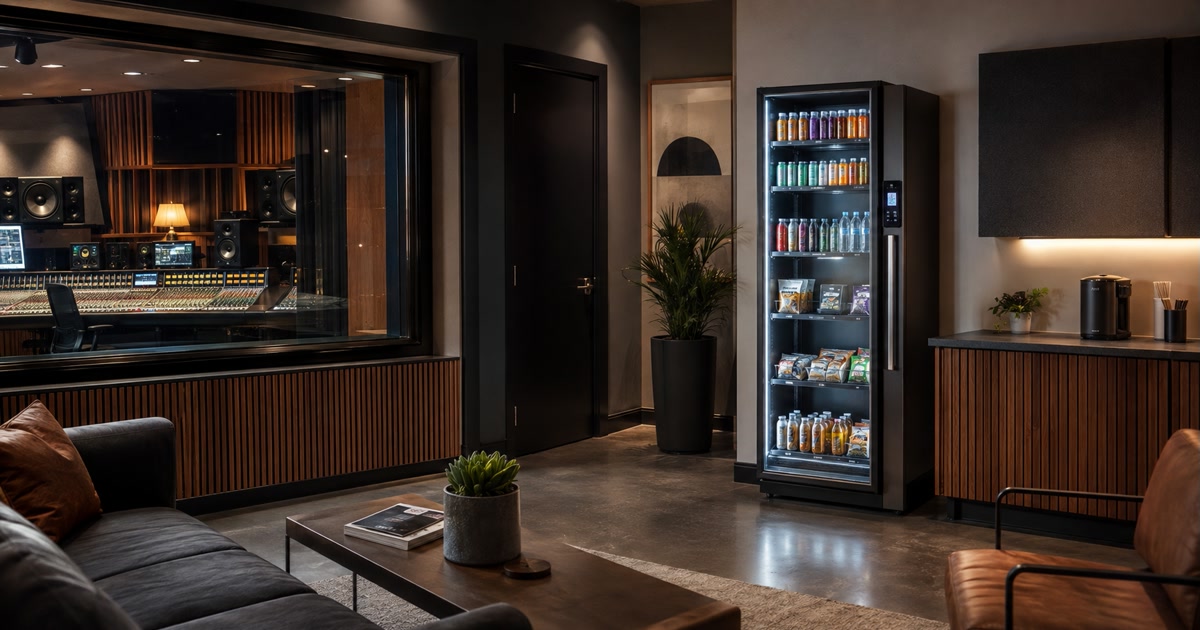
Creative sessions have awkward break timing
A creative studio is not a standard office with predictable lunch traffic.
The work tends to move in bursts.
People wait while a room is reset.
They step out while another person records.
They grab a drink while files export.
Small breaks happen all day, but those breaks are not always long enough for a food run.
A badly placed food option does not solve that problem.
If the machine sits too far away, people ignore it.
If it sits beside a tight doorway, it gets in the way.
If it sits too close to sound-sensitive rooms, it becomes a distraction.
The location matters more than the novelty.
A good setup starts with the obvious path.
Where do people go when they leave the recording room?
Where do they wait between takes?
Where can a cooler sit without blocking gear movement?
Those questions are basic, which is exactly why they get missed.
Revvolto’s role is to make the amenity easier to own.
We handle stocking.
We handle payment tech.
We handle service.
For a lean creative workplace, that is the difference between a useful amenity and another chore with better lighting.
The break route matters more than the machine
Most weak vending plans start with a blank wall and a hope.
Creative spaces should start with the break route instead.
The break route is the place people naturally pass when they are not fully working and not fully gone.
In a studio, that could be the edge of a lounge.
It could be a kitchenette wall.
It could be the shared area between workrooms and seating.
The best spot is usually ordinary.
That is the point.
Smart vending should not turn a calm common area into a crowded corner.
A unit needs door clearance.
It needs power.
It needs service access.
It also needs enough visibility that people remember it exists.
If a team has to explain where the snacks are every time, the placement is already losing.
This is also why the machine format should follow the room.
A smart fridge can support cold drinks and fresh grab-and-go items.
A smart vending machine can support packaged products with cashless access.
A compact micro market may fit a larger creative workplace with steady use.
The right answer depends on the site, not a one-size-fits-all pitch.
For creative studios, quiet usefulness beats flash.
Nobody books a studio because the vending area looks futuristic.
They remember when the day runs long and the building still works.
Product mix should fit the workday
Creative spaces get stereotyped as coffee and energy drinks.
That is too lazy for a real plan.
A better product mix starts with how the room is used.
Morning sessions may call for cold coffee and light breakfast items.
Afternoon work may lean toward water and simple snacks.
Longer evening blocks may call for something more substantial.
The mix should be practical, not precious.
Purchase data can help refine the assortment over time.
That does not mean the machine magically knows what people want.
It means usage can guide better stocking decisions.
If people choose cold drinks more often than shelf-stable snacks, the mix can adjust.
If the room runs more evening sessions, the mix can reflect that pattern.
The bigger value is ownership.
The studio team should not have to count cans.
They should not have to chase payments.
They should not have to guess what disappeared from a communal shelf.
A modern cashless setup keeps access simple and gives the operator a cleaner way to manage the amenity.
That is the practical difference between “we have snacks somewhere” and “the space supports the workday.”
One creates clutter.
The other supports the rhythm of the room.
The Austin hook is really an operations lesson
Studio Hill Austin is the local prompt.
The broader signal is that Austin keeps making room for specialized work.
Creative studios, production offices, and rehearsal spaces all share a similar problem.
People gather for focused work, then need quick food access without scattering the group.
This is not a hospitality trick.
It is a building-operations detail.
The food option has to fit the layout.
The service path has to be workable.
The setup has to feel appropriate for the room.
If it adds friction, it will not age well.
Smart vending is strongest in that boring middle.
It does not need to be the main character.
It needs to sit where people already pause and keep working without turning into a staff project.
That is useful for recording studios.
It is also useful for small production workplaces and creative offices.
For Austin creative spaces, the planning question is simple.
Where do people pause when the workday stretches?
Can that spot support stocked, cashless food access without adding another job for the team?
If you are planning food access for a studio or creative workplace, tell us about the location at revvolto.com/contact-us.



