
Cedar Park just gave facilities teams a useful planning cue.
On September 10, the city announced two advanced manufacturing projects tied to Cedar Tech I. One Cedar Park release describes about 48,000 square feet for precision manufacturing. The other Cedar Park release describes about 50,000 square feet for specialized finishing. Together, the planned footprint sits near 98,000 square feet and 240 new full-time jobs. That is not a vending story by itself. It is a building-operations story.
When advanced manufacturing grows, food access cannot be treated like decoration in the corner. People work around controlled areas and strict shift timing. Training rooms and service routes add their own movement patterns. A smart fridge or smart vending setup only works if it respects that movement.
This is where Austin-area teams should think earlier. If a staff break area is added after occupancy, it usually lands wherever space is left. Better planning starts with the route people already use between production support and training. Locker rooms and office space matter too, but they should not pull the unit away from the real staff route.
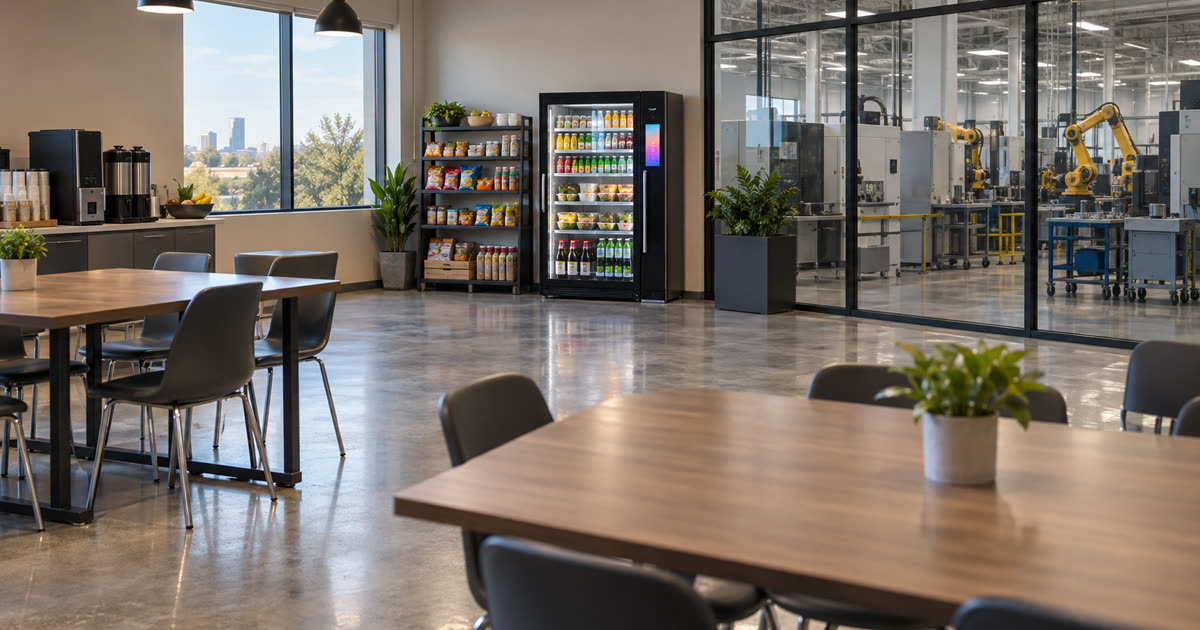
Manufacturing buildings run on controlled movement
Advanced manufacturing space is not a normal office with louder equipment. It has controlled doors, safety expectations, and delivery windows. It also has work areas where people cannot casually drift in and out.
That matters for food access. If the only easy snack or drink option sits on the wrong side of the building, people will skip it during short breaks. If the unit blocks a service path, it becomes a facilities problem. If the payment screen or cooler door creates a pinch point, the placement will annoy the same people it was meant to help.
The Cedar Park releases are useful because they point to a bigger Austin-area pattern: more specialized industrial work is landing in buildings that have to balance precision work with everyday human needs. Staff still drink water. They still grab coffee. They still have ten minutes between tasks. The building has to support that without turning break access into a long walk.
A smart fridge can fit that kind of environment because it does not require a staffed counter or a full kitchen buildout. A compact smart vending setup can also work near a training room or staff corridor when there is enough daily use to support it. The test is not whether the machine looks good in a rendering. The test is whether people can reach it without crossing the wrong path.
Staff food access should be planned before the room feels finished
The easiest time to place a smart fridge is before everyone decides the staff area is done.
Look at the room before furniture and traffic flow have already claimed every useful wall. Coffee equipment and waste bins can crowd a good location fast. A strong placement gives people room to open the glass door, make a cashless purchase, and step aside. It also leaves enough service access for stocking and maintenance.
For manufacturing teams, the practical questions are simple. Where do people naturally pause before or after a controlled area? Where can a stocked unit support breaks without pulling people across the site? Where can service happen without getting in the way?
Those questions beat the usual amenity wish list. You do not need a giant food court for every building. You need a realistic food-access point that matches the rhythm of the work. For one location, that might be a smart fridge in a staff breakroom. For another, it might be a small smart vending cooler near training rooms. The right answer depends on traffic, room shape, and service access.
Revvolto handles stocking and payment tech for qualified locations, typically at no cost to the site. We handle service too. That matters in manufacturing because the facility team already has enough to manage. Snack duty should not become one more unofficial job.
The best placement is close to the staff route, not the front door
A front entrance is not automatically the best place for vending in an industrial building.
In a manufacturing environment, the better spot is usually closer to the real staff route. That might be near a staff break area, a training room, or a controlled transition point where people already stop. The unit should be visible enough to use, but not so central that it creates congestion.
This is also where a smart fridge differs from old vending thinking. Traditional vending often gets treated as a box you push against a wall. Smart vending takes more planning because the door swing and screen position both affect use. Power, lighting, and stocking access affect whether the setup works day after day.
The Cedar Park announcements also mention supply-chain clustering. That is another reason placement matters. As related manufacturers share nearby buildings or industrial parks, staff movement tends to become more patterned. People come in waves around training, shift changes, and scheduled work. A food-access point should be ready for those waves without demanding extra staff attention.
The goal is not to make people stay inside all day. The goal is to give them a practical option when leaving the site does not fit the break they actually have.
Smart vending should make facilities work lighter
A good manufacturing amenity should reduce work for the building team, not create a tiny retail operation in disguise.
That is the line worth holding. A smart fridge that constantly needs someone on site to restock it or answer payment questions is not much of an amenity. If the site team also has to chase product issues, it becomes a chore with a glass door.
Revvolto’s model is built around taking that work off the site team. We stock and restock the unit, maintain the equipment, and support the cashless payment experience. For the building team, the main decision is whether the location has enough traffic and a clean placement path. The audience fit has to be real too.
Advanced manufacturing teams should ask those questions before the last outlet is already spoken for. Food access sounds small compared with major facility decisions, but it affects the daily experience of the people who keep the building moving.
Cedar Park’s September manufacturing announcements are a good reminder: when new industrial space fills up, the staff route fills up too. Plan the smart fridge before it becomes a hallway compromise.
If your Austin-area facility is planning staff food access around a manufacturing or lab environment, tell us about the location. We will help you pressure-test whether a smart fridge, smart vending cooler, or compact market setup fits the space.



