
Arbor Park offers a useful Austin example of a senior-living property where daily convenience matters. The City announced the affordable 55+ community in Northwest Austin in April 2025.
That announcement points to a practical question for senior-living properties across the city: how do you make everyday refreshments easier to reach without giving the front desk another job?
A well-placed smart cooler can help. The machine matters, but the operating plan matters more.
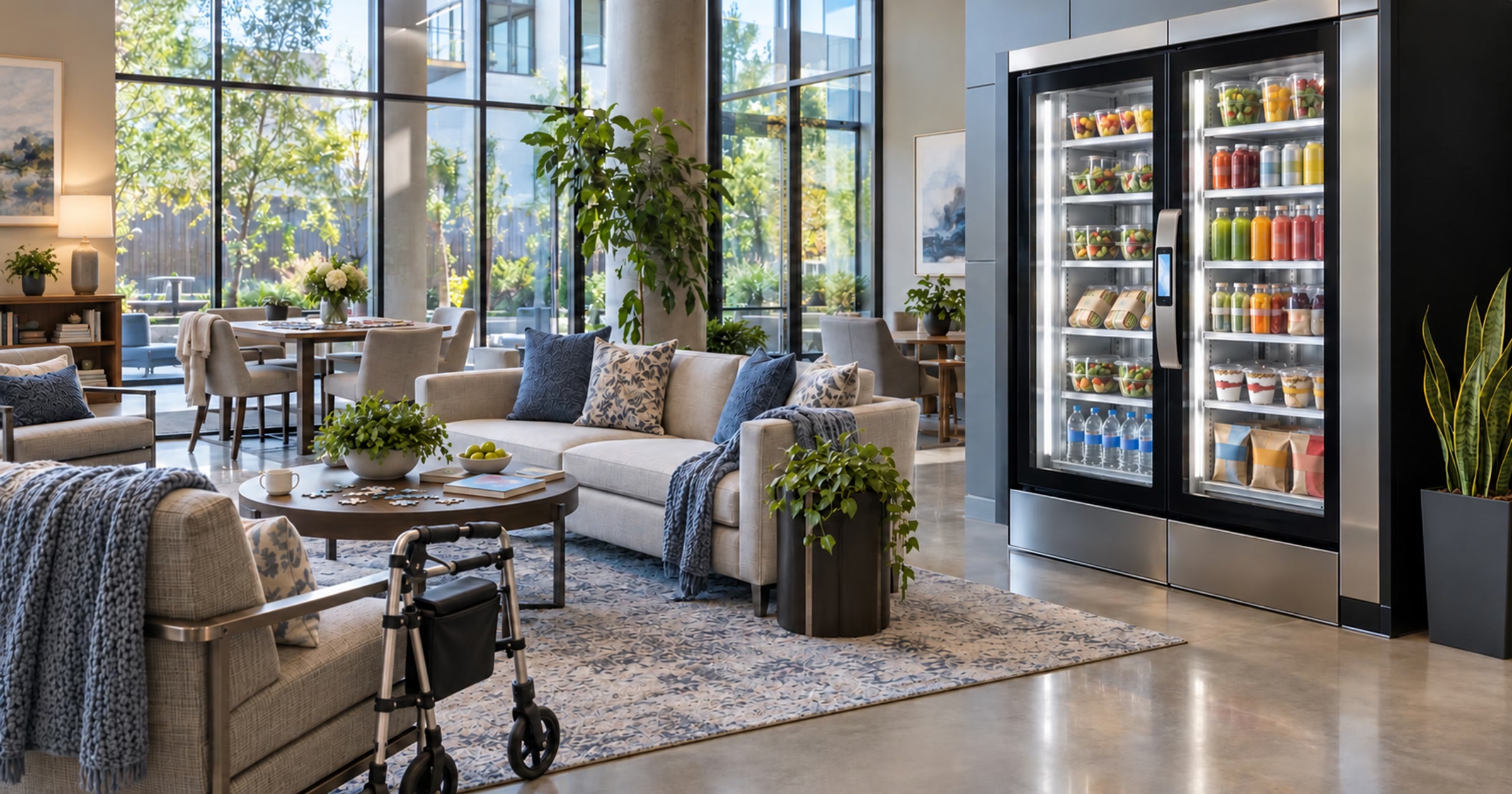
Start with the common area, not the machine
A cooler works best when it fits an established routine. Think about the lounge near the mailroom, the activity room used throughout the week, or the dining area people pass on the way back to their apartment.
The strongest location usually has three qualities:
- residents already pass through it;
- it is comfortable and easy to approach;
- staff can see that the area stays orderly without managing each purchase.
That last point is important. A refreshment amenity should not turn reception, maintenance, or activities staff into an unpaid vending crew.
The setup is also about dignity. The unit should feel like a normal part of the building, not a special-purpose station that calls attention to age or mobility. Check the aisle, lighting, and payment-interface height during the site review.
What should go inside the cooler?
The right mix depends on the property and the people using it. A senior-living community is not an office breakroom with softer chairs, so copying an office product plan is lazy.
Start with familiar options and clear packaging. Drinks, light meals, and everyday snacks usually make more sense than chasing novelty. Then use actual sales patterns to adjust the mix. If a category sits untouched, replace it. If a small group of items sells quickly, give those products more space.
The point is not to promise the perfect assortment on day one. The point is to create a stocked amenity that can improve as real purchasing behavior becomes visible.
We handle the inventory work after installation. That covers product replenishment, payment systems, and routine machine service. Building staff should not be counting cans or troubleshooting a card reader between resident requests.
Cashless should still feel straightforward
Modern payment is useful only when it is easy to understand.
A senior-living installation needs a simple transaction flow, a readable interface, and clear contact information if something goes wrong. Tap-to-pay can reduce the friction of coins and bills, but the screen and prompts still have to make sense at a glance.
That is why hardware selection belongs inside the site plan. Door weight, shelf visibility, and screen position all affect how comfortable the experience feels. Lighting and floor clearance matter too.
Some communities may also want staff or family members to help residents understand the system when it first arrives. A short introduction can do more than a wall of instructions. After that, the machine should be simple enough to stand on its own.
The operating model is the real amenity
Buying the hardware is easy. Running it well is not.
Someone has to choose the products, monitor sales, and refill the unit. Slow sellers must be replaced, while hardware problems require a response. If those responsibilities fall back on building staff, the “amenity” becomes another operational burden.
Our model is different. For qualified Austin-area locations, we install and operate the cooler, typically at no cost to the property. We manage the assortment, transaction system, and ongoing upkeep.
Site fit still matters. Resident count, foot traffic, and access all affect whether a location can support the program. We review those details before making a recommendation. A clean no is better than forcing a machine into a corner where nobody will use it.
What the announcement signals
The City of Austin’s announcement is about affordable housing for adults 55 and older. It also reflects a broader reality: new residential properties are being asked to support daily life inside the building, not just provide four walls and a parking lot.
A stocked cooler will not define that experience. It can, however, remove one small piece of friction when the nearest convenient food or drink option is outside the building.
For property managers, that makes the buying question fairly simple: will residents encounter the unit naturally, and can a local operator keep it useful without creating work for staff?
If both answers are yes, the placement is worth exploring.
A practical site review
Before recommending equipment, we look at how the building actually works.
Where do residents spend time? Which common area stays active beyond scheduled events? Can a delivery person reach the unit without disrupting the building? Is there enough clearance to browse, pay, and open the door comfortably? Will the placement still make sense during evenings and weekends?
Those details are more useful than a glossy amenity checklist. A unit hidden beside a service corridor may look tidy on a floor plan and fail in real life. A visible placement near a trusted common area gives the service a much better chance.
We also look at the expected product mix and service rhythm. A smaller community may call for a focused assortment. A busier property may support more variety. Either way, the plan should match the site instead of treating every building as interchangeable.
The Austin advantage
Local service matters when the machine is part of residents’ daily routine.
Revvolto is Austin-based. We can review the property, recommend the right format, and manage the unit without routing every question through a distant national queue. That does not mean promising perfection. It means having a clear local operator responsible for the result.
For senior-living properties considering a new refreshment amenity, the best first step is not choosing a machine from a catalog. It is walking the building and identifying where convenience, visibility, and local operations can meet.
If you manage a senior-living property in the Austin area, we can evaluate the location and tell you plainly whether this type of cooler makes sense.
Sources
- City of Austin Housing Department: New affordable 55+ community, Arbor Park, opening in Northwest Austin
- Revvolto service model: inventory management and cashless transactions, plus equipment upkeep for qualified locations. The service is typically provided at no cost to the property.



