
Austin office buildings are not back to one simple pattern, but they are busy enough that break access deserves a real look again.
Opportunity Austin’s September economic indicators report said the Austin office market posted 1.4 million square feet of positive net absorption, with vacancy down from the same time last year. The same report said the region added 23,800 jobs year over year through July 2026. That does not mean every building is full. It does mean property teams and employers should stop treating food access like an afterthought that can be solved by a coffee pot and a drawer of stale granola bars.
Smart vending gives Austin business parks a practical middle lane. It can support short breaks and late work blocks in the rooms people already use. That matters because the alternative is usually asking a front desk or facilities team to run an accidental snack program.
Office activity changes the break path
A business park does not have to be packed every day for food access to matter. The harder question is when people are on-site, where do they actually pause?
In many office buildings, the answer is not the lobby. It is the hallway between meeting rooms, the tenant lounge near the coffee bar, or the break area people pass when they are trying to get back to a call in ten minutes. If the nearest food option means leaving the building, people will skip it. A parking-lot trip is too much friction for a short break.
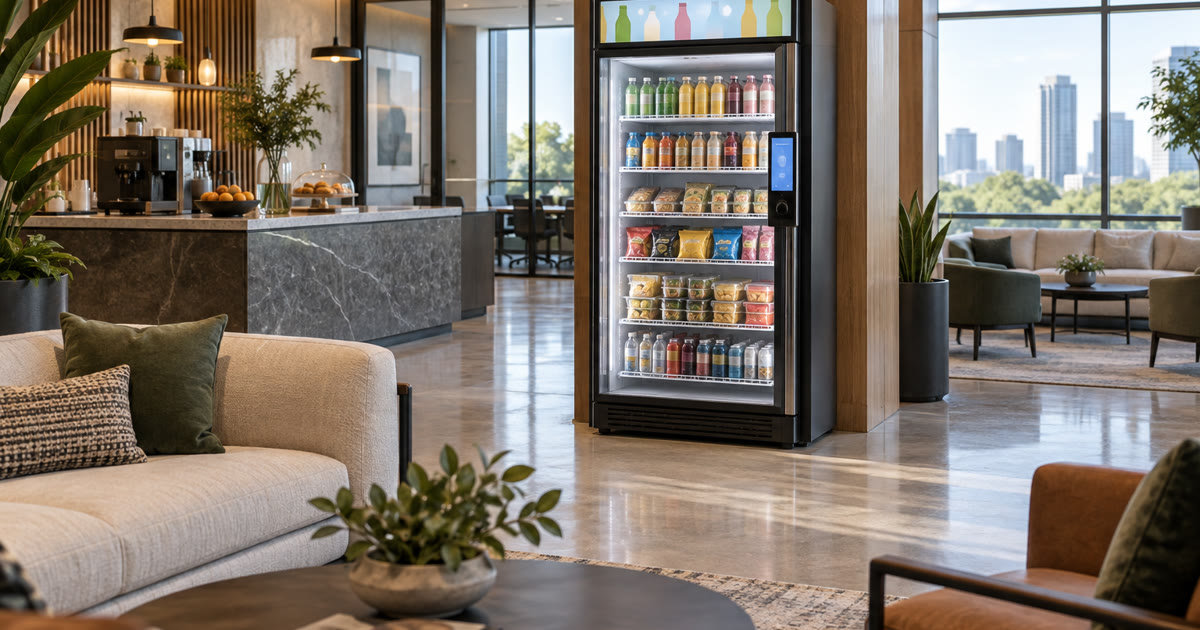
That is the gap a modern smart vending setup can fill. A glass-front cooler or smart fridge can sit inside the normal movement path and give people a cashless way to grab drinks, snacks, and fresh items. The point is not to replace lunch. The point is to make the small in-between moments easier.
For property teams, that matters because small amenities are judged in real time. Tenants do not usually complain because a building lacks a grand food hall. They complain because the place is inconvenient at 2:40 p.m., when the next meeting starts at 3:00.
Smart vending works when the room is planned
A smart vending machine is only useful if the placement makes sense. Put it in the wrong corner and it becomes furniture with refrigeration.
The best office and business-park placements usually start with traffic, visibility, and service access. People should be able to see the unit without hunting for it. They should be able to use it without blocking a doorway. We also need enough room to stock and service the machine cleanly, because a good amenity gets bad fast when the service path is ignored.
This is where smart vending beats the old “someone will handle snacks” plan. A stocked cooler needs an operator, a restock cadence, and payment support. If those pieces land on the tenant team by default, the amenity becomes one more small job nobody wanted.
Revvolto’s role is to take that work off the building team where the location qualifies. We install and stock the equipment on a regular cadence. We also support cashless payment and service. The property team still has to choose the right spot. They should not have to become the snack department.
The useful signal is not just job growth
Local growth data is easy to overuse. A chart says Austin added jobs, and suddenly every vendor wants to staple their pitch to it. That is lazy.
The better signal is physical occupancy pressure. When more work happens in office buildings and tenant spaces, the friction shows up in specific places. People rush between meetings. Facilities teams get pulled into small amenity complaints. Office managers buy emergency snack cases because the break area is always one step behind the day.
Opportunity Austin’s report is useful because it points to business activity returning to real buildings, not because it proves any single office needs a machine. Smart vending should be evaluated at the location level. Count the people. Watch the path. Look at the room. Ask who handles restocking if the current setup runs out.
If the answer is “whoever notices first,” the building has already made its case.
What to check before adding smart vending
Start with the break path, not the product list. The product mix can change. A bad location is harder to fix.
A strong business-park setup usually has three signs. People already pass the spot during the workday. The machine can be stocked without disrupting normal movement. The audience is large enough and consistent enough for a maintained grab-and-go program.
Then look at the operating burden. If your team is already managing tenant requests and access cards, adding snack inventory to the pile is a strange way to improve the workplace. Smart vending is supposed to reduce friction, not relocate it to someone with a spreadsheet.
The best version is boring in the right way. People see the cooler. They tap, grab, and get back to work. We handle the back end. The building gets a useful amenity without turning a staff member into the vending coordinator.
Austin’s office market is still uneven, and that is exactly why the placement question matters. Do not add amenities because a market report sounds optimistic. Add them when your building has enough daily movement, enough short-break demand, and a clear spot where food access would make the workday less annoying.
If your Austin-area business park or office building is reviewing tenant amenities, tell us about the location. We will help you figure out whether smart vending or a smart fridge fits the room.



