
Austin just gave facility planners a useful reminder: food access is not only a restaurant problem.
The City of Austin announced $102,000 in Food and Climate Equity Grants for 34 community-led projects focused on local food access and resilience. The grants are small. The signal is bigger than the dollar amount: when people gather in real buildings, food access becomes part of how that space works.
That matters for community centers, clinics, and shared staff spaces. If people are already coming to your building for a class or shift, the food question shows up somewhere. It may show up in the lobby. It may show up near the staff room. It may show up in the hallway where people wait longer than planned.
Smart vending in Austin works best when it starts with that map of movement.
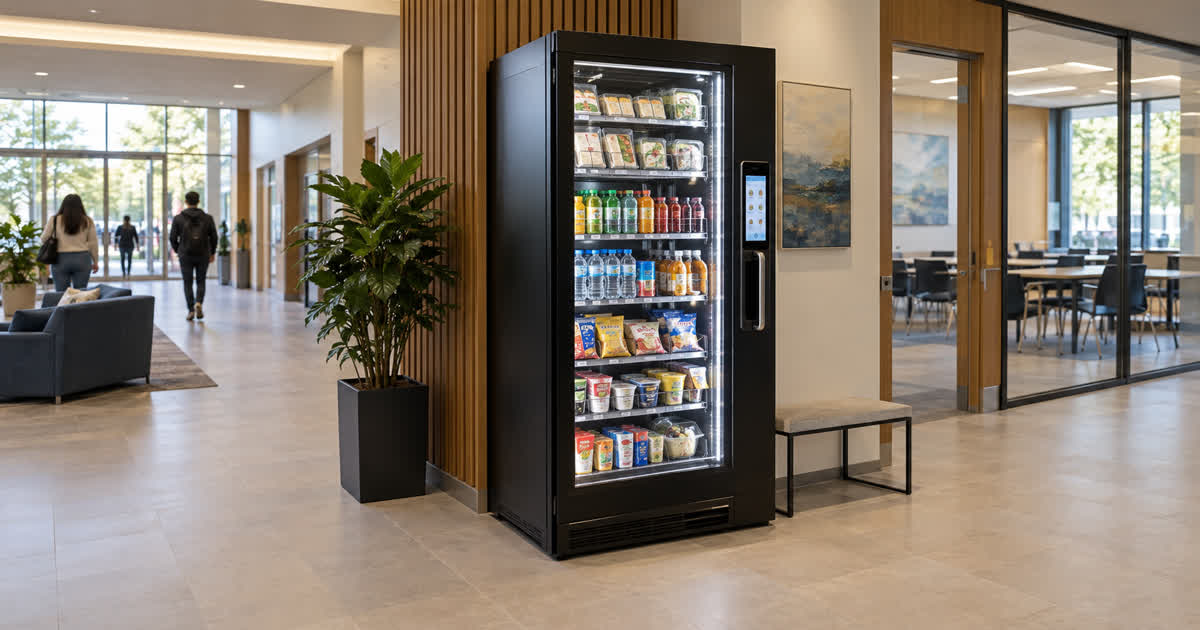
Food access belongs in the room plan
The City source is about community grants, not vending. That distinction matters. Revvolto is not connected to the FACE Grants program, the City of Austin, or any named funded group.
The lesson for building operators is still practical. Food access is easier to support when it is planned into the facility instead of patched around it later.
A community building can look busy on paper and still leave people without a realistic place to grab something during the actual day. Staff may have ten minutes between programs. Volunteers may arrive before nearby food options open. Visitors may wait through a class, intake process, or meeting block. In those moments, the useful amenity is not a giant market concept. It is a clean, compact, stocked point on the route people already use.
That is where smart vending and smart fridges fit. The unit is not there to turn the building into a store. It is there to make the waiting spot work better.
The best location is usually already obvious
Before you pick equipment, watch how people move.
Where do they stop when they come in? Where do employees pass between rooms? Where does a line form when one meeting ends and the next one starts? Where can service happen without blocking a doorway?
Those questions beat a pretty floor plan. A vending machine placed in a dead corner is still a dead corner. A smart fridge near a real staff route can serve people without asking staff to become snack managers.
For community-serving buildings, the placement test is simple. The unit should sit close enough to the natural route that people see it, but far enough from the front desk that it does not create another interruption point. It should have room for the door to open. It should have room for restock visits. It should not crowd accessibility routes or make a narrow hallway worse.
None of this is glamorous. Good building operations rarely are. But it is the difference between an amenity people use and a shiny box everyone walks past.
Stocking matters more than novelty
Food access does not improve because a machine has a screen.
The screen helps with cashless payment and user flow. The real value is a maintained assortment that fits the audience and the time of day. A staff-heavy location may lean toward cold drinks, quick meals, and practical snacks. A community program space may call for simple grab-and-go options that work during afternoon and evening activity windows. A training room may need different choices than a reception area.
The point is not to guess once and hope. Smart vending works when purchase data, restock patterns, and service visits keep tightening the assortment over time.
That is also where the workload question gets honest. A building team should not have to chase inventory or handle cash. It should not have to call around for repairs or clean up a half-managed snack shelf. If the amenity creates more work than it solves, the building got the wrong version of convenience.
Revvolto handles stocked smart vending and smart fridge programs for qualified locations. We manage stocking and service. Our team also supports payment tech so your team is not stuck owning another back-office chore.
Use the local hook as a facilities prompt
Austin’s FACE Grant announcement names food access as part of a broader resilience conversation. Facility teams can use that as a prompt without pretending every building is running a public food program.
Ask a narrower question: where does your building already create waiting time, staff movement, or after-hours friction?
A community center has program turnover. A clinic has staff break timing. A nonprofit office has volunteers coming in around meetings. A campus building has study and event traffic. Different settings, same operational test: people need practical food and drink access near the paths they already take.
Smart vending is not the answer for every site. It works when there is enough consistent use, a logical placement point, and a service path that lets the operator keep the unit stocked without getting in the way.
If those pieces line up, the amenity can feel almost boring in the best way. People see it. They use it and move on with their day.
Build around the real route, not the pitch
The wrong way to add vending is to start with equipment specs.
Start with the real route. Stand in the building at the time people actually use it. Watch the doorways, the staff route, and the rooms that run long. The vending plan gets clearer fast.
Then ask the practical questions. What can fit here? What should be cold? Who restocks it? How does service reach the unit? What happens when activity runs past normal food options nearby?
That is the buyer question behind smart vending in Austin right now. Not whether a building can squeeze in another amenity. Whether it can support food access in a way that respects the room, the people, and the team responsible for keeping the place running.
If your building has a real waiting spot or staff route, Revvolto can help you decide whether a smart vending machine or smart fridge belongs there. Tell us about the location at revvolto.com/contact-us.



