
A public Eventbrite listing for Community Co-working September 2026 described a two-hour East Austin coworking morning at Open House Austin. The format centered on laptop work and phone booths, with small-group rooms nearby and a coffee cart on site. That is not a Revvolto story. It is a useful local reminder: flexible workdays still create very physical pause points.
Revvolto has no affiliation with the listed coworking event or the organizations named in the listing. We are using the public listing as a local planning cue. When a shared work space invites people to settle in for a short block of focused work, food and drink access becomes part of whether the room works smoothly.
Coworking spaces are not just desks with better lighting. They are part office and part neighborhood stop, with meeting rooms folded into the day. That mix changes the food access question. A smart vending machine or smart fridge should support the way people already move through the space, not make the team run a snack counter on top of everything else.
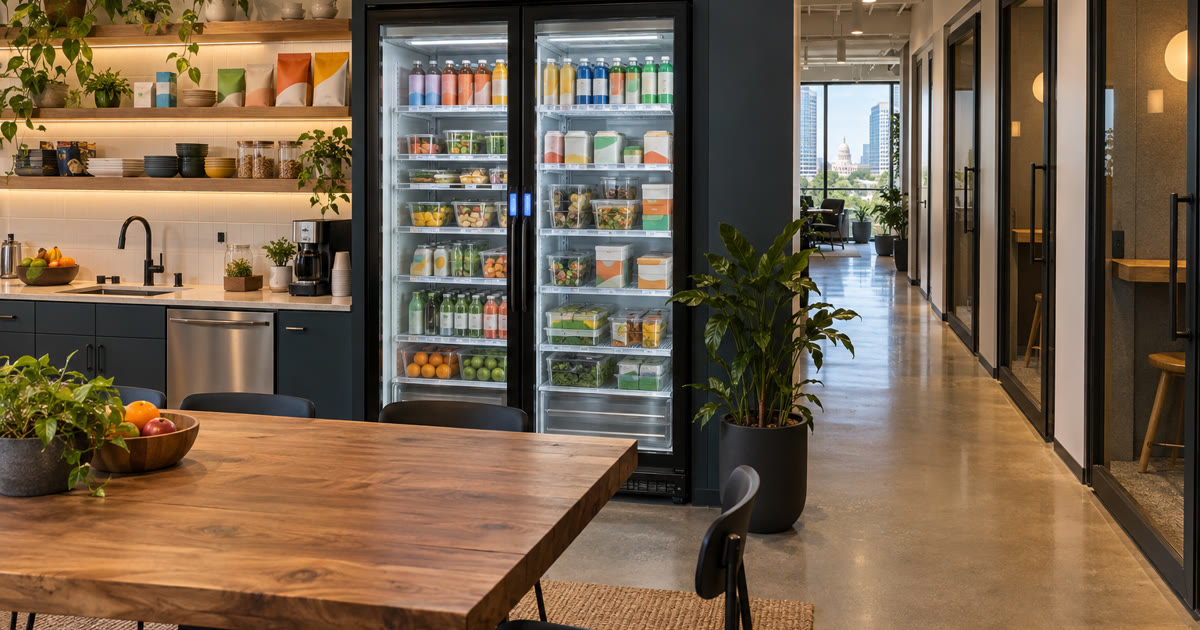
Coworking mornings create short pause paths
The Community Co-working September 2026 listing described an in-person morning where people could bring a laptop and use open working space. It also mentioned phone booths, small rooms, and flexible arrival. That pattern is familiar across Austin’s flexible work scene. People arrive with a task. They take calls. They meet someone between work blocks. Then they look for a drink or quick bite without wanting to leave the room.
That is the pause path Revvolto cares about.
In a coworking setting, the useful vending location is rarely the most decorative corner. It is the point between work tables, meeting rooms, and the coffee area. If someone has to cross the whole building for a cold drink, the amenity feels bolted on. If the unit blocks a small room entrance, it creates friction. If the offering relies on staff attention, the convenience starts borrowing time from the people managing the space.
Smart vending works better when the location matches the rhythm. A compact smart fridge near the kitchen wall can serve quick breaks. A larger smart cooler can fit a shared lounge if the service route is clean. A micro market style setup can make sense when the room has enough traffic and enough square footage. The point is not to install more hardware. The point is to place the right format where people already pause.
The coffee cart is a clue, not the whole answer
The event listing mentioned a coffee cart pop-up. For a two-hour coworking morning, that detail makes sense. Coffee gives people a reason to settle in, talk for a minute, and keep working. But permanent or recurring shared work spaces usually face a broader food access question than coffee alone can solve.
People do not all want the same thing at the same time. Some want something cold. Some want a snack between calls. Some want a simple meal option because leaving breaks the work block. The wrong setup turns that into a collection of little interruptions. Someone restocks a shelf. Someone answers payment questions. Someone cleans up after a half-planned snack area.
That is where smart vending and smart fridges earn their keep. The unit should be cashless, easy to use, and stocked on a regular cadence. The service owner should be clear. The product mix should be adjusted over time instead of guessed once and forgotten. Revvolto handles stocking and restocking for qualified locations. Payment technology and maintenance stay with us too, which keeps the amenity from becoming another job for the workspace team.
The best coworking food setup does not compete with coffee. It supports the moments coffee does not cover. Cold drinks, packaged snacks, and simple grab-and-go items can keep the room useful between meetings without asking anyone at the front desk to become the snack sheriff.
Shared work spaces should avoid snack-duty creep
Flexible work spaces tend to look simple from the outside. Open tables. A few phone booths. Good Wi-Fi. Maybe a kitchen. The operational reality is less cute. Every shared amenity has an owner, whether anyone names that owner or not.
If the workspace buys snacks itself, someone has to choose the items. If a shelf runs low, someone notices. If payment is informal, someone reconciles it or ignores the mess. If guests ask where to find food nearby, the question lands on the same people already handling access and room setup. Community flow gets pulled into it too.
That is snack-duty creep. It sounds small until it becomes part of the weekly routine.
A smart vending machine or smart fridge gives the space a cleaner operating model. The unit can sit near the real break path, take cashless payment, and stay stocked without turning the community team into an inventory crew. For Austin coworking spaces and creative studios, that matters because the team’s real job is keeping the environment useful. Small business hubs face the same issue. Food access should help, not hijack the day.
This also keeps the experience more consistent for visitors. Someone dropping in for a two-hour work block may not know the neighborhood. A member between calls may not want to leave. A small team using a meeting room may want food access without making a catering decision for every session. Smart vending gives the building a middle option: more dependable than a forgotten snack basket, less complicated than operating food service.
Austin’s local work scene rewards practical amenities
Austin’s work culture keeps changing. Some teams are fully remote. Some rotate through coworking rooms. Some small businesses use flexible spaces because the lease math is cleaner than a traditional office. That means the food access problem follows people into smaller, more flexible environments.
The buyer question is practical: can the space support people for the length of time they are actually there?
For a quick meeting, coffee may be enough. For a half-day work session, a stocked smart fridge starts to matter. For a busy shared workspace with member traffic, a smart vending cooler or compact micro market may be the better fit. The answer depends on room layout and audience. Service access and daily use matter just as much. That is why the site review matters more than generic amenity talk.
Revvolto can help qualified Austin-area locations add modern cashless vending, smart fridges, or micro market formats without making the building team manage the whole thing. We look at traffic and placement before recommending a setup. Service access and product fit shape the answer too.
The local hook is not that every coworking event needs a vending machine. That would be lazy. The real point is sharper: whenever Austin spaces invite people to stay and work, food access becomes part of the experience. Meetings and short tasks only make that more obvious. Plan it around the pause path, and the amenity feels natural. Ignore it, and someone eventually inherits snack duty.
If your Austin workspace or studio is trying to support longer visits without adding more operational work, tell us about the location at revvolto.com/contact-us.



