
Austin keeps adding places where small teams work in more flexible ways. Some are coworking rooms. Some are office and warehouse suites. Some are business parks built for makers, service companies, and early-stage operators that are not ready for a traditional standalone facility.
That changes the food-access question.
A flex workspace is not a normal office breakroom. People come in at different times. They share rooms, meet customers, and move between office work and hands-on work. If the only food option is to drive somewhere, the building has already lost part of the break.
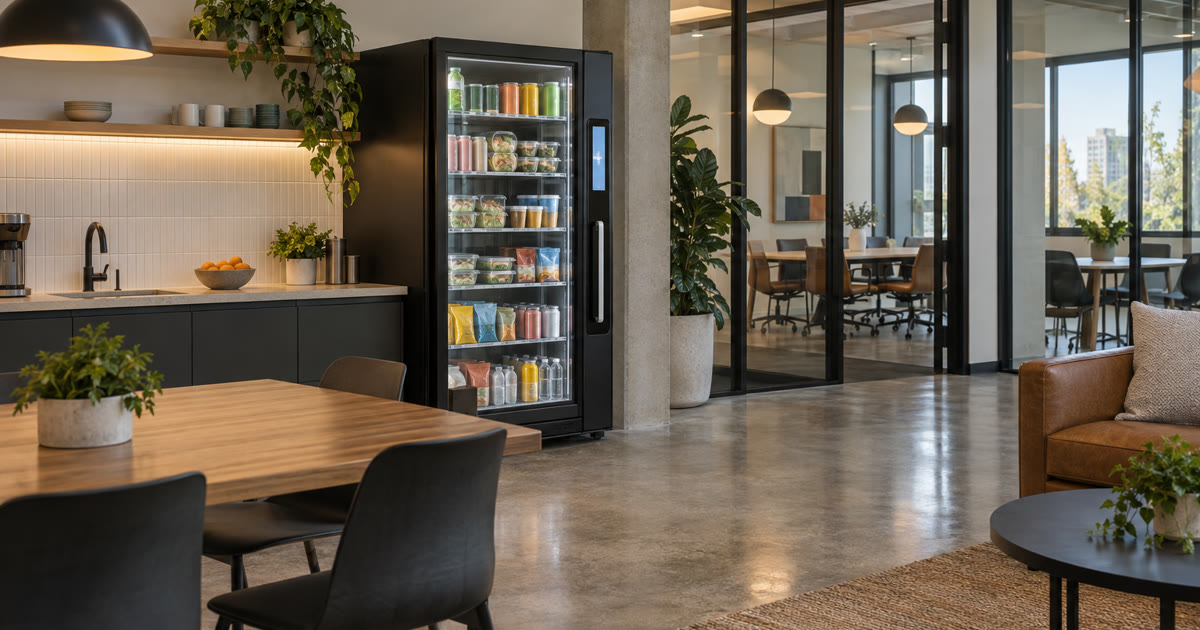
That is where smart vending Austin planning gets practical. A smart cooler or smart fridge is not just a snack box in the corner. In the right shared space, it becomes part of how people move through the building.
Why this local flex-workspace hook matters
WorkHub’s Pflugerville page describes a pre-leasing business park at 19241 Wilke Lane with 36 office and warehouse suites across 71,527 square feet. Community Impact has also reported on Central Texas space options for small businesses. The story points to coworking and co-warehousing as part of that mix.
Revvolto has no affiliation with the named local sources or organizations. The useful point is the building type.
Flex workspace combines people who use space differently. One tenant may run meetings. Another may pack products. Another may use a small office as a base between field work and customer visits. Shared amenities have to work for all of them without turning the front desk, property team, or office manager into the snack department.
That is why food access belongs in the floor-plan conversation early. If a smart vending machine is added after the main paths and seating areas are already fixed, the location can become an awkward compromise. If it is planned with the tenant path in mind, it can support the building without getting in the way.
Put the cooler where people already slow down
Good placement starts with behavior, not with the prettiest empty wall.
In a flex workspace, the strongest stopping point is usually close to a shared kitchen or tenant lounge. People are already slowing down there. They are checking messages. They are waiting between appointments. They are grabbing coffee before heading back to work.
That moment matters. A smart fridge near the right route lets someone grab a drink or quick meal without leaving the property. It also keeps the amenity visible enough to become part of the daily routine. Tucked behind a low-traffic corner, the same machine can feel like an afterthought.
The service path matters too. Revvolto has to stock and maintain the unit. If the machine blocks a door or competes with deliveries, the placement creates friction for everyone. The better setup gives people easy access and gives service teams a clean route.
That is the real placement test: can tenants use it naturally, and can the operator service it cleanly?
Shared buildings make service ownership clearer
Shared spaces can make snack duty weird fast.
Nobody wants to decide who refills the fridge or who handles payments. Nobody wants stale inventory turning into an awkward shared-building problem. The more mixed the building is, the faster that little amenity becomes someone else’s unpaid job.
Smart vending changes the ownership model. Revvolto installs the equipment in qualified locations and keeps stocking, payment tech, and service on our side of the line. The building gets a modern grab-and-go option without creating another internal errand.
That is especially useful in flex workspaces because the audience is not one tidy department with one schedule. A tenant may arrive early for a call. Another may work late after deliveries. A visitor may have ten minutes between meetings. A shared food option has to work without waiting for a staffed counter or a breakroom manager.
The building still has to qualify. Traffic and placement matter. Product fit and service access matter too. But when the fit is right, the value is simple: your team supports food access without becoming the food operator.
What to check before adding smart vending
Start with the path. Where do people already pause, and where do they avoid stopping?
Then look at the room around the machine. A smart cooler needs enough visibility to be used, enough breathing room to feel intentional, and enough service access to stay practical. It should not make the shared kitchen cramped. It should not sit where deliveries fight the same floor space. It should not force people to stand in the middle of a doorway while deciding what to buy.
Product mix is the next question. Flex-workspace users are not all eating the same thing at the same time. Drinks, quick meals, and simple snacks usually carry more value than a random shelf of impulse items. The mix should reflect the building’s rhythm, not a generic vending plan copied from somewhere else.
Payment also matters. Cashless access makes more sense in a shared tenant environment, especially when people are moving quickly and the building is not staffed like a retail counter.
The final check is maintenance. If the machine looks good on day one but creates problems in week three, the placement failed. The right setup lets Revvolto service the unit without making the property team chase inventory, repair tickets, or payment issues.
The buyer takeaway
Austin flex workspaces are built around shared resources. Food access should follow the same logic.
A smart vending machine, smart fridge, or compact micro market works best when it fits the building’s actual tenant route. Put it where people already slow down. Give it a clean service route. Match the product mix to the users who actually move through the space.
That is how a small footprint can do real work. It supports tenants, keeps breaks inside the building, and gives property teams a cleaner answer than stocking snacks themselves.
If you are planning a flex workspace or shared tenant amenity area in Austin, we can help review whether smart vending belongs in the layout. Tell us about the location at revvolto.com/contact-us.



