
Austin has another long public-service day on the calendar.
The City of Austin announced its 2026 Fair Chance Hiring Job and Resource Fair for September 30 at the Permitting and Development Center. The event is designed to connect job seekers with employers and community resources in one place.
That local hook matters beyond the event itself. Any building that brings people together for appointments and resource navigation has the same quiet operational question: where do people get something to drink or eat without pulling staff away from the work they came to do?
That is where smart vending belongs in the planning conversation.
Long civic days create food-access friction
A job fair is not a normal lobby day.
People arrive early. Some wait between conversations. Staff and employers stay on site for hours. Community partners may not have time to leave the building. The pressure is not dramatic, but it is real enough to shape the day.
If food access is an afterthought, the building usually falls back on weak options. Someone sends people off site. Staff point visitors toward whatever is nearby. A team member becomes the unofficial snack person. None of that is a crisis, but it is still friction.
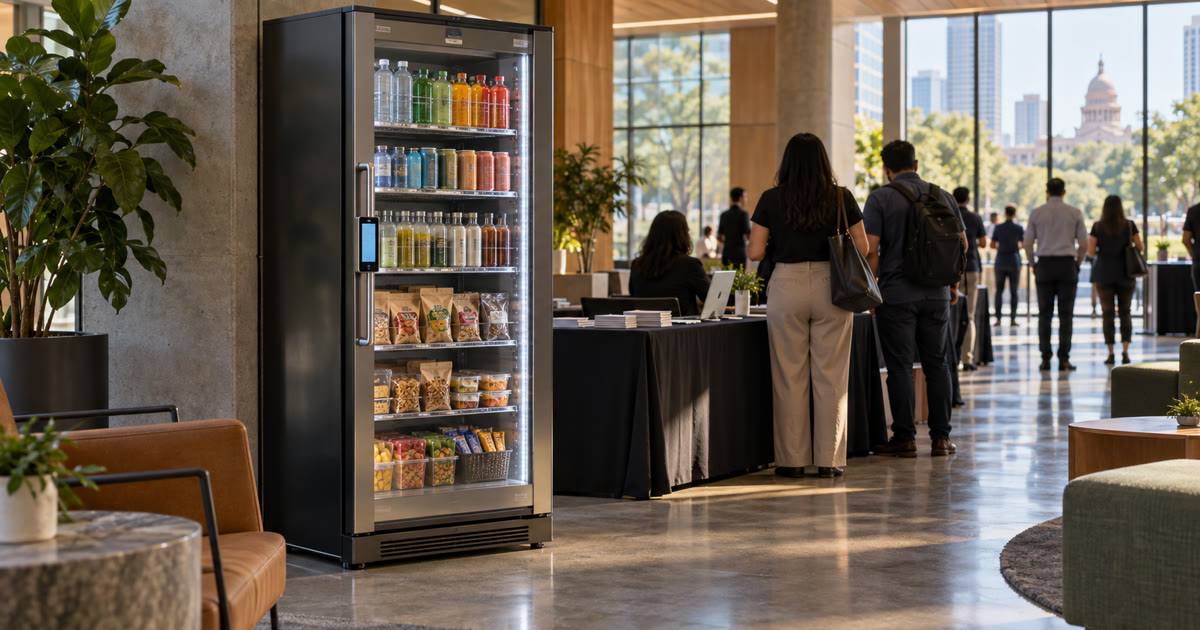
Smart vending gives civic and workforce-event teams another option. A clear glass smart cooler or smart vending unit can sit near the pause path where people already slow down. The right placement supports visitors and staff without turning the event team into a mini food-service crew.
The point is not to make every public building feel like a store. The point is to support the work already happening inside the building.
The best placement is near the pause path
For resource fairs and hiring events, the best vending location is rarely the loudest part of the room.
Registration tables need space. Interview areas need a calmer feel. Main walkways need to stay clear. A smart vending unit works better near the edge of the activity, close enough to be useful but not so close that it crowds the flow.
A good site walk should look for three things.
First, where do people naturally wait? That might be near check-in, outside a meeting room, or beside a seating area.
Second, can the unit be serviced without interrupting the event? Restocking should not cut through the busiest line.
Third, does the location feel obvious without becoming visual clutter? People should see the option without needing a map or a staff explanation.
That is the difference between adding a useful amenity and dropping a machine into the first open wall space.
Service ownership matters more than the machine
The hardware gets the attention. The operating model is what decides whether the amenity stays useful.
A civic team or workforce partner may like the idea of on-site food access. That does not mean they want to manage product buying, payment support, and maintenance.
That is the buyer question smart vending should answer clearly: who owns the work after the unit is installed?
Revvolto is built for that handoff. We stock and maintain modern cashless smart vending and smart fridge setups for qualified locations. The building gets a more useful food-access point. The internal team does not inherit a snack operation wearing a nice glass door.
For long public-service days, that matters. The team should be focused on the event, the visitors, and the work in front of them.
Austin workforce events are a planning signal
The City announcement is not a reason to imply Revvolto is connected to the event. We are not.
It is a useful planning signal for Austin buildings that run long service days. Hiring fairs and permit appointments create similar movement patterns. People arrive with a purpose. They wait. They move between tables or rooms. Staff stay planted for long stretches.
If the only food plan is “people can leave if they need to,” the building is asking visitors and staff to solve a problem the layout could have handled better.
A smart cooler or vending machine will not fix bad event planning. But it can remove one small source of friction from a day that already asks people to manage schedules and paperwork.
That is a practical use case. Not flashy. Not overbuilt. Just useful.
What to check before adding smart vending
Before adding smart vending to a civic or workforce setting, start with the building path.
Walk the route a visitor takes from entrance to check-in to waiting area. Then walk the route staff use during setup and break periods. If those paths never pass the same spot, the vending location has to choose a primary job.
For public-facing events, keep the unit easy to see but out of the main line. For staff-heavy days, place it closer to the break path. For mixed-use civic buildings, the best location may support ordinary staff use on normal days and event traffic on busier ones.
The product mix should match the setting. Cold drinks, simple snacks, and grab-and-go items usually make more sense than anything complicated. The payment experience should be cashless and simple. The service route should be clean enough that restocking does not become its own disruption.
That is the real lesson from Austin’s local workforce-event calendar: food access works best when it is planned before the busy day arrives.
If your Austin-area building runs long public-service days or resource fairs, Revvolto can help you decide whether a smart vending machine or smart fridge belongs in the path. Tell us about the location at revvolto.com/contact-us.



