
Austin Public Library is preparing a full-day Centennial Party at Central Library on October 17, according to the Austin Chamber and the Library Foundation. The public notice points to music, family programming, and arts activity across the building.
That kind of public gathering raises a practical building question: where do people get a drink or quick snack without turning the information desk into a refreshment counter?
This is not about turning a library into a store. It is about planning refreshments around the way people already move through a civic building. A modern self-service cooler can fit that job when it is quiet, visible, and easy to manage.
Public gatherings create short break moments
A normal library visit has a rhythm. People arrive, browse, and leave after a program. A full-day celebration changes that rhythm. Visitors stay longer. Staff move between rooms. Families step out of activities. Volunteers and partners get short gaps between sessions.
The Austin Chamber notice points to a 10 a.m. to 5 p.m. celebration at Central Library. That is a long window for any public building. Even when outside food vendors or nearby restaurants exist, people still look for easy options inside the building during short gaps.
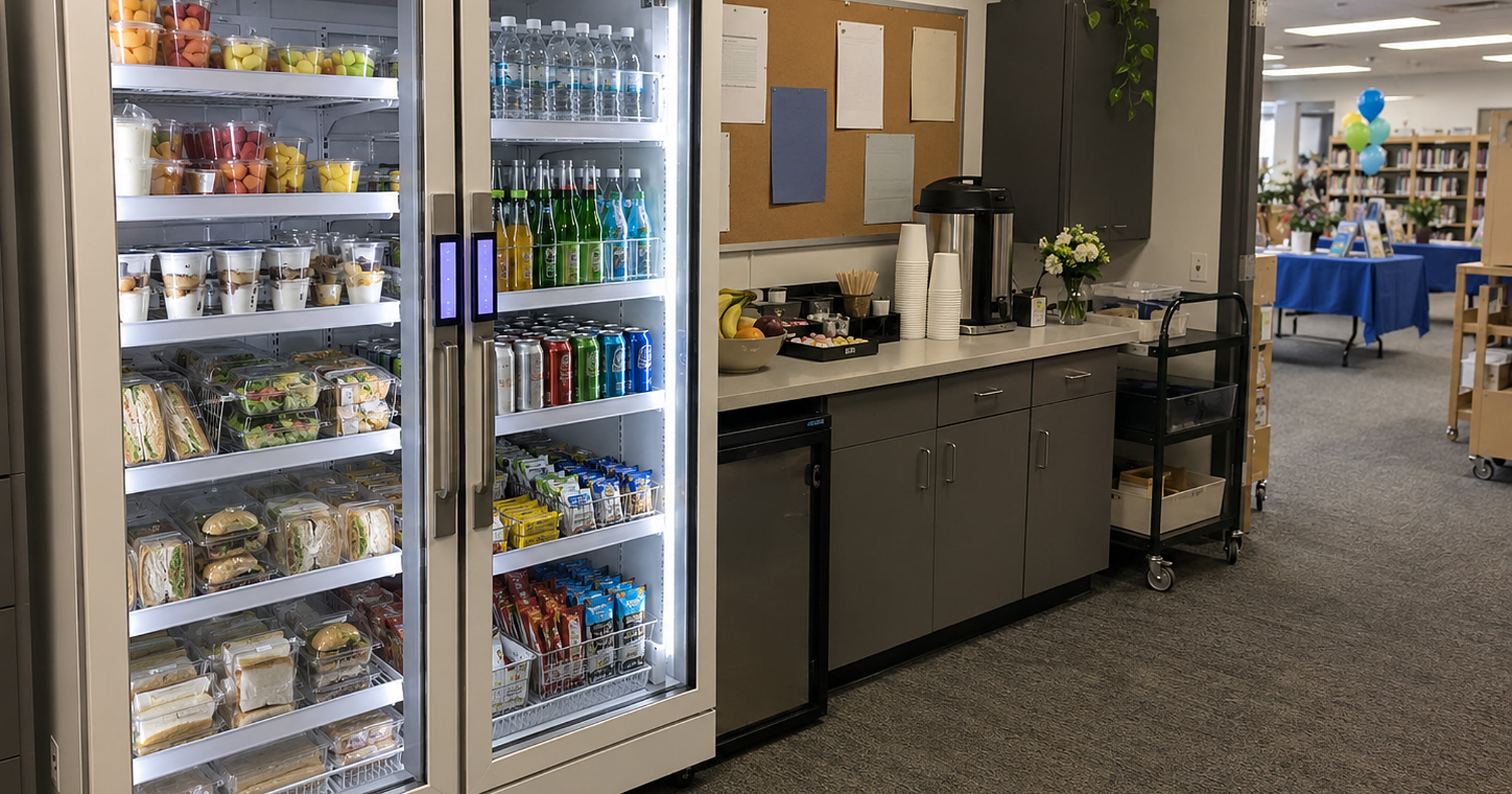
Those gaps are where a cashless cooler can help. A clear glass unit near a lobby route or staff area gives people a simple option without asking staff to run a snack table. Cashless payment also keeps the setup cleaner than a cash box or volunteer-managed cooler.
The buyer question is not “can we add snacks?” The better question is whether the building has a natural place for self-service that does not block circulation, confuse visitors, or create another job for the counter team.
Placement matters more than the machine
A public building has different pressure points than a private office. The best location is rarely the busiest possible spot. It is the spot where people can stop briefly without creating a line in the wrong place.
For a library or civic building, that could mean a cafe-adjacent wall or a staff support room. It could also be a public corridor that already handles short waits. It should not sit where people need staff help or where event check-in already has enough traffic.
The unit also has to look like it belongs. Full-glass coolers work better than old-school vending boxes in civic interiors because people can see the product mix before opening the door. A clean, modern unit also makes the amenity feel intentional instead of temporary.
Restock access matters too. If a service visit requires moving through a crowded program space, the location is wrong. The right spot gives Revvolto room to stock and clean the unit without interrupting the building’s main activity.
Staff counters should not become snack counters
Public-facing teams already answer directions and room questions. They handle lost items too. Adding food questions to that pile is how a small amenity becomes an operational nuisance.
Self-service refreshments work best when ownership is clear. We stock the unit, handle payment technology, and take care of maintenance. Your staff should not be buying cases of drinks or taping up price signs. They should not have to explain where the granola bars went.
That matters during a full program day because the pressure comes in waves. A session ends, people step into the corridor, and everyone has five minutes before the next thing starts. A stocked cooler can absorb that moment more cleanly than a staffed table.
It also helps between gatherings. Civic buildings and community rooms often have quiet periods followed by sudden traffic. A smart fridge setup can sit ready for both patterns without asking staff to predict every rush.
The product mix should match the building
A library celebration does not call for a stadium concession stand. The better fit is simple: cold drinks, light snacks, and a few grab-and-go food items that make sense for longer stays.
That product mix should stay general. No health promises. No special dietary claims unless the products and labels support them. No made-up local partnership language. The point is convenience, not a fake wellness program.
A modern vending setup also gives the operator room to adjust. If drinks move faster than snacks, the assortment can change. If celebration traffic behaves differently from normal weekdays, stocking can respond. That is more useful than guessing once and leaving the building with a stale shelf.
The practical test is simple: does the amenity reduce friction without becoming the center of attention? If yes, it is probably in the right place.
What Austin civic buildings should check first
Before adding a self-service cooler to a public building, walk the space during a real program day. Watch where people naturally stop. Watch where staff already get interrupted. Watch where a restock visit could happen without turning into a parade through the program room.
Then check the basics in plain terms. Is there power? Is there enough walking space? Can the unit be stocked without disrupting the room? If the answer is yes, the setup may be smaller and quieter than people expect.
The Central Library celebration is a good reminder that public buildings are movement systems. People arrive, wait, and gather before leaving. Refreshments should fit that movement instead of fighting it.
If your Austin-area building has full-day programs or staff areas that could use a cleaner refreshment plan, Revvolto can help you test whether a modern vending cooler or smart fridge belongs in the layout. Tell us about the location at revvolto.com/contact-us.



