
Austin is asking residents for feedback on planned mobility hubs. The City describes them as community spaces that connect travel options with public-realm amenities. That is not a vending story by itself.
But it is a useful signal for property teams.
When movement changes outside a building, the small decisions inside the building start to matter more. Someone arrives early. A resident comes in after a commute. A contractor ends up waiting near the lobby. A worker wants a cold drink without leaving again.
That is where **smart vending Austin** planning gets more interesting than simply “put a machine somewhere.” The better question is where grab-and-go belongs when a building lobby starts doing real daily work.
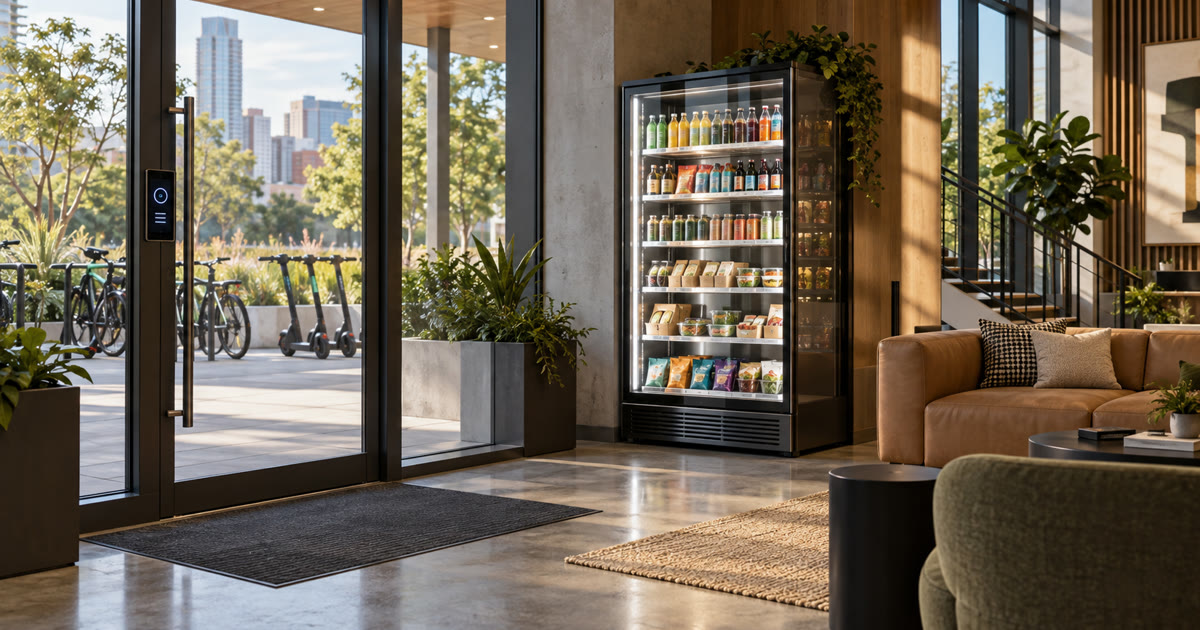
Mobility planning changes how arrival rooms get used
The City of Austin’s Mobility Hub Survey describes mobility hubs as places that connect public and private transportation options with amenities such as seating and shade. Revvolto is not connected to that project, and this is not a claim about serving those public hubs.
The useful takeaway for private buildings is simpler: Austin is thinking harder about how people move.
For an office or mixed-use property, the lobby may no longer be just a door. It can become a waiting spot, a meeting point, or the room people cross between errands. If the room has daily traffic but no convenient food option nearby, the building often pushes small interruptions onto people or staff.
A modern cooler can work well near that kind of area if the placement is planned carefully. It should be easy to find without crowding seating. It should also leave room for refills.
That sounds obvious. A lot of bad amenity decisions fail exactly there.
The grab-and-go decision belongs before furniture is locked
Shared lobbies tend to get planned around furniture first. The seating looks right. The counter finds a wall. The package area gets its corner. Then someone notices that people still leave the building for a snack.
By then, the easiest vending spot may be the worst one.
Better planning starts with three plain questions:
- Can people see the unit without blocking the room?
- Can refills happen without dragging boxes through the main seating zone?
- Does the location have the power and clearance for a glass-front cooler?
Those questions do not require a giant buildout. They do require treating refreshments like part of the room instead of an afterthought.
For mixed-use properties, this matters even more. The same front-of-building room may serve office workers during the day and residents later. A compact smart fridge can fit that rhythm if the assortment and service routine match the actual traffic.
Austin buyers should plan around service
A busy lobby can make vending attractive. It can also make service messy if the unit is placed poorly.
Revvolto looks at more than visible foot traffic. The practical questions are about ownership. Who keeps products stocked? How does payment work? Where does the unit sit so refills are not disruptive? What happens when someone has a checkout question?
That is why a staffed pantry and a self-service cooler are not the same decision. A pantry can look warm on day one and become another task for the property team by week three. A managed vending setup should keep the experience simple for the building while Revvolto handles stocking and maintenance.
The right fit depends on the location. Buildings with steady traffic and a practical refill route are better candidates than spaces where a cooler would be hidden or awkward.
The point is not to chase every transportation update with a vending machine. The point is to notice when Austin’s movement patterns are changing and ask whether the building’s refreshment plan still matches actual daily use.
A better building amenity feels quiet, not flashy
The best placement near a mobility-heavy arrival room should not scream for attention. It should feel like it belongs there.
That means the machine has to look modern, the products have to match the audience, and the service burden has to stay off the property team’s plate. A glass-front cooler in the right lounge can feel natural because people already stop there, check messages, and decide whether they have time to leave the building.
For Austin properties near transit corridors or mixed-use centers, this is a practical planning question. If the lobby is becoming a daily transition space, refreshments should be part of the conversation before the layout hardens.
The same logic applies beyond mobility-heavy buildings. A lobby near tenant meeting rooms can create similar demand when the room becomes a natural handoff point. Residential amenity floors and shared workspaces can do the same.
There is also a brand signal here. A tired vending box near the door makes the whole room feel like an afterthought. A clean glass-front cooler with the right product mix feels intentional. It tells visitors and daily users that the building noticed real movement through the space. That is not glamorous. It is just the kind of detail tenants remember.
Revvolto helps qualified Austin-area locations add modern smart vending, smart fridges, and compact micro market options. Revvolto stocks and maintains the setup, typically at no cost to the location.
If your building has steady daily traffic and the lobby is doing more work than it used to, tell us about the location at revvolto.com/contact-us.



