
Austin just put fresh attention on small business growth. The next question is more practical than most planning decks admit: when people come together for a long working session, where do they actually get a drink or snack without leaving the building?
The City of Austin announced on September 24 that City Council approved new support for small businesses. The announcement covers financing support and a future pitch competition with The University of Texas at Austin McCombs School of Business. The point of those programs is capital access, not vending. Still, they point to a familiar building problem. Small business support is not only paperwork. It often happens in rooms where people spend real time.
That is where smart vending and smart fridges become a facilities decision instead of a snack afterthought.
Small business support creates real pause points
A funding workshop or pitch-practice day does not feel like a retail store. It feels more like a temporary workplace. People arrive early and stay focused when the room supports the whole session.
Austin Economic Development described the new capital programs as a way to give entrepreneurs more options to start, stay, and grow in Austin. That kind of support usually brings people into business-support spaces for real working sessions. The building may not be a restaurant. The people inside still need basic food and drink access.
That matters because the food-access question is usually solved too late. Someone adds a coffee table. Someone orders a case of bottled water. Someone points visitors toward the nearest convenience store. None of those options answers the daily operational question: who keeps the area useful and clean without giving staff another errand?
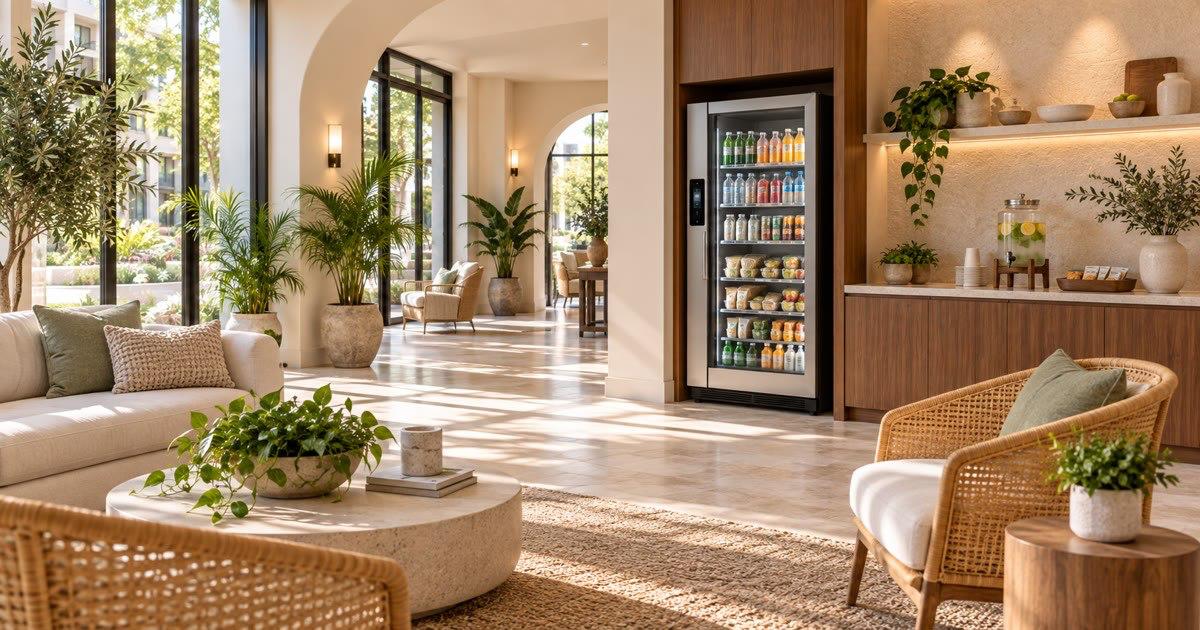
A smart vending machine or smart fridge gives the building a quieter answer. It can sit near the natural pause path. It can support cashless purchases. It can carry simple grab-and-go items without turning the space into a staffed concession point.
The best location is not always the front door
For small business resource spaces, placement matters more than novelty. The best machine is usually near the pause path, not the most dramatic wall.
Think about where people naturally slow down. That might be outside a meeting room. It might be near a check-in desk. It might be by the coffee area, elevator bank, or shared work tables. If the machine is too hidden, people miss it. If it blocks circulation, it becomes clutter. If it sits too close to a quiet working zone, every door open and payment beep becomes annoying.
This is why smart vending planning should happen before the room is fully locked in. A good layout lets people use the unit without blocking the next person. It also leaves a clean route for service visits, because the machine has to be maintained like part of the building, not treated like furniture.
For Revvolto, the useful question is simple: where are people already pausing, and can food access support that moment without creating more work for the team running the space?
Service ownership is the part people underestimate
Small business support centers often run lean. The people managing them are already handling scheduling, room setup, and visitor flow. Adding unmanaged snacks to that list sounds harmless until the restocking, cleanup, and payment friction start showing up.
This is the part of vending that buyers should take seriously. The machine is only one piece. The service model matters just as much. Who stocks it? Who watches inventory? Who handles payment support? Who notices when the assortment is wrong for the people using the space?
A modern smart vending or smart fridge setup can help because it is built around managed access, cashless purchase behavior, and regular service. It does not ask a receptionist, program manager, or facilities lead to become the snack person. In a civic or training environment, that is the difference between a nice amenity and another small operational drag.
The goal is not to make every entrepreneurship room feel commercial. The goal is to keep people in the building, focused on the reason they came, with a food and drink option that does not require staff to improvise every week.
Austin growth spaces need flexible amenities
Austin’s small business ecosystem is not one kind of room. Some programs happen in City offices. Some happen in libraries or campus buildings. Some happen in coworking spaces, nonprofit facilities, or neighborhood business centers. A full micro market may make sense in one space. A smart fridge may be the better fit in another. A compact smart vending machine may be enough for a smaller training room.
That flexibility matters. A space that handles occasional workshops has a different rhythm than a daily coworking floor. A pitch coaching series has a different food-access pattern than a resident resource center. A shared office with steady traffic has a different product mix than a civic room used around scheduled sessions.
Revvolto’s role is to help match the format to the room and the workload. That means looking at traffic, placement, and service ownership before anyone starts talking about the machine as a standalone object.
Austin’s latest small business support push is about capital, coaching, and opportunity. For building teams, there is a quieter lesson inside it. When more people gather to work on the business, the room has to support the workday around them.
Smart vending will not make a business plan better. It can make the space easier to use.
If you are planning a shared business or training space in Austin, tell Revvolto about the location. We can help you think through the food-access path before it becomes someone’s side job.



