
Austin keeps adding programs to help small businesses grow. That is good news. It also creates a practical question that rarely makes the headline: when business owners and support teams gather in the same rooms, where do people actually pause?
The City of Austin announced on September 24 that it is expanding access to capital for local small businesses through a loan buydown program, Austin Kiva Hub matching support, and a future business plan pitch competition with UT Austin McCombs. The details are about financing, but the building lesson is simpler. Growth programs do not only create paperwork. They create training days, coaching sessions, and after-hours prep.
That is where smart vending belongs in the planning conversation. Not as a flashy amenity. As a simple food and drink access point near the rooms people already use. The right placement can make a long program day feel less patched together.
Growth support brings people together
A business owner might come in for coaching before a pitch. A founder might meet a mentor between sessions. A small team might spend half a day in a workshop, then go straight back to work.
Those moments are too short for a full lunch run and too long to pretend water and stale candy are a plan.
Small business support spaces are built around movement. People arrive, wait, and leave on tight schedules. If the food access is two blocks away or buried in another part of the building, most people skip it. If the only option is a staffed counter, someone has to operate it.
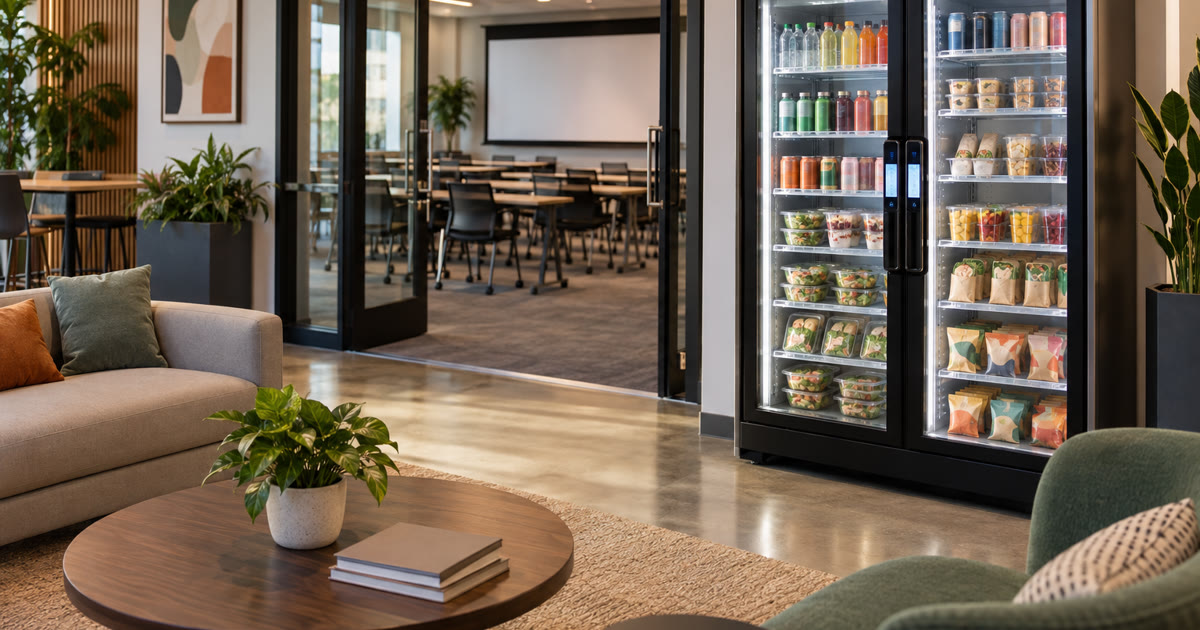
A smart vending machine or smart cooler gives the building a middle option. It can sit near the training room, a lobby-adjacent lounge, or a shared kitchenette. People can grab something quickly, pay cashless, and get back to the session without turning a short break into a building exit.
For a small-business program, that is not a luxury detail. It is part of keeping the day moving without sending people away from the room they came to use.
This is not only about visitors. Program teams and building staff use the same paths. If they are supporting long event days or evening sessions, the break plan matters for them too.
The best location is usually boring
The best smart vending placement is rarely the dramatic spot. It is the practical one.
Look for the path people already take between the entrance and the session room. Watch where they wait before doors open. Notice the corner where staff put their bags, refill water, or answer a quick message.
That is usually where a smart fridge or smart cooler earns its keep.
A small business resource center does not have to build a public market to make breaks easier. It may only need a clear-glass unit near the workshop corridor. The machine needs enough space for the door swing, a safe service path, and a place where people can pause without blocking traffic.
The boring details decide whether the setup works. Can someone reach it without interrupting a class? Can Revvolto service it without crossing through a meeting? Is the lighting good enough for people to see what is inside? Is the path easy after normal front-desk hours?
Those questions are not glamorous. They are the difference between an amenity people use and a machine everyone walks past.
Keep the service work out of the program team’s lap
Small business programs already ask a lot from the people running them. They coordinate rooms, speakers, and sign-ins. Follow-up and facilities handoffs are enough work already.
Snack duty should not get added to that list.
That is the operational case for smart vending. We install the equipment, stock it, and handle cashless payment support for qualified locations. We also manage restocking and service. The building team gets a modern food-access point without assigning someone to buy drinks or chase down a broken machine.
For training-heavy spaces, that matters. Demand can be uneven. One week may have three workshops. Another may have a pitch event, a morning class, and an evening meeting. A staffed food option can be overkill. A neglected snack shelf looks cheap fast.
A smart cooler is a better fit when the room needs to stay flexible. It can support day-to-day staff use, bigger workshop days, and after-hours sessions without changing the purpose of the space.
Use the local hook, not a fake connection
The City announcement is not about Revvolto, and we should not pretend it is. The useful takeaway is broader: when Austin invests in small business support, more people move through training rooms and resource centers.
Those places need the same kind of operational planning as any other busy building. Where do people pause? What happens when the session runs long? Who restocks the food option? What can stay open when the front desk is not staffed?
Smart vending answers those questions cleanly when the location has enough traffic and the right placement. It does not turn a business program into a cafeteria. It simply gives people a reliable grab-and-go option at the point where they already stop.
If your Austin building is adding workshops or coaching days, plan the break path before the calendar fills up. The earlier you solve it, the less your team has to patch later.
Tell us about the location at revvolto.com/contact-us.



