
When an Austin building refresh adds shared amenities, food access should not be the leftover decision.
That is the practical lesson from a recent Austin office refresh filing. Community Impact reported several new Austin-area Texas Department of Licensing and Regulation filings this week, including a renovation at 901 E. Fifth St. The linked state filing describes lobby work plus a new tenant amenity floor.
Revvolto has no affiliation with that project or its filing parties. The useful point is broader: when property teams are already planning where people pause and reset, smart vending belongs in the conversation early.
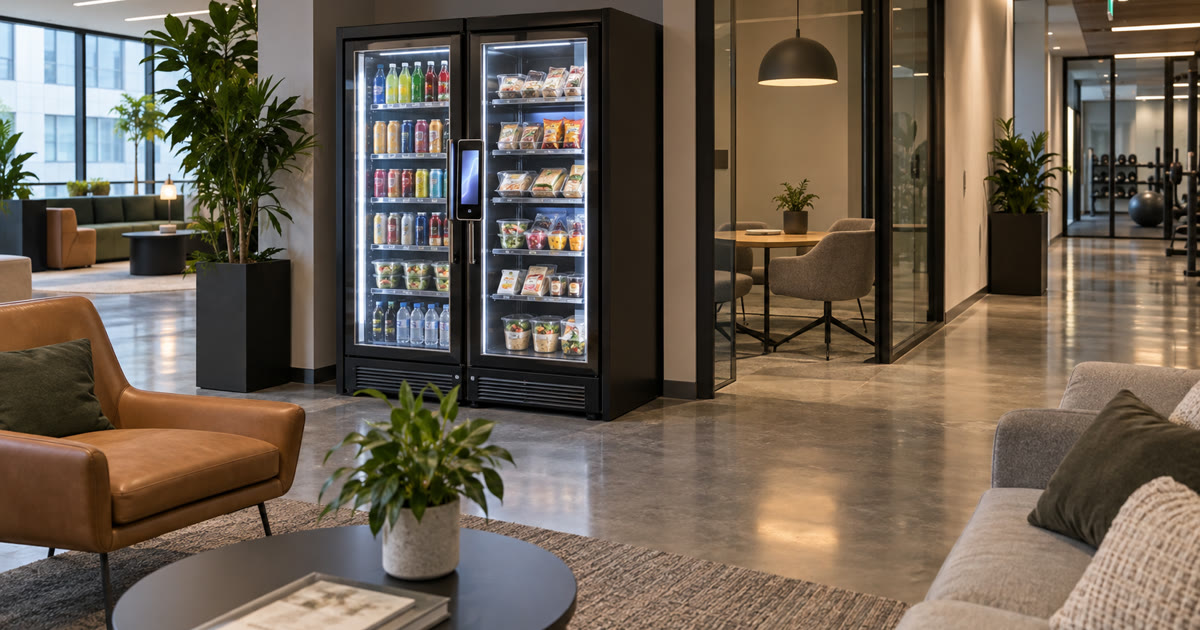
Amenity floors create real pause paths
Tenant lounges are not just decoration. They are where people step out between calls or take a short break without fully leaving the building.
That kind of space can feel polished and still miss a basic operational question: what happens when someone wants a drink, a snack, or a quick meal outside the easiest lunch window?
A nearby smart vending machine or smart fridge can support that pause without turning the lounge into a staffed café. The point is not to make the building feel like a convenience store. The point is to make the amenity floor work harder for the people already using it.
Placement matters. A smart cooler that blocks a path, sits too far from the lounge, or lacks a clean service route becomes friction. A unit placed near the natural break path can feel like part of the building plan rather than an appliance dropped in after the furniture arrived.
That difference shows up fast. People do not want to hunt for food access inside a building. They also do not want a premium lounge where the only practical option is leaving the property.
Food access should be designed, not patched in
The TDLR filing for the 901 E. Fifth St. refresh is about construction scope, not vending. Still, the listed amenities are exactly the kind of spaces where food access gets either planned cleanly or solved awkwardly later.
A tenant lounge, conference center, and fitness area all create different traffic patterns. Meetings create short bursts. Lounge areas create slower dwell time. Fitness-adjacent paths create quick grab-and-go moments.
Those are not the same use case, so one generic snack corner can miss the mark. A good smart vending plan asks where people already pause, where service access stays simple, and where the unit can be visible without taking over the room.
This is where modern smart vending has an advantage over old-school vending thinking. The buyer question is not just, “Can a machine fit?” The better question is, “Can food access fit the way this floor will actually be used?”
That means looking at circulation, power access, and the path a restock visit would take. It also means deciding who owns the experience after install. If nobody owns the day-to-day support, the amenity starts creating work instead of reducing it.
Revvolto’s model is built around that ownership question. For qualified locations, we stock and maintain modern cashless vending and smart fridge setups, typically at no cost to the property team.
Tenant teams should protect the service path
The boring detail that makes smart vending work is service access.
If a unit sits in a beautiful lounge but the restock path cuts through crowded seating, the design will annoy people later. If it sits near the right pause point but blocks circulation, the building has traded one problem for another.
The better setup is simple: visible enough for daily use, tucked in enough to preserve the room, and reachable enough for service without a production.
That is especially true in a refreshed office building. New lounges and meeting areas often carry high expectations. The food-access layer should match that standard. A modern glass smart cooler with cashless access feels different from a traditional machine parked in a corner. It can support the room without making the room feel cheap.
Product mix matters too. Tenant lounges do not always call for the same mix as a warehouse breakroom or a hotel pantry. Drinks, light meals, and quick snacks can serve different moments across the day. Purchase data can also help adjust the assortment over time, without pretending the machine magically knows what people want.
The practical goal is less glamorous than the renderings, and more important: make the building easier to use.
The Austin takeaway
Austin property teams are still investing in shared building spaces, even as office usage keeps changing. That makes amenity planning more selective. Every feature has to earn its square footage.
Smart vending earns its place when it supports a real path: meeting breaks, lounge traffic, or staff food access after the easy lunch window has passed.
It falls flat when it is treated as a last-minute machine placement.
The 901 E. Fifth St. filing is a useful reminder because it names the spaces where this decision shows up. Lobby refreshes, tenant lounges, and conference amenities are not just design moments. They are operations decisions.
If your building is planning a shared amenity refresh, food access is worth mapping before the room is finished. The right question is not whether a vending machine can squeeze in somewhere. It is where a smart vending setup would actually make the space easier to use.
Revvolto helps qualified Austin-area properties add modern vending machines, smart fridges, and stocked grab-and-go setups without handing the snack program to the front desk or facilities team.
Tell us about the location at revvolto.com/contact-us.



