
Austin is starting to draw clearer rules around data centers. That is not just a land-use story. It is a reminder that secure, operations-heavy buildings have to plan the human parts early too.
On August 27, 2026, Austin City Council advanced work on code amendments for data center uses. The official Council agenda item and backup resolution focus on where these facilities fit in the city. For building teams, there is a quieter takeaway: staff food access cannot be an afterthought once a facility is secure and hard to casually leave.
Revvolto has no affiliation with the City of Austin, Community Impact, or any named data center project. We are using the local update as a planning cue for Austin-area teams thinking about smart vending, smart fridges, and managed food access in staff-only areas.
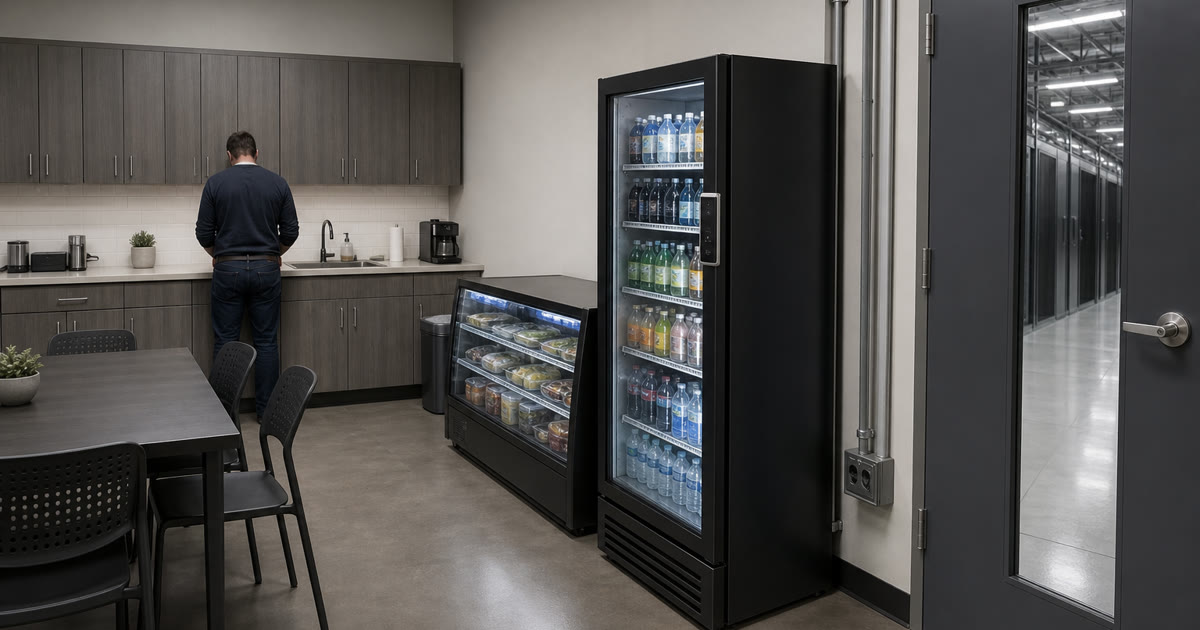
Smart vending belongs in the staff-area plan, not the leftover corner
Data centers and secure facilities are built around control. Access points matter. Service routes matter. Back-of-house rooms matter. That same discipline should apply to staff food access.
A smart vending cooler or smart fridge should not land wherever there is an empty outlet and a hopeful shrug. It should sit where employees already pause during the workday, close enough to be useful but not in the way of controlled movement. The best placement is usually boring in the right way: visible from the staff route, easy to service, and separated from sensitive work areas.
That matters because these buildings do not behave like casual offices. People may work long shifts. Leaving the site may be inconvenient. Deliveries may have security limits. Internal break areas may carry more weight than they would in a standard workplace.
A good plan answers a simple question before the walls, badge routes, and service doors are locked in: where can people get food and drinks without creating a new operational headache?
That is where smart vending earns its keep. The unit is not the strategy by itself. The strategy is matching the machine to the food-access pattern and the restock path.
Secure buildings make service ownership obvious
Austin’s data-center discussion is mostly about development rules and local impacts. Community Impact reported that Council moved toward a new framework for data-center oversight, while city documents point to definitions and operations plans. That kind of planning mindset is useful inside the building too.
Food access can fail when ownership is fuzzy. If staff are expected to manage snacks and chase service issues, the amenity becomes one more loose end.
Revvolto’s model is built to remove that friction. We handle the stocking, payment technology, and maintenance for qualified locations. For secure facilities, that matters because the support path is part of the fit. A stocked unit is only helpful if the service plan respects access rules and does not dump work onto the people already running the building.
The same thinking applies to product mix. A data-center staff area may call for cold drinks, grab-and-go meals, and simple snacks that work across different shifts. The right mix is not about chasing novelty. It is about making the common choice easy when someone has ten minutes and does not want to leave the property.
Smart vending works best when the location team can clearly explain the user, the placement, and the service path.
The buyer question is staff route plus service route
The strongest food-access plan usually starts with two routes.
The first is the staff route. Where do people naturally stop during the workday? That could be a staff breakroom, a kitchenette, or a locker-adjacent lounge. The vending point should meet that movement instead of trying to create a new habit from scratch.
The second is the service route. How does restocking happen without disrupting secured zones, blocking a corridor, or depending on an internal team member to babysit the process? This is where many amenities look good in a rendering and become annoying in real life.
A smart fridge or smart vending cooler should have clear access around the door, enough room for a person to browse, and a restock route that makes sense. It should also fit the room. A compact staff area may want a single glass-front cooler. A larger support space may be better served by a broader setup.
None of this requires turning the building into a cafeteria. That is the point. Modern cashless vending can give staff useful food and drink access without adding a staffed counter, building a full market, or handing the job to the front office.
For secure facilities, that practical middle ground is often the win.
Local planning is the signal, not the sales pitch
The City of Austin’s current work is not about vending machines. It is about how a growing facility type should fit into the city. But for operators and workplace planners, it points to a larger truth: high-control buildings reward early operational planning.
Food access is one of those details that feels small until it is missing. If the only nearby option is outside the secure area, people lose time. If the snack setup depends on internal staff, the building inherits a job it may not want. If the machine is placed badly, it either gets ignored or gets in the way.
Smart vending is not magic. It is a practical amenity that works when the site fit is right. For data centers and other secure operations spaces, that means enough daily use and a sensible service path.
Austin is having the big planning conversation. Building teams should have the smaller one before the staff area becomes whatever space is left over.
If you are planning an Austin-area staff space and want stocked food access without turning it into another internal chore, tell Revvolto about the location.



