
Austin keeps adding places where people do not move like office workers.
That matters for smart vending.
A family attraction or entertainment venue has a different rhythm from a standard breakroom. People arrive in waves. Staff work behind public areas. Visitors pause where the building gives them shade, seating, or a moment to regroup. Service teams need a way to restock without cutting through the worst foot traffic.
The current local hook is simple: Community Impact reported that COTALAND is nearing its debut at Circuit of the Americas, with the park opening September 26. The report says the roughly 30-acre park is planned with 33 attractions and a compact layout designed partly around shade. The official COTALAND site also points to the September 26 opening.
That does not mean Revvolto is connected to COTALAND or Circuit of the Americas. We are not making that claim.
It does make the buyer question useful: when a venue brings more people into one property, where should food and drink access live so it helps instead of adding another operations headache?
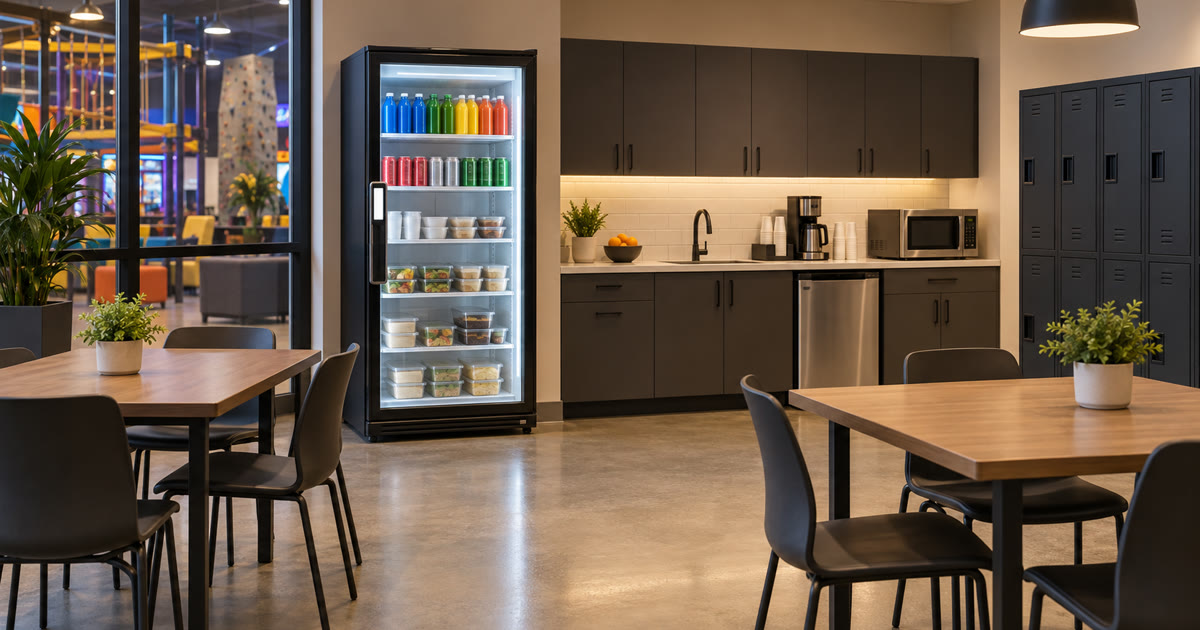
Start with the pause path, not the machine
A smart vending unit is only useful if it sits where people naturally stop.
At an entertainment venue, that is rarely the prettiest blank wall. The better test is movement. Where do visitors slow down after a ride, before a show, or between activities? Where do employees actually pass during breaks? Where can a service visit happen without blocking the public path?
The answer may be a visitor rest area. It may be a staff lounge. It may be an indoor corridor near seating. The wrong answer is the spot that looks convenient on a floor plan but makes people detour when they are already tired, hot, or trying to keep a group together.
That is why venue vending should start with a walking audit. Watch where people enter. Watch where they wait. Watch where they look for a drink before moving again. A compact smart cooler can fit into a building better than a larger food setup, but only if the location respects how the venue works.
If the machine goes where people already pause, it feels helpful. If it goes where nobody wants to stop, it becomes expensive furniture with a screen.
Separate visitor access from staff food access
Public venues usually have two food-access problems, not one.
Visitors need fast grab-and-go options that do not require another long line. Staff need reliable break access that does not pull them through public traffic or push snack duty onto a front counter.
Those two uses can share an operator, but they should not always share a location.
A visitor-facing smart vending cooler belongs near natural dwell time. Staff food access belongs where employees can actually use it during a short break. For some venues, that means a public-facing unit and a staff-only unit. For others, one carefully placed machine can serve both groups if the access path is clean and the service plan is realistic.
The important part is not the hardware category. It is ownership.
Who stocks it? Who handles payment support? Who keeps the assortment from turning into a random pile of leftover snacks? Who notices when certain products move faster during event-heavy days?
That is where a managed smart vending setup beats the old habit of asking someone on site to make food access work in their spare time.
Plan service access before opening-week traffic arrives
New venues and major expansions tend to focus on the visible guest experience first. That makes sense. Lighting matters. Parking matters. So does the path people follow once they are inside.
Food access still needs a service path.
If a smart fridge or smart vending cooler has to be restocked, the operator needs a reasonable way to reach it. That sounds obvious until the best-looking placement turns out to sit behind peak-hour crowd movement, locked access points, or a path that only works when the building is quiet.
A good placement conversation should ask plain questions:
Can the unit be serviced without interrupting guests? Can staff reach it on a real break? Can cashless checkout work cleanly in that part of the building?
Those questions are not glamorous. They are the difference between an amenity that supports the venue and one that creates new work for the same team already handling everything else.
For Austin-area venues, this matters even more during hot months. People look for shade, a cold drink, and a quick decision. If the only convenient option creates another line, the venue has not solved the pause-path problem. It has just moved it.
Cashless vending works best when the room is honest
Entertainment venues are full of impulse moments.
Someone wants a cold drink before heading back outside. A staff member has seven minutes before the next rush. A parent wants something quick without restarting the whole outing. A crew member needs food after a long setup window.
Smart vending helps when the room makes that decision easy.
That means clear sightlines, enough space to stand without blocking a door, and payment support that does not make people hunt for cash. It also means the product mix should match the venue moment. Drinks may matter more near outdoor paths. Refrigerated food may make more sense near staff areas. Snacks may work well near seating or family waiting zones.
None of that requires a fake promise that one machine fixes the whole venue. It does not.
The better point is that smart vending gives the property team a flexible food-access layer. It can support staff, visitors, or both when the site has enough traffic and the placement is right. Revvolto handles the day-to-day operation for qualified locations, including stocking and payment support, typically at no cost to the business.
The venue test is practical
Before adding smart vending to an entertainment venue, ask four things.
Where do people already pause?
Where can staff reach food without turning a break into a hike?
Where can service happen without fighting the busiest path?
Where does cashless grab-and-go make the day easier instead of adding another line?
Those answers matter more than the trendiness of the machine.
Austin’s venue scene keeps stretching into bigger, more varied experiences. That is good news for visitors. It also means operators have to think harder about the unglamorous parts of the day: cold drinks, refrigerated food, and restocking.
Smart vending works when it is planned like part of the building, not dropped in as decoration.
If you are planning food and drink access for an Austin-area venue, tell us about the location. We will look at traffic, placement, and service access before recommending a setup.



