
Austin does not add a new entertainment destination every week. So when COTALAND announced its September 26 opening at Circuit of The Americas, it was a useful reminder for anyone planning food access inside high-traffic visitor spaces.
This is not about COTALAND needing Revvolto. It is not a partnership note. It is a simple facilities lesson: when a venue pulls people through visitor paths and staff zones, food access cannot live only at the obvious counters.
Community Impact reported that COTALAND is opening with more than 30 experiences across rides and attraction areas. The official COTALAND announcement frames the opening as a public launch date for a new Austin attraction. That kind of visitor environment creates the same question every entertainment venue eventually faces.
Where do people pause when the main food service point is not the convenient answer?
For Austin venues, smart vending and smart fridges are not replacements for the main food operation. They are the quiet backup layer. They serve the corners of the day that fixed counters usually miss.
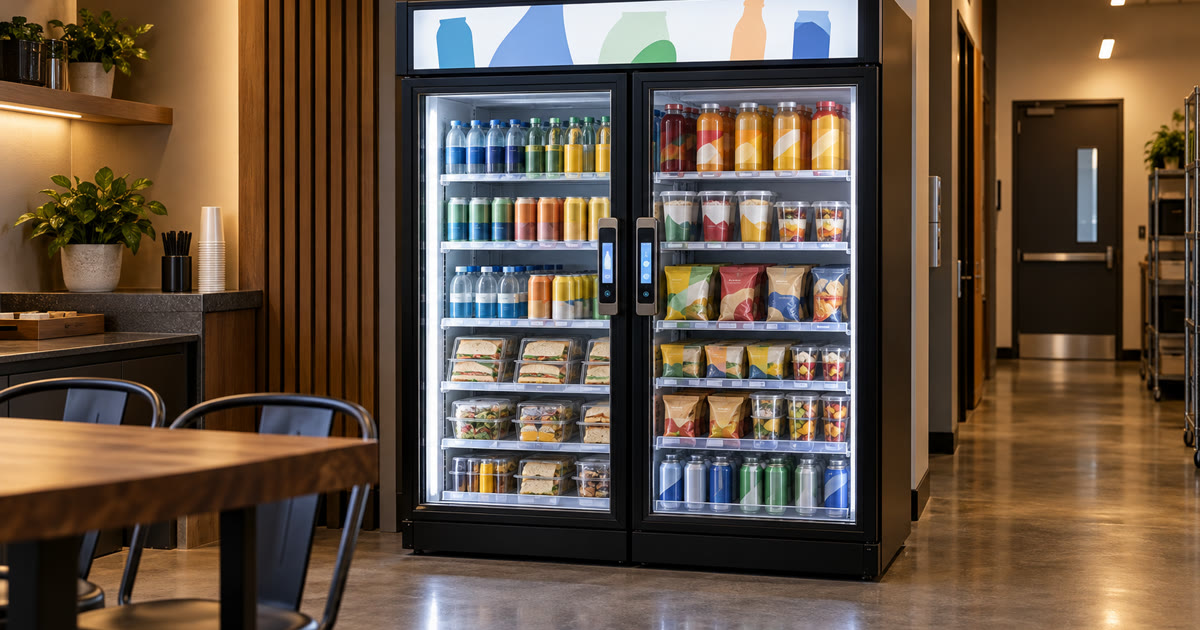
Why venue food access breaks between the big moments
Entertainment venues are designed around peaks. Doors open. Lines form. Shows start. Families move between activities. Staff reset spaces. Guests drift out in waves.
Food service often gets planned around those peaks too. That makes sense on paper. The problem is that real visitor movement is messier. Someone wants a cold drink before the next activity. A parent wants something quick without leaving the area. A staff member gets a short break after a rush and does not have time to cross the property.
That is the gap smart vending is built for.
A modern smart vending machine or smart fridge can sit near a practical pause path instead of competing with the main food operation. Think of the quieter stretch near seating, a staff-only break area, or a controlled corridor where people already slow down. The goal is not to turn every wall into retail. The goal is to give the building a small, reliable food-access layer where the layout already creates friction.
The COTALAND opening is a timely local hook because it puts the venue-planning question in front of Austin again. Large entertainment spaces are not just about attractions. They are about circulation. When circulation is the product, the pause points matter.
The useful test is not “where can we fit a machine?”
That question is too small.
A better question is: where does the building already create a food-access problem?
For a family entertainment venue, that problem may show up near a long route back to the car. It may show up near a staff area that sits far from the public counter. It may show up after the first rush, when people still need drinks but the main line feels like too much effort.
That is where smart vending earns its place. It works best when it supports an existing movement pattern. It should be visible enough to use, but not jammed into the flow. It should be close enough to matter, but not so close that it creates a bottleneck.
This is also where a smart fridge can beat a traditional vending mindset. A clear-glass smart cooler gives people a fast look at food and drink options. Cashless checkout keeps the interaction short. Remote inventory visibility helps the operator support the unit without making the property team babysit the snack corner.
For Revvolto, the best-fit conversation usually starts with the site, not the machine. Where do people enter? Where do staff take breaks? Where do visitors wait longer than expected? Where would a stocked unit help without adding a new operational chore?
Those answers matter more than picking the flashiest hardware.
Service ownership matters as much as placement
Venue teams already have plenty to manage. That is why smart vending becomes more useful when the service model is clear.
A good on-site food solution should not become another clipboard for the property team. Someone needs to stock it. Someone needs to handle product rotation. Someone needs to manage the payment tech and service issues. If those jobs fall back on the venue, the amenity gets old fast.
That is the difference between adding equipment and adding an operated food-access layer.
Revvolto’s model is built around that distinction. In qualified placements, Revvolto brings in the smart vending or smart fridge setup and handles the ongoing service work. The property team gets a modern amenity without turning into a snack operator.
For entertainment venues, that matters because food access is not only public-facing. Staff areas need attention too. A break option behind the scenes can be just as important as a public-facing cooler near a waiting area. The right answer may be one unit, a small cluster, or no unit at all if the traffic and service path do not support it.
The point is to plan the break path before the pain shows up.
What Austin venue teams should review before adding smart vending
Start with movement, not product mix.
Map where people slow down. Watch the areas that collect waiting, not just the areas that collect crowds. Then look for the service path. If stocking a unit requires awkward access or a long haul through active guest space, the placement is probably wrong.
Next, decide whether the unit is mainly for visitors or staff. Public areas need visibility and simple use. Staff areas need dependable access without creating privacy or workflow problems. A mixed-use placement needs extra care because the unit has to serve two audiences without confusing either one.
Then look at payment expectations. Most modern visitors expect cashless convenience. That does not mean the venue needs a complicated retail buildout. It means the food-access layer should match how people already move through the building.
Finally, decide who owns the work after installation. If the answer is “the venue team will figure it out,” the plan is not finished.
The Austin lesson from a new attraction opening is simple: big destinations are built around movement. Food access should be planned the same way.
Smart vending is not the star of the venue. Good. It should not be. It should be the thing people are glad to find when the main line, the break schedule, or the building layout makes a quick option useful.
If your Austin venue or high-traffic building is reviewing where people pause, tell us about the location. Revvolto can help evaluate whether a smart vending machine, smart fridge, or compact micro market actually fits the site.



