
Community Impact reported September 1 that Golf Lounge 18 is planned for Shops at Tech Ridge in Austin. The report says the company leased 12,000 square feet of retail space. A Texas Department of Licensing and Regulation filing lists renovation work that includes food-service and support areas.
Revvolto is not affiliated with the project. The useful lesson is broader: indoor sports venues create weird little food-access moments that standard retail planning can miss.
A golf simulator lounge is not a restaurant. It is not a gym either. People arrive in groups, wait for bays, and sit between sessions. Then they move between the screen area and the exit. That creates a pause path.
Smart vending works best when you plan for that path before the room is finished.
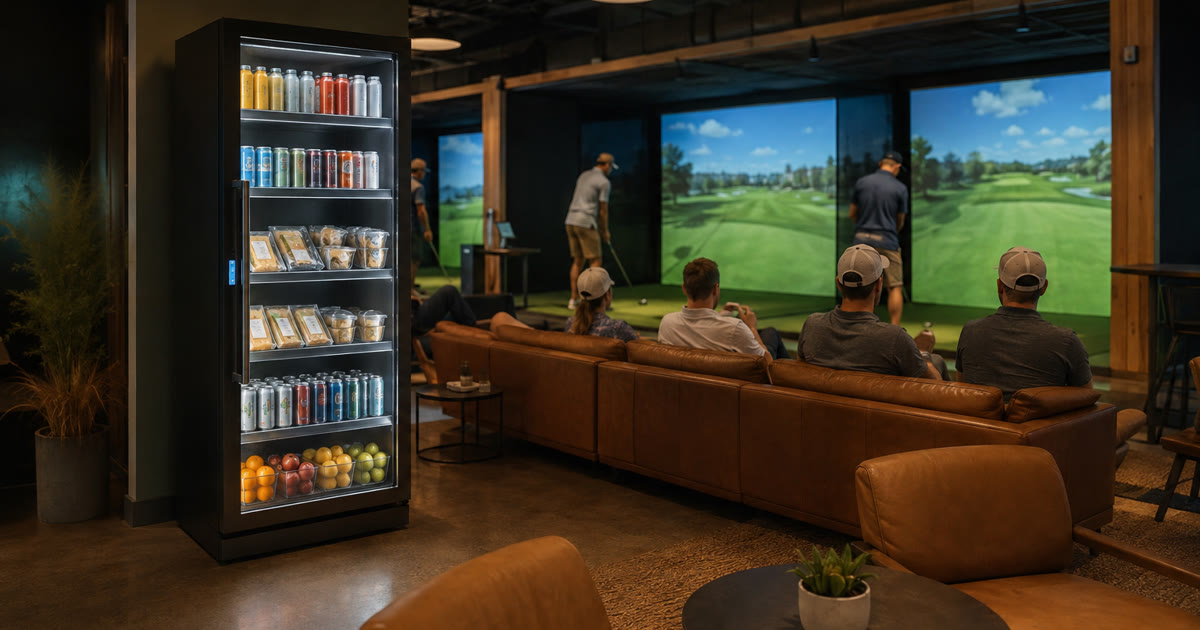
Indoor sports venues run on pauses, not just peak crowds
Venue teams usually think about peak traffic first. That makes sense. Nobody wants a lobby jammed at check-in or a line blocking the entrance.
But the better vending question is quieter: where do people pause when the main activity is not happening?
In an indoor golf lounge, that pause might happen before the bay is ready. It might happen between simulator blocks. It might happen when one person in the group is playing and two others are sitting nearby. Staff may also use simple food and drink access that does not pull them away from the floor.
That is a different planning problem from a restaurant counter or a front desk cooler. A counter depends on staff. A traditional snack shelf depends on someone noticing what is gone. A smart vending setup can sit closer to the natural pause point and keep the transaction simple.
The placement still matters. A machine stuck near the back door will not help the visitor who has five minutes before the next swing. A machine placed in the check-in path can create clutter if the lobby is narrow. The best spot is usually close enough to be noticed and far enough away that it does not become a traffic cone with snacks inside.
Renovation planning is the moment to solve service access
The Community Impact report points to renovation work that includes support spaces. That detail matters because food access is easier to plan before a venue opens than after finishes, seating, and back-of-house routes are locked.
Smart vending is not only a customer convenience decision. It is a service decision.
Someone has to restock the unit. Someone has to reach it without dragging carts through the worst customer traffic. Someone has to handle payment support, cleaning around the unit, and product rotation. If the machine lands in a pretty but awkward corner, the burden shows up later.
This is where indoor sports and entertainment venues should be honest about building movement. The right location has three traits. People naturally pass it. Staff can keep service access sane. The unit does not fight the room layout.
That is not glamorous. It is the stuff that keeps an amenity from becoming another chore.
For qualified locations, we install the smart vending or smart fridge setup and handle the service. The building team should still help answer the placement question because they know the room better than anyone.
Food access should fit the venue, not compete with it
A smart vending setup in an indoor sports venue should not try to become the main attraction. That is not the job.
The job is to cover the small moments around the main attraction. A cold drink after a session. A snack while someone waits. A grab-and-go option for staff working a shift. A simple choice when the kitchen or bar is not the right answer.
That distinction keeps the offer clean. If the venue already has a kitchen, smart vending can still make sense as a backup or off-peak option. If the venue has a bar, a smart fridge can cover non-bar moments without making staff run a miniature convenience store from the counter.
The product mix should match the behavior in the room. Indoor sports visitors may want cold drinks, light snacks, and easy grab-and-go items. Staff may want items that work during short breaks. The mix should be useful without making health, performance, or recovery promises. We do not need to pretend a bottle of water is a training plan.
The strongest vending setups feel obvious after they are installed. People see them because the unit sits where the pause already happens.
The buyer test for Austin venue teams
If you are planning an indoor sports venue in Austin, walk the space before you decide where food access belongs.
Stand where people will check in. Walk to the activity area. Sit where a group waits. Notice the common route back to the exit. Then ask where a smart vending cooler can support that movement without creating counter work for your team.
This is also the time to decide what the unit should carry. A simulator lounge, a family entertainment venue, and a training facility will not all want the same mix. Good vending is not about filling shelves with whatever is easy. It is about matching the room.
Austin keeps adding places where people gather for activities instead of formal meals. Those spaces still have food and drink moments. The venues that plan for them early usually make the amenity feel natural instead of bolted on.
If you are planning a venue or tenant amenity space and want smart vending that fits the room, tell us about the location at revvolto.com/contact-us.



