
Austin does not only grow through flashy office towers and downtown openings. Sometimes the more useful signal is a facility most people will never walk through.
The Austin Chamber recently shared member news that Prudential Overall Supply plans a $40 to $45 million Austin expansion: a cleanroom and industrial laundry processing facility at 1001 West Howard Lane, with more than 150 planned jobs and an October 1 groundbreaking and ribbon cutting ceremony. The announcement says the facility is expected to support regulated advanced-industry work across the Austin region.
That is not a Revvolto story. It is a local operations story. And it points to a question more industrial buildings should answer before the floor plan hardens: where will people get food and drinks when the workday does not move like a normal office day?
For many Austin-area industrial sites, smart vending is not a lobby perk. It is part of planning the staff route.
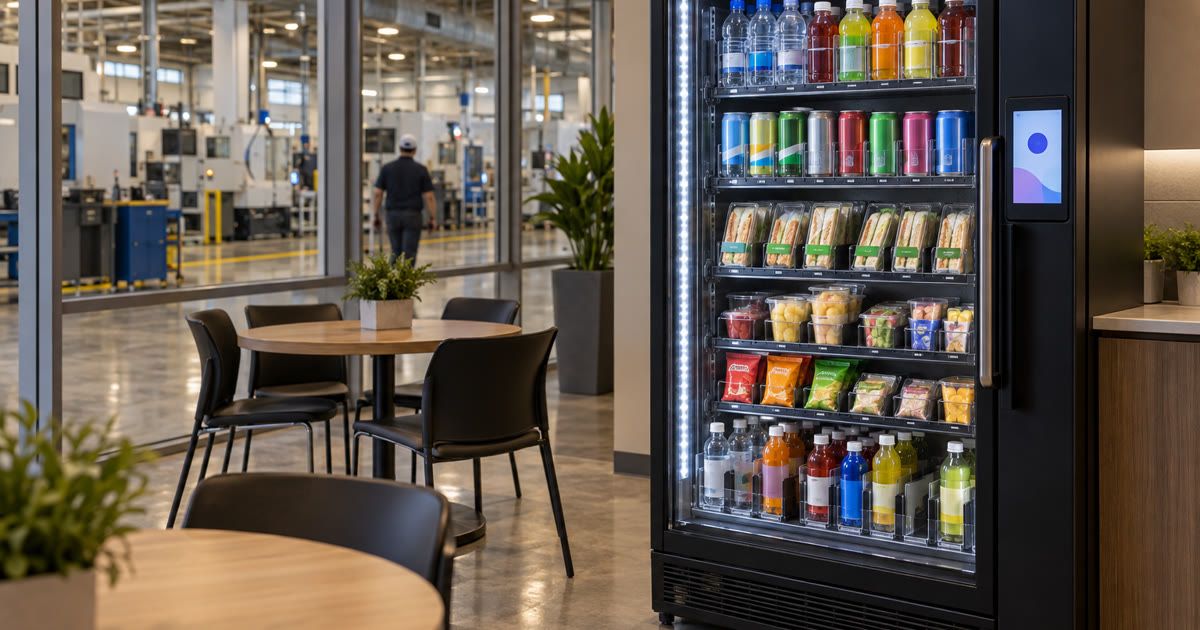
Industrial facilities create different food-access problems
Industrial, cleanroom support, and production-adjacent buildings rarely behave like a standard workplace. People may enter through controlled points, move between work zones, and take breaks on a schedule shaped by operations instead of a lunch calendar.
That matters because a food-access plan that works for an office can feel clumsy inside an industrial building. A cafe may be too much. A stocked pantry can become someone else’s side job. A traditional vending setup may not match the kind of fresh, cold, cashless grab-and-go experience modern staff areas now expect.
A smart vending machine or smart fridge gives the building team a middle path. It can sit beside the staff route without requiring a full food-service buildout. The better question is not whether the machine looks nice in a brochure. It is whether it sits where people naturally stop.
That is why local expansion news is useful for any facilities team planning a new or refreshed industrial space. Once the layout is decided, food access gets harder to fix. It is cheaper and cleaner to think about the staff route early.
The best placement is close to the real staff route
A smart vending plan should start with movement, not equipment.
Where do staff members enter? Where do they badge in? Where do they wait before training? Where can a service visit happen without interrupting the workday? Those questions matter more than picking the prettiest wall.
In an industrial setting, the right spot is usually near a natural stopping point. That might be a staff lounge outside a controlled area. It might be a training room where teams gather before a shift. It might be a corridor between lockers and the work floor. The exact answer changes by building, but the principle does not: place food access where people already slow down.
That is where modern smart fridges and smart vending can do real work. They can support grab-and-go food and drinks without asking internal teams to manage stocking and payment support.
The operational fit matters too. The machine needs power, clearance, and a clean service path. If a refill visit forces someone to cross an awkward work zone, the placement is wrong no matter how good the unit looks.
Service ownership matters more than the amenity label
Industrial teams are allergic to fake convenience, and they should be. If a food amenity creates extra work for the same people already managing facility issues, it is not really convenient. It is just another task wearing a snack label.
That is why service ownership belongs in the decision from the start. Who stocks the unit? Who adjusts the product mix when buying patterns change? Who handles cashless payment support? Who fixes the machine when something goes sideways?
Revvolto’s model is built around that ownership. We place modern cashless smart vending and smart fridges in qualified locations, then handle stocking and service. For the building team, the point is not to become a miniature food operator. The point is to add food access without creating a new internal chore.
This is especially useful in industrial environments where schedules and movement patterns can be less forgiving than office work. A unit that is open around the clock can support unusual shifts and short breaks. Purchase data can also help refine the assortment over time, so the mix is not based on guesswork.
Local growth should trigger a food-access check
The Chamber’s member-news item is a good reminder that Austin’s business growth is not only about where people work. It is about how buildings support them once they are inside.
When a new industrial facility is planned or refreshed, food access should sit on the same checklist as break areas and service access. Not because every site needs the same setup. It does not. But because the wrong setup becomes obvious fast.
If staff have to leave the building for food or drinks, short breaks get stretched. If the only option is a lightly stocked pantry, the workload often lands on someone who did not sign up to manage food. If the vending area is hidden in the wrong corner, people ignore it.
Smart vending works best when it is planned like infrastructure for the workday. It should be visible, stocked, and easy to service. That is not glamorous. It is just the difference between an amenity people use and a machine that slowly becomes office furniture.
The takeaway for Austin industrial, manufacturing, and production-support facilities is simple: do not wait until after move-in to ask where staff food access belongs. Put it into the planning conversation while the staff routes are still flexible.
Revvolto can help evaluate whether a smart vending machine or smart fridge fits your location and traffic pattern. Tell us about the location at revvolto.com/contact-us.



