
Trade schools and vocational training centers run on a different clock than traditional offices. Students rotate through labs, shops, and classrooms in blocks. Instructors move between cohorts. Facilities teams manage high-traffic corridors, specialized equipment zones, and strict safety perimeters. The break is not a lunch hour — it is a ten-minute window between a welding lab and a CNC demo, or a fifteen-minute gap before the afternoon clinical simulation starts.
When food access lives only in a distant cafeteria or a vending machine that hasn’t been restocked since orientation, people leave. They drive to the gas station. They order delivery to the loading dock. They lose the momentum that makes a compressed training day work.
Smart vending changes that equation. Not by adding another thing to manage. By removing the management.
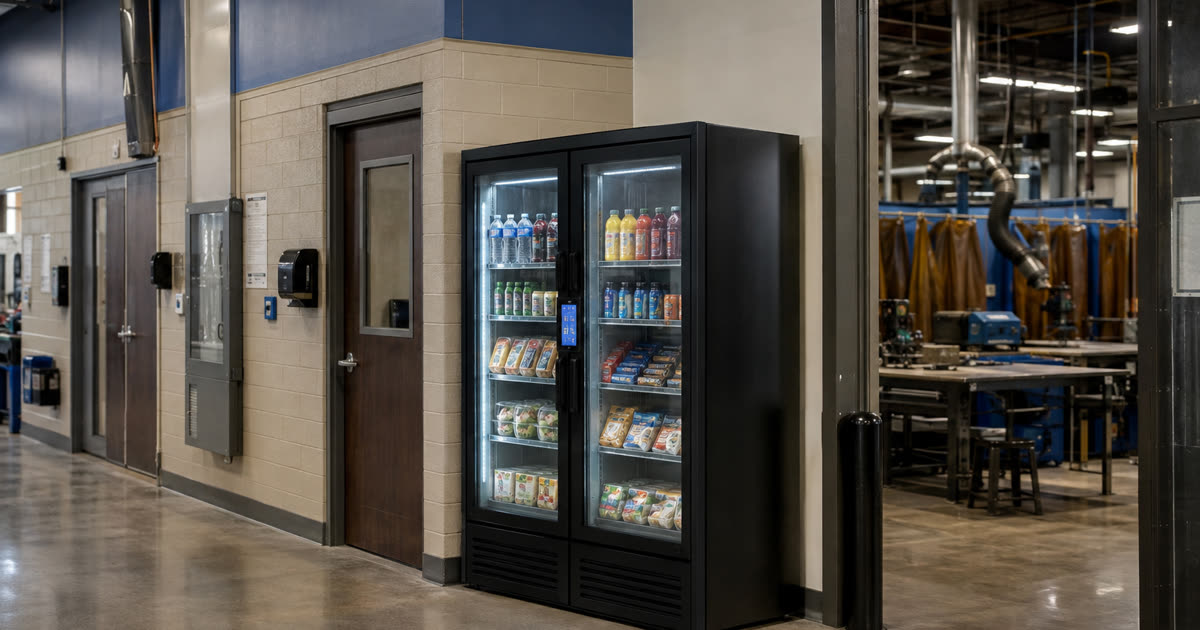
The break-path problem in training environments
Trade programs run in scheduled blocks, and the useful break window is usually short. A campus cafeteria may help during the middle of the day, but it does not always line up with lab blocks and testing windows.
Students in hands-on programs move through corridors that connect labs, classrooms, and credentialing test centers. The natural pause points are the hallway outside the bay doors, the lounge near the testing center, and the lobby by the administrative offices. Those are the places where a smart vending unit or smart cooler earns its keep.
That matters because career-school operations are already structured around program rules and licensing expectations. The Texas Workforce Commission publishes the state framework for career schools and colleges, which is a useful reminder that these are managed training environments, not casual breakrooms. Food access has to fit the program day, the facility rules, and the staff capacity behind it.
Traditional vending fails here because it is static. Product mix does not shift when the culinary cohort needs protein bars and the welding cohort needs electrolyte drinks. Restock happens on a route schedule, not a usage signal. Payment readers fail and stay failed for weeks. The facilities team gets the complaint ticket.
What smart vending actually does
A modern smart vending unit or smart fridge uses AI-driven inventory to track what sells, when, and where. The system reports real-time stock levels. Restock visits trigger on data, not a calendar. Cashless payment works because the payment stack is maintained by the provider, not the campus IT team.
For a trade school, this means:
- The unit outside the welding lab stocks cold drinks and high-protein snacks during the day, with more substantial grab-and-go options for later cohorts.
- The smart cooler in the student lounge carries fresh fruit, yogurt, and cold brew without a dedicated food-service hire.
- The compact micro-market module near the testing center offers meal options for long testing windows.
- All of it is stocked, serviced, and warrantied by Revvolto. The campus provides power and a few square feet. Typically at no cost to the location.
The inventory data shows what sells by location and time of day. That lets the product mix move toward the actual demand instead of guessing from a generic vending plan.
Placement, product mix, and zero facilities workload
Placement is not “find a wall.” It is “find the pause.”
- **Lab-adjacent corridors:** Students exit a two-hour shop session. They need water and a protein bar before the next classroom block. A dual-door smart cooler with a handle-integrated LCD fits the traffic flow without blocking egress.
- **Testing center lobby:** Certification exams run four hours. Candidates cannot leave. A smart fridge with ready-to-eat meals keeps them fueled without a cafeteria run.
- **Student lounge / common area:** The social hub. A horizontal smart market unit with fresh prepacks and drinks becomes a useful amenity, not a forgotten vending machine.
- **Admin / admissions entrance:** Visitors, prospective students, and guests see a modern amenity. It signals the campus invests in student experience.
Each placement is scoped to the program schedule. Revvolto’s service team maps the traffic patterns during the site review and proposes a layout that matches the actual day.
Office vending assumes a 9-to-5 crowd. Trade schools can run across multiple dayparts and programs. The product mix should reflect that.
- Morning cohorts: coffee, breakfast sandwiches, fruit
- Midday lab blocks: cold drinks, protein bars, jerky
- Evening cohorts: substantial grab-and-go meals, hydration, late-night snacks
- Weekend intensives: fresh-food options and meal replacements
Revvolto’s AI-driven inventory supports product-mix adjustments based on actual sales data. Less guessing. Less stale product sitting around.
This is the part that matters for campus operations teams. Revvolto handles:
- Installation and electrical coordination
- Planogram design and initial stock
- Ongoing restock on a data-driven cadence
- Payment system uptime and PCI compliance
- Equipment maintenance and swap-outs
- Remote monitoring and proactive alerts
The facilities team gets a cleaner operating model. No product ordering. No vending coordination. Fewer “the vending machine is broken” tickets landing on the wrong desk.
Students expect tap-to-pay. Staff expect clean records. Revvolto’s payment stack supports cashless access and gives the operation better data for stocking decisions. No coin boxes. No jammed bill acceptors. No “exact change only” signs.
A real planning conversation
If you run facilities or student services at a trade school in the Austin area, the conversation starts with a site walk. We look at your schedules, corridor traffic, and current food options. Then we propose a placement plan and product mix. You decide if it fits.
No pressure. Typically at no cost to the location.
Tell us about the location at revvolto.com/contact-us.



