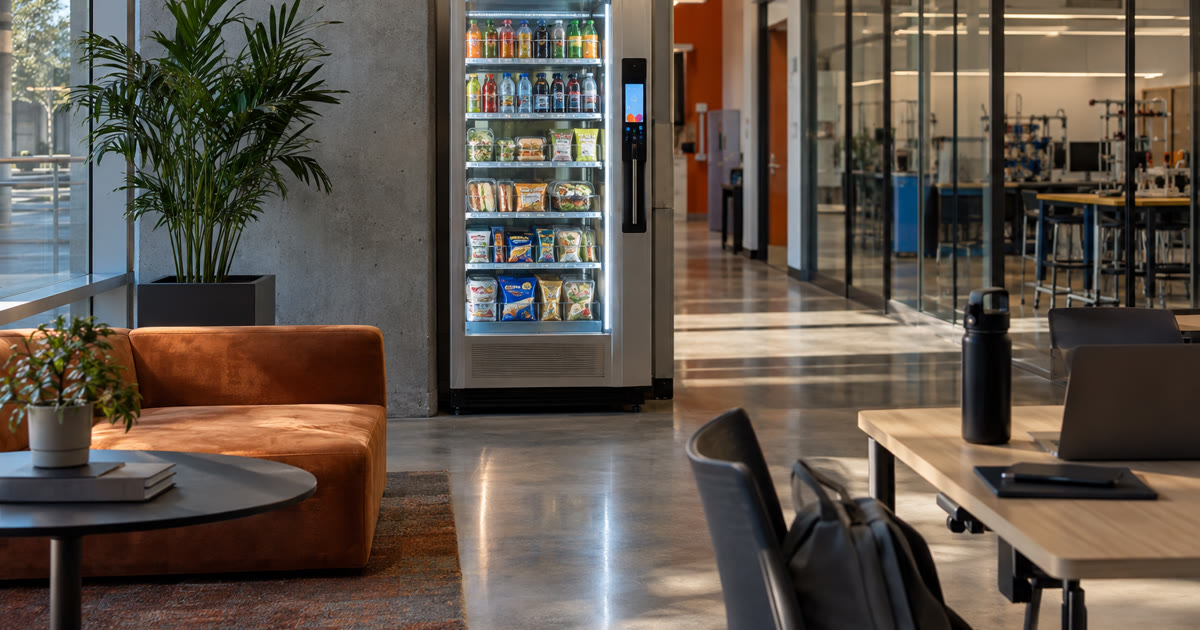
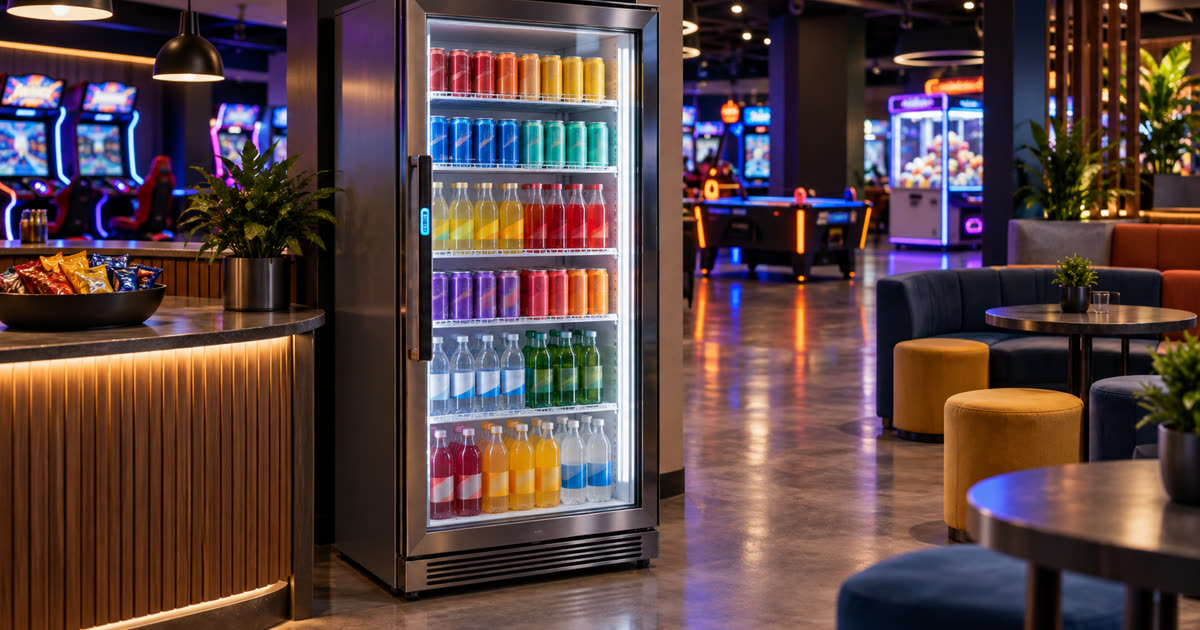
A university vending machine should solve a campus problem, not just fill a blank wall.
Students, faculty, staff, visitors, and evening program attendees move through campus at odd hours. Dining halls have schedules. Bookstores close. Events run late. Libraries, residence halls, athletic buildings, commuter lounges, and student commons do not always match food-service hours.
That is where vending can be useful. Not glamorous. Useful.
A smart vending machine, smart fridge, or compact campus market setup can give people a self-service option for drinks, snacks, and grab-and-go items without asking one department to become a tiny convenience store. The catch: if placement, payment, restocking, and support are sloppy, the machine becomes another help-desk ticket with chips inside.
The better question is not “Should the campus add vending?” It is: where would vending make campus life easier without creating another operational chore?
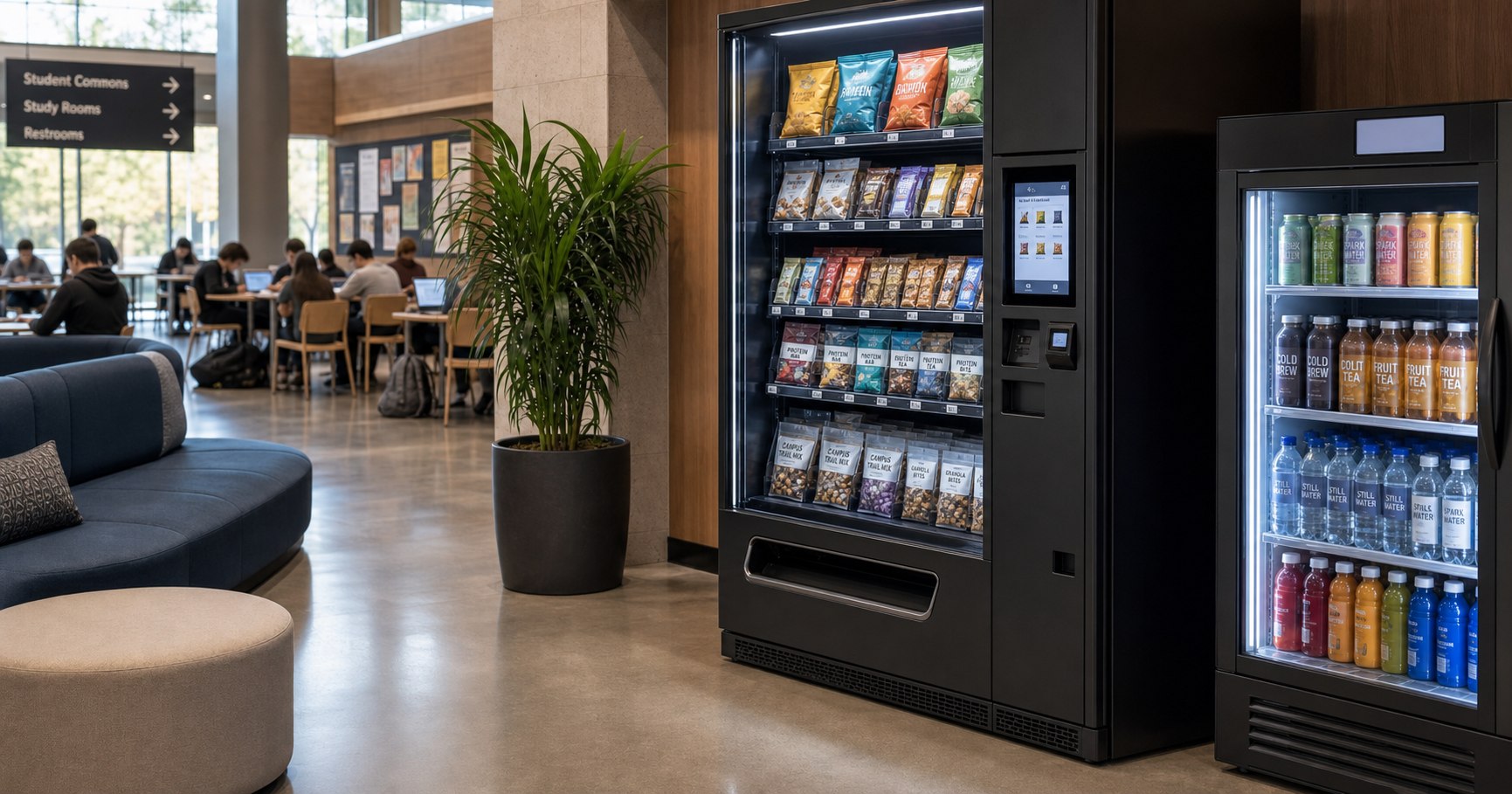
The campus problem is not that machines are missing. It is what they usually solve, or fail to.
University vending works best when it is tied to a real moment in the day.
That moment might be a student leaving the library late, a staff member between meetings, a commuter student with twenty minutes before class and no appetite for a dining hall detour, or a parent waiting during an evening event.
A commuter student’s twenty minutes is not a faculty member’s twenty minutes. Both know it. The machine should too.
Different buildings create different vending jobs. A residence hall may need late-night basics. A library may need quiet access. A student center may need throughput. An athletic building may need cold drinks. A commuter lounge may need reliability between classes.
That is why the first planning step is boring but important: map the traffic pattern.
Good campus locations have a few things in common:
- people already pass through the area
- the machine is visible without blocking movement
- users can browse without crowding a hallway
- staff can point people to support without owning every issue
- restocking can happen without interrupting classes, events, or office traffic
Bad placement turns vending into clutter. A spot chosen because the ficus moved is not a spot chosen because students pass it. A machine that mostly serves lost-and-found flyers is not doing the job. Good placement feels obvious.
Product mix should read the building, not the buyer’s assumptions.
Campus vending should not treat every building the same.
A residence hall, faculty office building, student center, commuter hub, and athletics facility may all need different product mixes. The goal is not the most impressive shelf. The goal is to stock what people are likely to use in that setting and adjust it when the data says the shelf is lying.
The useful planning questions are practical:
- Are people using the space before dining options open or after they close?
- Is the location mostly students, staff, visitors, or a mix?
- Does the building need shelf-stable snacks, cold drinks, refrigerated grab-and-go items, or a smaller compact setup?
- Who reviews slow-moving products?
- How often does the assortment change by building, semester, or season?
That last question matters. Campus traffic changes. Finals week is not summer session. Move-in week is not a quiet Friday in February. If the assortment feels like it was chosen by someone who remembers vending as a coin slot, students will notice. A good operator reviews purchase and inventory patterns over time. That does not mean the machine “knows what students want.” It means the operator has better information than guesswork.
Before the efficiency badge marches into a proposal wearing a cape, keep it in its lane. ENERGY STAR’s commercial refrigerator and freezer guidance treats commercial refrigeration as equipment designed and tested for commercial operations. That supports one narrow point: refrigerated vending or smart-fridge decisions need equipment and operating review, not just a nice-looking door.
It does not prove, promise, certify, estimate, or guarantee energy savings, utility savings, equipment eligibility, refrigeration performance, product freshness, food safety, product safety, campus suitability, student adoption, staff adoption, visitor adoption, maintenance requirements, Revvolto equipment performance, any Austin-area installation, any future installation, any specific machine, any specific smart fridge, any specific compact market setup, or any future placement result. Source: ENERGY STAR
Payment support should never end up in the bursar’s inbox.
Campus vending is usually quick. People want to tap, grab, and move. That makes payment support more important, not less. When a student is charged and an item does not vend, the closest campus employee may become the complaint desk by default. Campus vending should not become another late-night complaint wearing a student ID.
Before a campus adds smart vending or smart fridge options, buyers should ask:
- What payment methods are supported?
- What happens if a product does not dispense?
- Who handles refunds or payment questions?
- What should campus staff never collect from users?
- How does the operator spot recurring payment or machine issues?
Before payment language grabs a clipboard and starts acting like campus staff, keep the ownership clear. The PCI Security Standards Council says PCI DSS defines technical and operational requirements for environments where payment account data is stored, processed, or transmitted. That supports a narrow buyer point: payment roles and support paths should be clear before cashless vending goes live.
It does not prove PCI compliance for any vending machine, smart vending machine, smart fridge, payment terminal, payment processor, app checkout, software dashboard, inventory platform, operator, campus deployment, Austin-area installation, future installation, Revvolto setup, checkout flow, card tap, mobile wallet payment, student purchase, faculty purchase, staff purchase, visitor purchase, refund process, charge dispute, support workflow, help desk response, host responsibility, or campus policy.
It also does not guarantee payment security, eliminate fraud risk, certify a provider, bless a payment experience, make the host responsible, or make “we take cards” a complete operational plan. Source: PCI Security Standards Council
In plain English: “we take cards” is not the whole answer. The better answer explains what users see, who supports the transaction, what the campus team owns, and what stays with the vending operator. A vending amenity that requires the RA to become the payment help desk has quietly hired your staff without asking Financial Aid.
A spot that looks empty at 10 a.m. is not necessarily a spot.
Campus spaces are busy in ways office breakrooms are not. A vending machine may sit near students with backpacks, parents with strollers, staff carts, event lines, cleaning routes, or class-change traffic. A spot that looks empty at 10 a.m. can become a traffic knot twenty minutes later.
That makes access planning important. Before that citation borrows a hard hat and starts giving legal advice, keep it measuring the thing it actually measures. The ADA’s 2010 Standards set minimum scoping and technical requirements for newly designed and constructed or altered public accommodations and commercial facilities to be readily accessible and usable by individuals with disabilities. That supports one planning point: vending placement should be reviewed in the context of routes, clearance, reach, and building access.
It does not prove, certify, guarantee, approve, inspect, or bless a specific Revvolto placement, campus site, machine, route, door swing, service path, checkout flow, reach range, floor clearance, student commons layout, residence hall setup, library setup, athletic facility setup, commuter lounge setup, Austin-area location, or future installation as ADA-compliant. Site-specific review still belongs with the campus and qualified professionals. Source: ADA.gov
The practical checklist is simple:
- Can people approach the machine without blocking the walkway?
- Does the location work during peak traffic, not just quiet hours?
- Can a route operator restock without interrupting building use?
- Is there enough room for doors, service panels, and carts?
- Is power and connectivity available where the machine actually belongs?
- Does the setup look like part of the building, or like someone lost a refrigerator in public?
That last one is not just aesthetics. A premium campus amenity should feel intentional. If the machine looks shoved into a leftover corner, people treat it that way.
Revvolto keeps campus vending off the RA’s plate.
The strongest university vending programs are not complicated. They are operated well.
Revvolto helps qualified Austin-area campuses, education-adjacent facilities, and student housing properties add smart vending or smart fridge options — and, where the site supports it, compact campus market setups — without turning the host into the operator.
For qualified placements, Revvolto’s model is typically at no cost to the host. Site fit still matters, and the right setup depends on traffic, placement, product needs, refrigeration, service access, and support expectations.
The best vending setup should do a few things well:
- give people a useful option when dining or retail is closed
- keep payment and support paths clear
- match product mix to the building
- stay stocked on a regular cadence
- avoid turning campus staff into vending operators
- fit the space like an amenity, not an afterthought
That is the standard. A machine is easy to place. A useful campus vending program takes more thought.
If your campus, student housing property, training center, or education facility is considering smart vending, a smart fridge, or a compact campus market setup, start with the moments people already need help: late study sessions, commuter gaps, evening events, staff breaks, and high-traffic common areas.
Then choose the equipment and service model around that reality.
Curious whether smart vending, a smart fridge, or a compact campus market setup fits your Austin-area campus or education facility? Tell us about your space at https://revvolto.com/contact-us.
No-cost site assessment. No install pressure. No commitment.