A vending plan for a hospital employee lounge can look fine on a floor plan and still fail at the exact moment the building is busiest: staff handoff.
That is when one team is wrapping up while another arrives. Corridors are active, and staff rooms may briefly carry more traffic than usual. A stocked smart cooler can support off-hour food access, but replenishment should not compete with that handoff.
The buyer decision is narrow: what service window keeps the unit stocked without putting a restock cart into shift-change traffic?
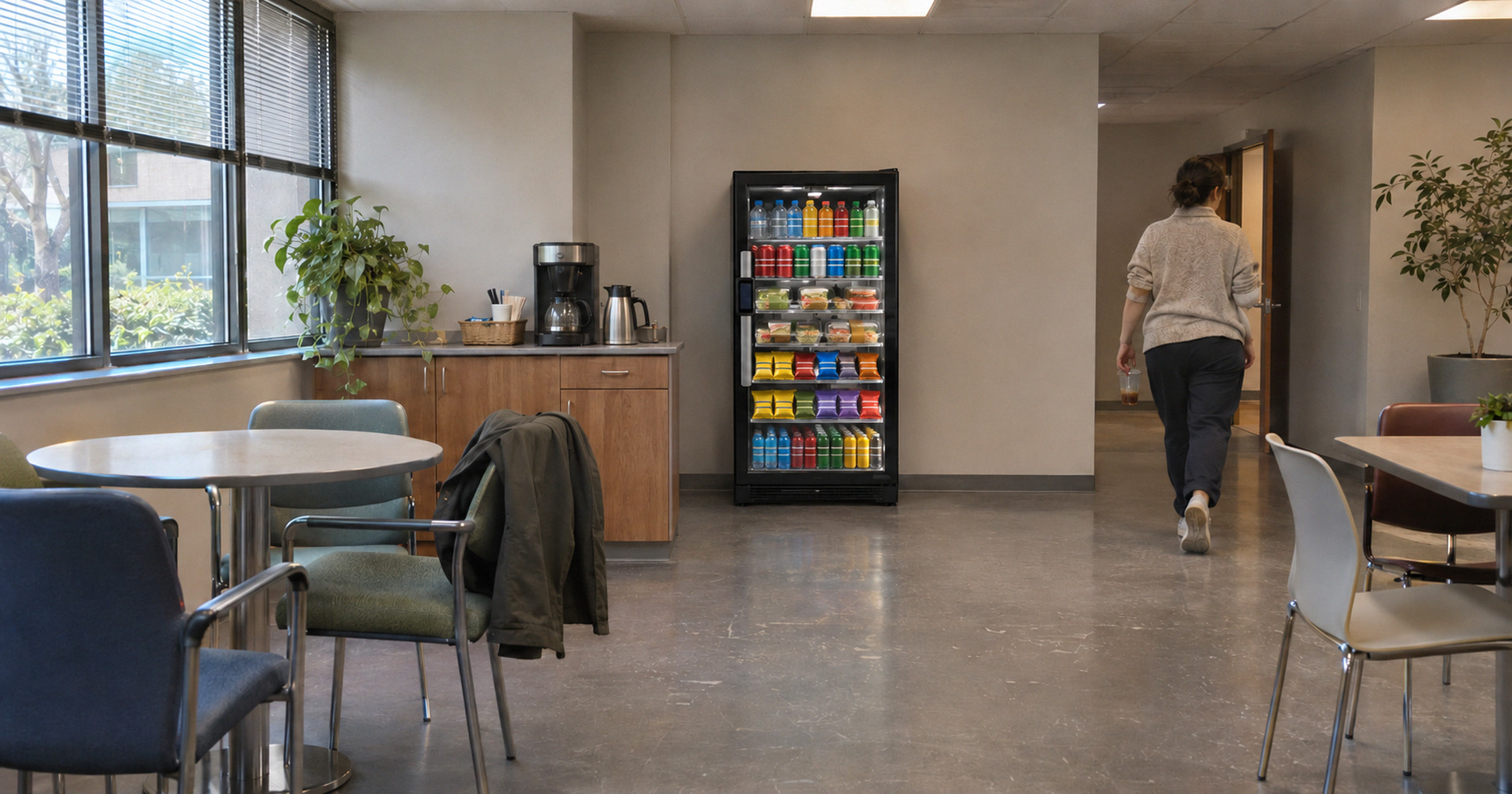
Map the busy window before choosing the refill window
Start with the staff area you are actually considering. Ask the facilities or operations contact when people arrive and leave. Then note how they move between the entrance and that room. You do not need invented traffic counts. You need an honest picture of the busiest 20 to 30 minutes.
Then keep replenishment outside that window. A service plan built around “someone can probably get through” is not a plan. The operator needs an approved entrance, a usable route, and a time when the open glass door and service cart will not choke the room.
This is not a clinical workflow claim. It is ordinary facility planning: protect the building’s active path and give the operator a repeatable way to do the work.
Run three service tests
Before installation, walk the proposed route with these scenarios:
- Normal refill: Can a cart reach the unit, park clear of the doorway, and let the door open fully?
- Shift overlap: If incoming and outgoing staff use the room at once, can service wait or move to a defined alternate window?
- Access exception: If the usual entrance or elevator is unavailable, is there one approved fallback route that avoids public waiting and treatment areas?
A failed test does not automatically kill the location. It tells you what must change: the service time, the route, or the placement. That is much cheaper to learn during a walkthrough than after equipment arrives.
The earlier hospital staff-area planning guide covers the broader room decision. This test starts after a staff area looks promising and asks whether it can be replenished cleanly.
Keep ownership simple
The hospital team should define approved entry and restricted areas. It should also set contact procedures and blackout windows. The vending operator should own stocking and routine equipment service.
Do not make the nearest employee the default vending coordinator. If access changes, give the operator one property contact and one escalation route. If a purchase question comes up, direct it to the support path at the machine rather than the staff desk.
Revvolto installs and operates modern cashless vending for qualified locations. We handle the equipment, stocking, and routine service while the property keeps control of its building access rules.
Make the handoff repeatable
The best service window is not merely available once. It can be repeated without a fresh negotiation every visit.
Before approving the location, record the approved entrance and normal route. Add the refill window, blackout window, and backup contact. Then walk the route at the edge of the handoff period. If staff can move normally while the cart is parked and the cooler door is open, the location is ready for a more serious recommendation.
Evaluating a staff-area setup? Tell Revvolto how the building runs, and we will review the room and service handoff before recommending equipment.