Community Impact reported this week that the University of Texas System Board of Regents approved the first phase of the planned UT Dell Medical Center for capital planning. That is a local development story, not a Revvolto story. We are not connected to the project.
But it points to a practical question every Austin healthcare-adjacent workplace should ask before a building layout becomes expensive to change:
Where will staff actually pause during the day?
Smart vending Austin buyers usually think about equipment first. The better question is path first. A modern smart vending cooler or smart fridge is only useful if it sits where people already move, slow down, and take short breaks without creating more work for the front desk or facilities team.
That sounds obvious until a building opens and the daily rhythm proves otherwise. The room everyone liked in planning may sit outside the actual staff loop. The back hall may carry more traffic than the polished break area. The training room may become the true pause point because people already gather there between shifts, meetings, and quick resets.
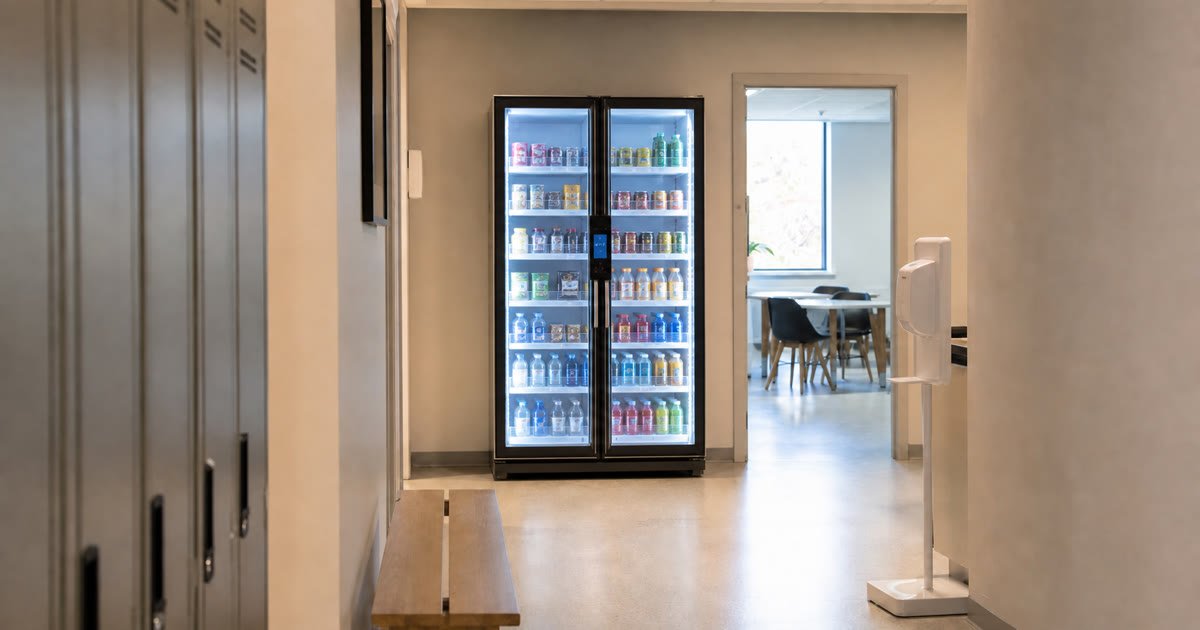
Design the staff break path before the room is finished
Food access gets awkward when it is treated as a leftover amenity. Someone picks an empty corner after the walls are up. The cooler lands wherever power is easy. The result may look fine on a floor plan and still miss the real break path.
Medical-campus and clinic environments are especially unforgiving because the day is chopped into short windows. Staff may not have a clean thirty-minute break. Training rooms turn over. Back corridors carry steady movement. Field offices and construction trailers can be active long before the final lobby feels finished.
That is why the placement conversation should start early. Not with a sales pitch. With the route.
A good staff-only vending location answers three questions. Who passes this point every shift? Can the machine be stocked without disrupting work? Will the spot still make sense when the building gets busier?
If the answer is fuzzy, the amenity is not ready yet. That is not a failure. It is useful information before you buy equipment, build cabinetry, or promise a convenience feature nobody wants to cross the building to use.
Keep the front desk out of snack duty
One quiet failure of workplace food access is making the wrong team own it.
A clinic receptionist should not become the unofficial snack manager. A facilities lead should not be chasing product requests between work orders. A practice manager should not be solving payment questions, restock timing, and broken-door complaints because someone wanted a nicer breakroom.
That is unpaid retail work with a cleaner cabinet.
For qualified locations, Revvolto’s model is built around the opposite idea: the vending or smart fridge program should be supported by the operator. The site team should help choose the right location and product direction, then get back to running the building.
That also changes the placement conversation. If restocking needs clean access, the machine cannot be squeezed into a decorative niche. If staff need a quick option without crossing public space, the unit cannot live only where visitors see it. The best spot is usually boring in the best possible way: visible to the people who use it, reachable for service, and out of the way of sensitive workflows.
That matters in healthcare-adjacent settings because the visible work already has enough friction. A staff food option should reduce small daily hassles, not create a new chore list wearing a stainless-steel jacket.
Match the machine to the privacy of the space
Healthcare-adjacent buildings also need a cleaner separation between public-facing and staff-only areas.
A public waiting area may need one kind of amenity decision. A staff corridor needs another. A training room might need something different again. The wrong placement can create crowding, awkward access, or a machine that feels too public for the people who actually need it.
This is where smart vending and smart fridges are more flexible than old-school vending thinking. A compact unit can serve a break path without turning the room into a full market. A cashless setup can keep the experience simple. A stocked cooler can support short break windows without asking the building team to manage inventory themselves.
The key is not to overbuild. Most facilities do not need a big retail moment. They need a reliable food and drink point where the day already bends.
Austin growth makes small access decisions bigger
The UT medical-campus approval is one example of a larger Austin pattern: new facilities, renovation plans, and mixed-use growth keep creating new movement paths before operators have fully tested daily building life.
That is when small decisions matter.
A vending machine near the wrong door becomes wallpaper. A smart fridge tucked behind the wrong corner becomes a nice idea nobody remembers. A cooler on the actual break path can become the thing people use because it is simply there when they need it.
For Austin healthcare-adjacent workplaces, the lesson is straightforward. Do not wait until opening week to ask where food access belongs. Walk the future path now. Look for the point where people naturally slow down. Then decide whether a smart vending cooler or smart fridge fits the traffic and service access.
Revvolto can help Austin-area businesses think through that placement before the amenity becomes an afterthought. Tell us about the location at revvolto.com/contact-us.