Austin’s manufacturing expansion is not only about square footage. It is also about what happens once people are working inside those buildings for long shifts, controlled workflows, and tight handoff windows.
That is the useful lesson from a recent Austin Chamber member news item. The Chamber reported that Prudential Overall Supply planned an October 1 groundbreaking and ribbon cutting for a new cleanroom and industrial laundry processing facility in Austin. The announcement described a $40 million to $45 million investment, more than 150 expected jobs, and a facility serving cleanroom and industrial processing work tied to advanced industries.
Revvolto is not affiliated with that company, the Chamber, or the project. The local signal still matters for Austin building operators: when industrial space adds people and controlled work areas, food and drink access cannot be an afterthought parked wherever there is an empty wall.
Industrial staff areas have different break math
A manufacturing or cleanroom support building does not work like a small office pantry.
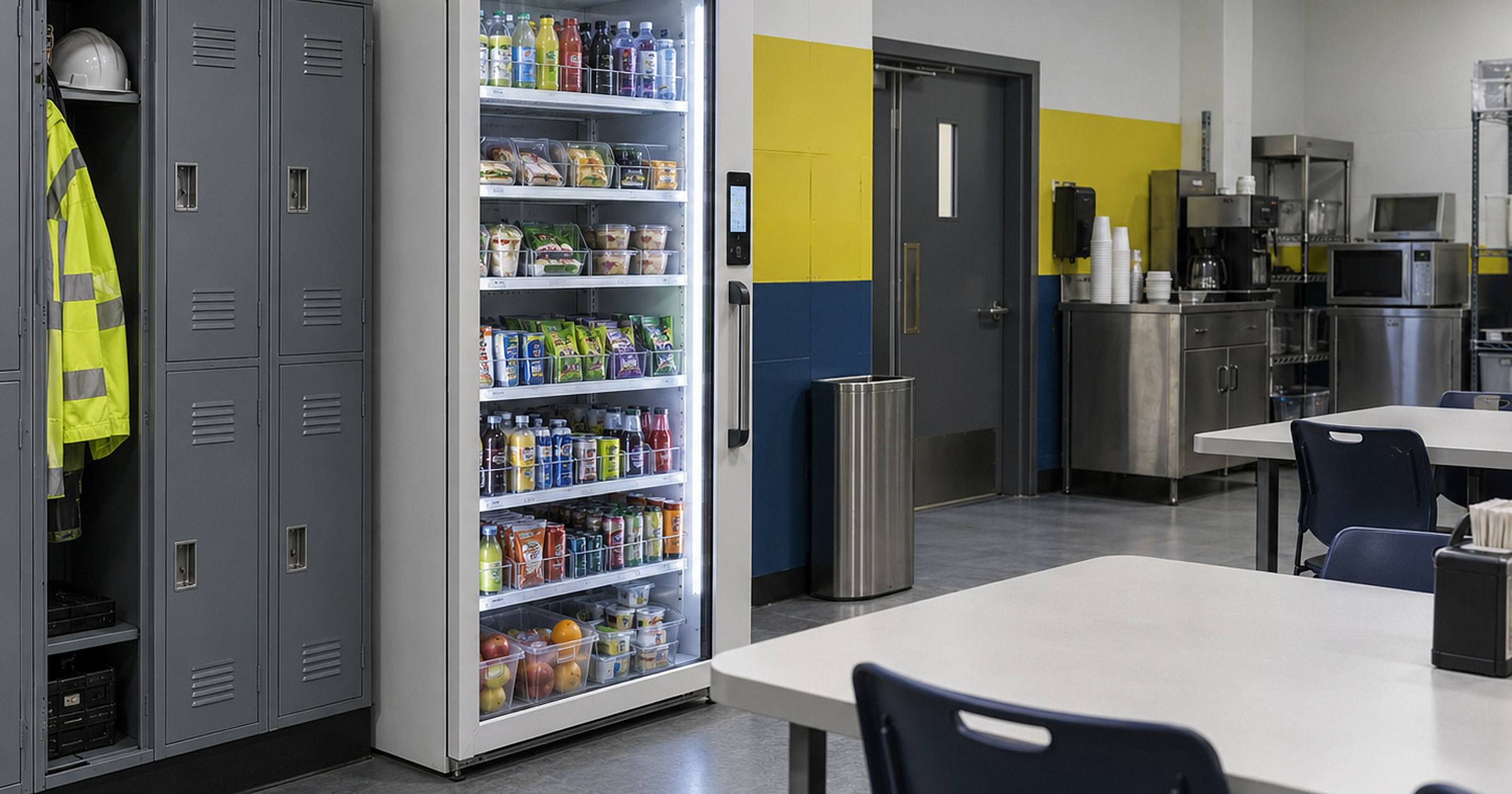
People may be moving between production-adjacent areas, lockers, and staff corridors. Some teams have scheduled breaks. Some cannot leave the building casually during a short window. If the nearest food option sits across a parking lot or down a long service route, the break becomes less useful before anyone buys a snack.
That is where a cashless vending unit or smart fridge fits the conversation. The right setup gives people a simple option close to the area they already use. It also keeps the food program out of the hands of supervisors, front desk staff, or whoever accidentally became the snack person.
For eligible buildings, Revvolto handles the stocked machine and service. Your team gets the amenity without turning it into a side job for someone already very busy.
Plan around the route people already take
The best placement is rarely the most decorative corner in the plan, especially once daily operations actually begin. It is the spot a busy person can use quickly and comfortably without thinking twice.
In an industrial building, the better question is where people naturally pass when they clock in or head to a staff room. A smart cooler near that route can make more sense than a bigger setup tucked into a room people skip.
The Austin Chamber item noted the new facility is expected to support cleanroom and industrial laundry processing work. That kind of environment makes the placement question sharper. Food access has to respect operations, service access, and the daily movement of staff.
A good site walk should check three things first: foot traffic, electrical fit, and restock access. If those do not line up, the machine will look fine in a photo and annoy people in real life.
This is also where early planning saves everyone grief. A machine near a staff entrance may be convenient, but it still has to allow a clean delivery route and a safe service window. A unit near a breakroom may feel obvious, but it can fail if the room is cramped or hidden at shift change.
The better move is to map the daily flow before the amenity is chosen. Where do people actually stop? Where can a restock visit happen without interrupting the work area? Where will the unit feel useful at 6 a.m. and again near the end of a late shift? Those questions are less glamorous than the equipment spec. They are also the questions that decide whether people use the thing.
Service ownership beats the machine alone
Buying a good looking vending machine is the easy part. Keeping it useful is the part that decides whether people trust it.
Industrial locations are hard on lazy amenity planning. Break windows can be short. Product mix matters. Payment has to be simple. Someone has to notice when the wrong items sit too long or the popular drinks move faster than expected.
The problem is not that teams lack snacks. The problem is that unmanaged snacks become stale, cash boxes become awkward, and the building team gets blamed for a setup nobody truly owns. A clean amenity plan puts ownership where it belongs: with the operator.
Smart vending helps because inventory and purchase data can guide restocking. That does not mean the machine magically knows what people want. It means the operator has better information and can adjust the mix over time.
That is the real value of an operated model. We install the unit, keep it stocked on a regular cadence, and handle service. The building team does not have to manage products, chase repairs, or collect cash.
The local takeaway for Austin operators
The Chamber’s announcement is one example of a broader point: Austin keeps adding buildings where people work in structured, time-sensitive environments. Food access has to fit that reality.
If you manage a manufacturing floor or staff-heavy service building, look at the break route before the furniture plan is finished. The best stocked amenity is usually the one people can use without rerouting their day.
Revvolto can help evaluate whether a smart vending machine, smart fridge, or compact micro market makes sense for the location. The answer depends on traffic, audience, and service access.
If your Austin-area facility is planning a staff area, tell us about the location. We will help you decide whether the setup is a fit.