Austin keeps giving small companies more ways to grow. That is good news. It also raises a plain building question: when the team gets bigger, where do people get a drink or a real break without adding another chore to the day?
The hook is current. On September 24, the City of Austin announced new small-company financing and entrepreneurship programs, including loan interest help and expanded Austin Kiva Hub matching. The public point is capital. The workplace point is simpler: growth plans should include the everyday rooms people use after the doors open.
Modern vending for a growing team is not about copying a big-company cafeteria. It is about making the staff area work before the problem is obvious.
Growth planning should include the break space
When a company gets funding or expands a lease, the first plan usually covers equipment and hiring. Food and drink access often show up late, after the layout is set and the nearest lunch option is still down the road.
That order creates friction. A small team may not have the space or budget for a staffed café. It may also be too busy for someone to become the snack buyer, fridge cleaner, and restock chaser.
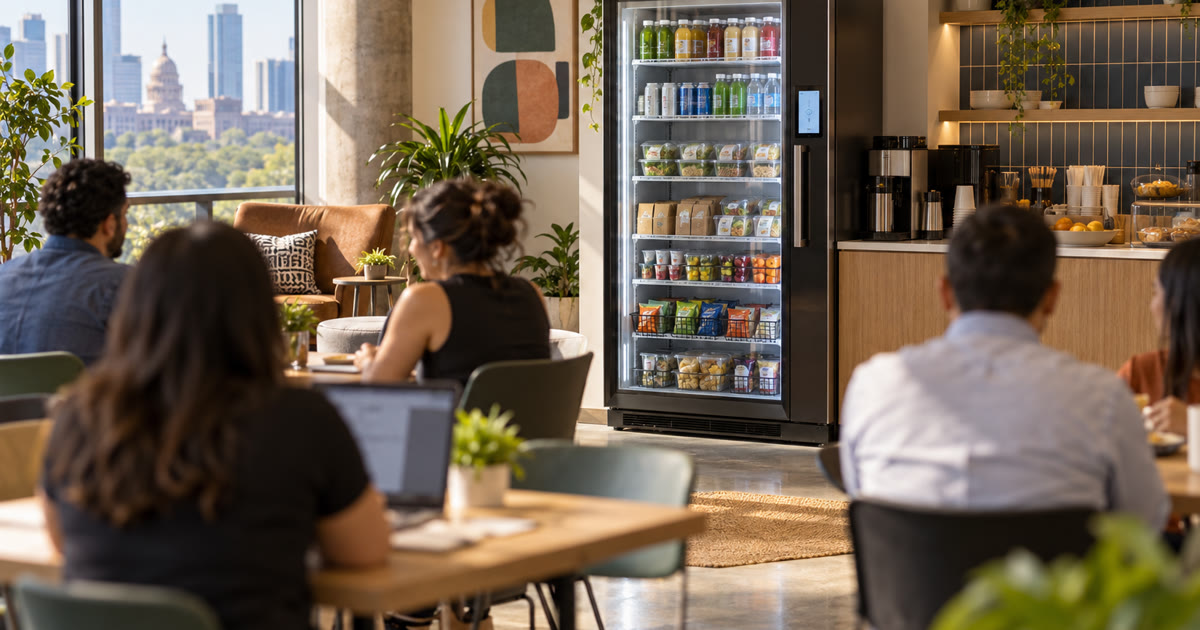
A modern vending unit or connected fridge can fit the middle ground. It gives staff and visitors a reliable grab-and-go option without asking the company to run a pantry. The point is not luxury. The point is removing a small daily drag before it becomes part of the routine.
For Austin owners using new capital programs, the amenity zone deserves a spot in the buildout conversation. Not because snacks are exciting. Because neglected amenities quietly create work.
The real buyer question is ownership
The wrong question is “Where can we squeeze a machine?” The better question is “Who handles it after launch?”
That work includes assortment, refill cadence, and equipment upkeep. If those duties fall back on a manager or front counter employee, the amenity can turn into another task.
This is where Revvolto’s model matters. The unit should be planned around traffic flow, visibility, and service access. It should also have a clear operator behind it. Revvolto handles stocking and maintenance for qualified locations, typically at no cost to the location.
Qualification matters. Not every room is a fit. A unit works best where enough people pass the same area consistently and where food access solves a real problem. If it is only decorating an empty corner, it is the wrong idea.
Austin’s new small-company programs are about helping owners invest in growth. The same discipline should apply inside the space. Do not buy complexity when the better move is a serviced amenity.
A connected fridge fits the middle
A growing business may not fit the cafeteria model. It may run a training room, professional office, or shared workspace. The common thread is simple: people are on site long enough to want something convenient, and the company does not want to manage food operations.
That is where a cooler or modern machine earns attention. Cold drinks and packaged snacks can serve different work patterns without taking over the room. Cashless payment also keeps the process cleaner than an honor box.
Placement still has to be sober. A unit near the wrong entrance may be ignored. A unit blocking a service route becomes annoying. A unit hidden in a back corner can underperform even when the assortment is good.
The best version is modest: a clean unit in a visible stop point, stocked for the people nearby, with an operator responsible for the work behind it.
Growth should not create amenity busywork
The City’s announcement is a reminder that Austin is still investing in business formation. That matters because growth does not only happen in pitch decks. It shows up in longer days, fuller rooms, and more decisions about how the workplace functions.
Food is one of those decisions. Ignore it and people solve it themselves. They leave the building, skip the break, or build a messy stash system someone eventually has to clean.
Plan it early and the room works better. The company does not have to become a food operator. The staff does not have to leave for every small purchase. Visitors get a better experience without turning the front desk into a convenience store.
That is the Revvolto angle. We are not here to make every Austin company run a market. We are here to make vending and stocked fridges feel like a practical part of the building plan when the traffic, audience, and layout make sense.
What to check before adding the unit
Start with the daily movement. Where do people naturally slow down? Where can the unit be seen without getting in the way? Can Revvolto service it without disrupting the room?
Then look at timing. A staff area may lean toward morning drinks. A workshop room may call for quick options between sessions. A shared workspace may benefit from a broader mix across the day.
Finally, decide whether the company wants to manage the work. If the answer is no, a serviced fridge or vending program may be the better fit than a self-managed pantry.
Austin’s small-company support programs can help owners think bigger. The building still has to work in small, daily ways. Food access is one of them.
If you are planning an Austin location with steady traffic and want a stocked, maintained vending or connected-fridge option, tell Revvolto about the space at revvolto.com/contact-us.